
Share with your CTO
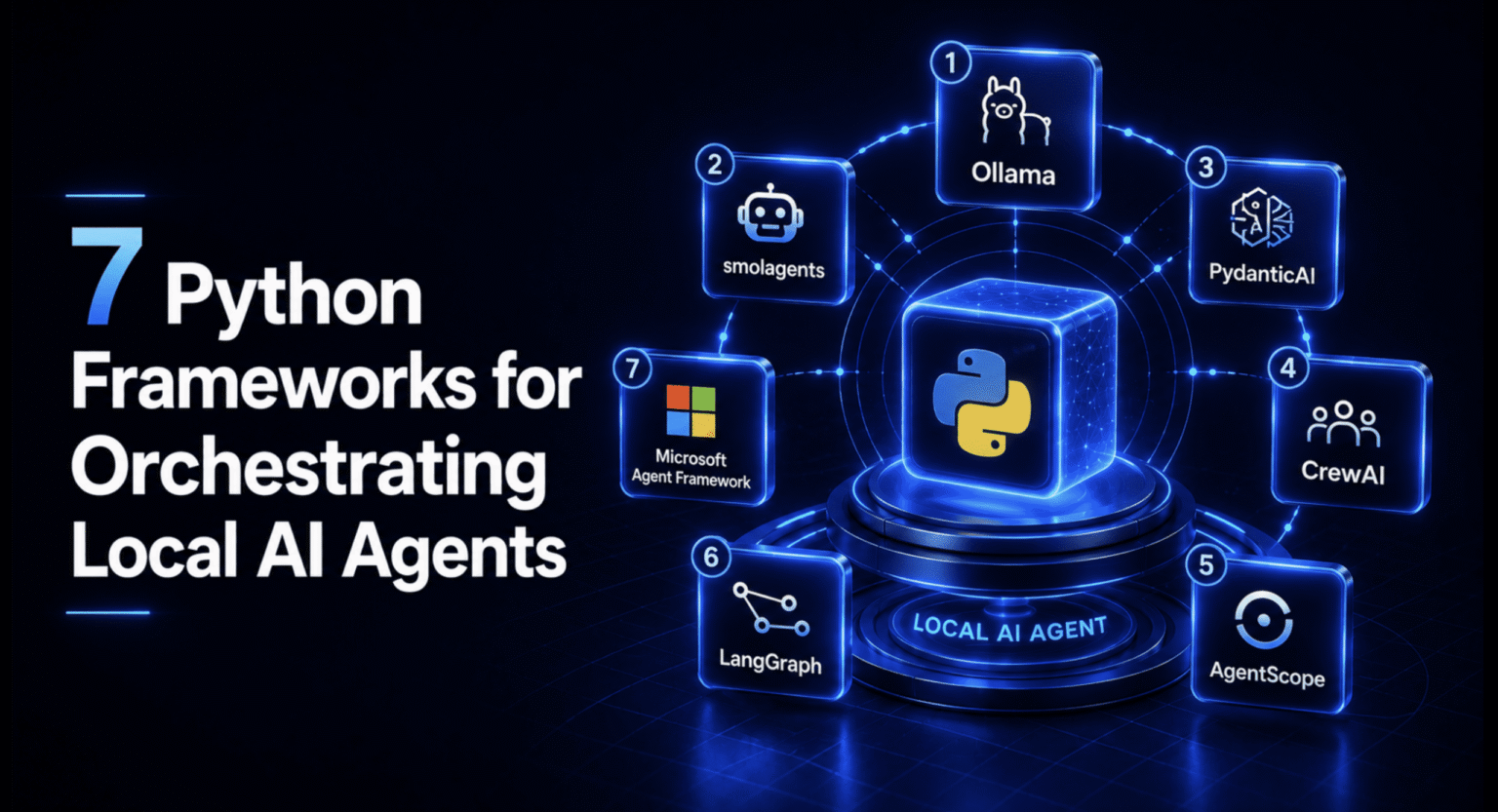
The local AI agent stack has quietly matured to the point where a Python engineer can assemble a production-capable multi-agent system without a single cloud API call. A practical breakdown of seven Python frameworks maps the current toolchain: Ollama as the model runtime foundation, smolagents and PydanticAI for lightweight or type-safe single-agent work, CrewAI for fast multi-agent prototyping, and AgentScope, LangGraph, and Microsoft’s unified Agent Framework (successor to AutoGen and Semantic Kernel) for stateful, auditable, production-grade deployments.
What this means for your business
Whether this stack is relevant to your engineering org comes down to one question: do you have workloads where data residency, per-token cost, or offline operation is a real constraint, not a theoretical one? If regulated data, air-gapped environments, or inference costs at scale are already on your roadmap, this toolchain has crossed the threshold from hobbyist to serious. If your current cloud API spend is negligible and your compliance posture doesn’t require it, the operational overhead of local model serving still probably isn’t worth it.
The most underappreciated detail in this landscape is how far the OpenAI-compatible API standard has traveled. Because Ollama exposes the same interface that most agent frameworks expect from a cloud provider, swapping a frontier model for a locally hosted one is genuinely a one-line configuration change in frameworks like PydanticAI and LangGraph. That portability means the architectural decision isn’t “local versus cloud” anymore, it’s “which orchestration layer fits our state management and validation requirements,” with the model backend becoming almost interchangeable. Teams that standardize on a framework for its governance and checkpointing features keep the option to run either backend without a rewrite.
Microsoft’s Agent Framework earns specific attention for enterprise shops already in the Microsoft orbit, but with a real caveat. Community reports cluster provider adapter bugs outside the Azure OpenAI path, which matters if Ollama or a non-Microsoft backend is the actual target. The framework’s lineage, combining AutoGen’s multi-agent abstractions with Semantic Kernel’s session state and telemetry, is the right architectural bet for large engineering orgs. The execution risk is that “supported” and “production-stable” aren’t the same claim, and validating provider integration before a broad commitment is the decision this reframes, not a feature comparison exercise.
Concept deep-dive: Model Context Protocol (MCP)
MCP is an emerging standard that lets an AI agent communicate with external tools using a shared, consistent interface, roughly analogous to how USB-C lets different devices share a single cable standard. Instead of each agent framework building custom connectors for every tool or data source, MCP-compatible agents and tool servers speak the same language out of the box. For local deployments specifically, MCP means an agent running entirely on-premises can still reach standardized enterprise tool servers without bespoke integration work each time.
Based on reporting from 7 Python Frameworks for Orchestrating Local AI Agents, originally published 2026-07-15 08:10:00.