
Share with your CTO
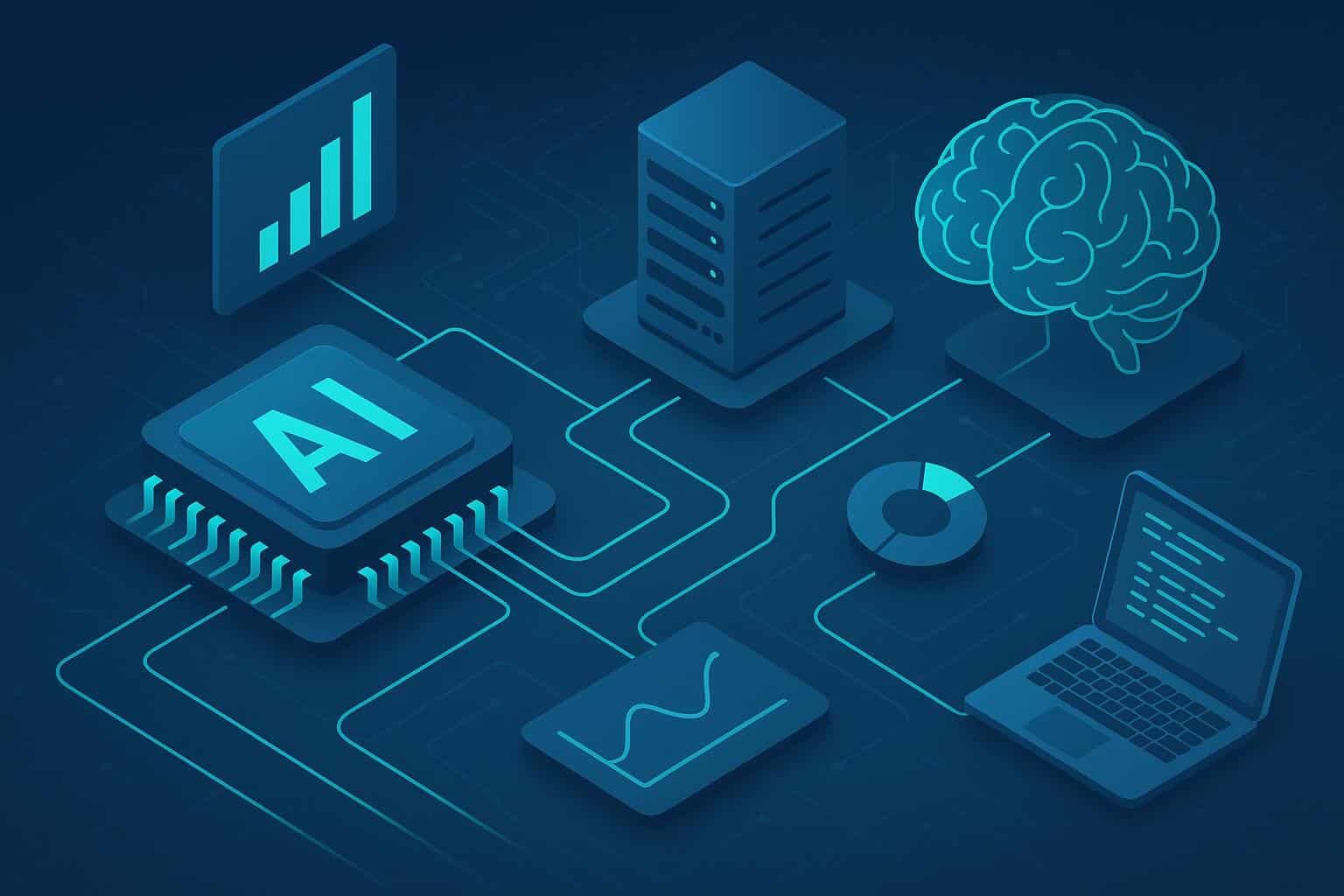
The gap between enterprises that bought AI and those that built it is widening fast. This guide to enterprise AI development services makes the case that production-grade deployments now require four compounding layers: automated data pipelines feeding vector databases, Retrieval-Augmented Generation systems that ground model outputs in verified internal documents, autonomous multi-agent workflows capable of executing multi-step business processes without human handholding, and continuous MLOps monitoring to catch model degradation before it reaches end users. Project budgets range from $15,000 for a proof of concept to $1M-plus for a global multi-tenant platform.
What this means for your business
The organizations most exposed right now are those that shipped a chatbot wrapper in 2023, declared AI “done,” and moved on. If your current AI footprint is a single API call sitting in front of a public model with no connection to your internal data, you are not behind on a trend, you are behind on infrastructure. The four-layer stack described here is not aspirational architecture; it is the minimum viable design for anything that needs to be auditable, accurate, and recoverable when the underlying model changes.
The framework agnosticism point buried in the strategic recommendations deserves more weight than it gets here. The article, published by a firm that sells AI development services and therefore has every incentive to understate the stickiness risk of custom builds, is actually correct on this one. Locking your proprietary workflows into a single vendor’s closed API is the technical-debt move that looks cheap in year one and catastrophic in year three when a cheaper foundation model arrives and you cannot migrate. Building on modular open layers like PyTorch or LangChain preserves optionality in a market where model pricing and capability are still moving violently.
The budget table is a useful forcing function for CFOs who keep treating AI as a line item rather than a platform investment. A $15,000 proof of concept is a real number, not a rounding error, and it buys a data audit plus a single-silo RAG test, not a deployed product. CTOs who present the PoC cost without the subsequent $100,000 to $250,000 enterprise platform phase are setting up a sticker-shock conversation at the worst possible moment. Price the full roadmap in the first board discussion or the project dies at phase two.
Concept deep-dive: Retrieval-Augmented Generation (RAG)
A large language model trained on public internet data has no idea what your contracts, internal policies, or product specs say. RAG solves this by intercepting every query, pulling the most relevant chunks from your private document store, and feeding only those verified passages to the model before it answers, like handing a lawyer the exact case files before cross-examination rather than asking them to recall from memory. For any regulated industry, RAG is what converts a plausible-sounding AI into a defensible one.
Based on reporting from Scaling the Enterprise Framework: The Definitive Guide to AI Development Services, originally published 2026-07-20 02:50:00.