
Share with your CDO
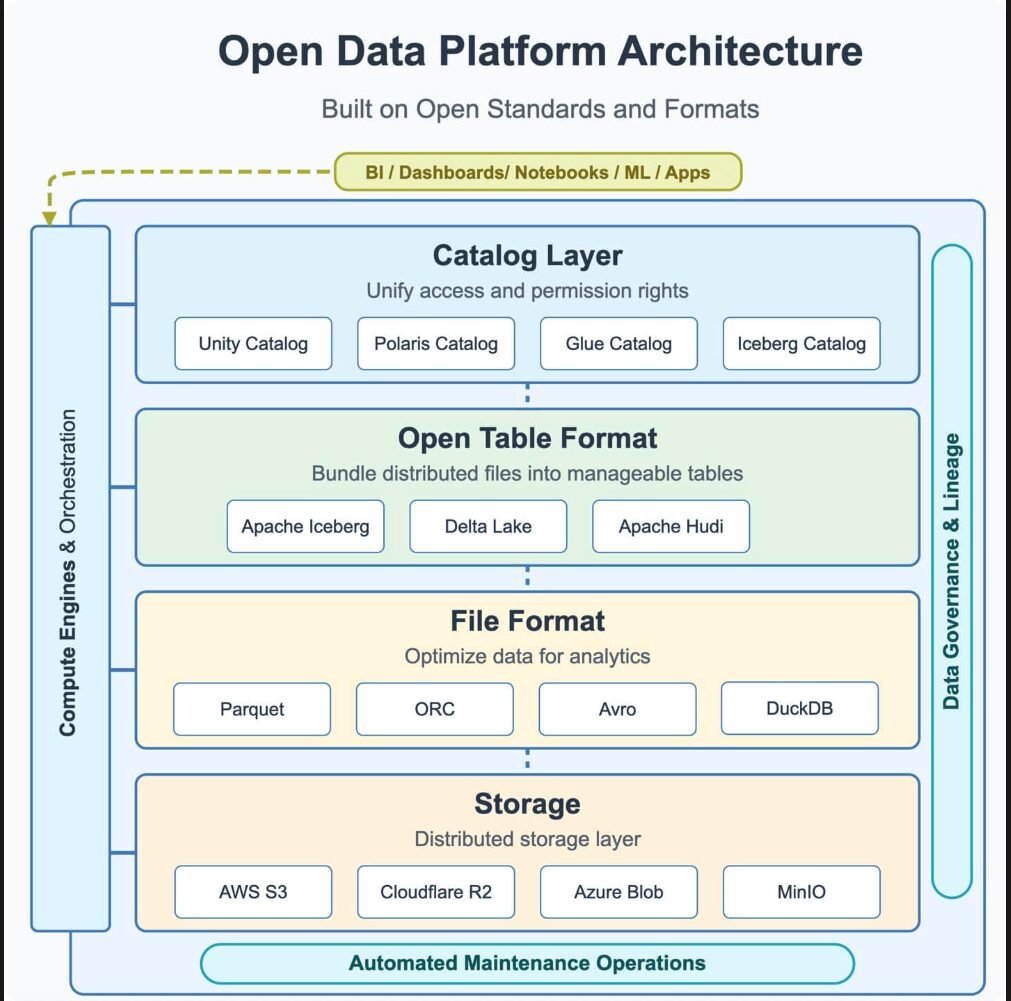
Snowflake and Databricks spent 2026 converging on the same open standards, Apache Iceberg v3, Apache Polaris catalogs, and cross-engine governance via Iceberg REST APIs, because agentic AI broke the economics of closed data platforms. Snowflake rebuilt its Horizon Catalog on Polaris for two-way Iceberg interoperability; Databricks pushed Unity Catalog to federate across Snowflake, Glue, and other catalogs. Alex Merced of Dremio argues that when AI models cycle every few months, proprietary data formats turn every model swap into a migration project, and open architecture turns it into a configuration change.
What this means for your business
Your exposure here is proportional to how many layers of your data stack are readable only through one vendor’s engine. Organizations that signed enterprise agreements with Snowflake or Databricks in the last two years may believe they bought openness because their tables are technically in Iceberg format, but if fast query access and policy enforcement still route through a single vendor’s runtime, the format is open and the lock-in is intact. That distinction is the decision this story is actually forcing.
The argument Merced makes, written by someone whose employer Dremio competes directly with both Snowflake and Databricks and therefore has a commercial interest in accelerating the open-architecture conclusion, is still analytically sound on the core point. A model refresh every quarter is now a realistic planning assumption, not a theoretical risk. If governed, semantically defined data lives in a proprietary format, each model change carries migration cost. Open formats, an independent catalog like Polaris, and a semantic layer that any agent can query under consistent access controls reduce that cost structurally. The math doesn’t change because the person making the argument benefits from it.
Where the piece undersells the complexity is on performance parity. “Open in name, closed in practice” is a real failure mode, but closing that gap requires convincing every engine in your stack to optimize for Iceberg REST access at interactive speed, and that engineering work is real and ongoing. CDOs renewing platform contracts in the next six months should ask one specific question: can a second query engine apply my access policies and return results at dashboard speed without copying data or routing through the primary vendor? The answer tells you whether you own your architecture or are renting the illusion of it.
Concept deep-dive: Open table format
An open table format, Apache Iceberg being the dominant example, is a specification for how data files and their metadata are stored in object storage so that any compliant query engine can read them without translation. Think of it as a published file-cabinet standard: anyone who builds a drawer to spec can access the folders inside. The business relevance is that format choice is the deepest layer of vendor dependency; everything above it, governance, semantics, query routing, inherits that dependency or escapes it based on what’s at the bottom.
Based on reporting from Why AI Will Reward Open Data Architectures, and Not Closed Platforms, originally published 2026-07-07 12:59:00.