
Share with your CTO
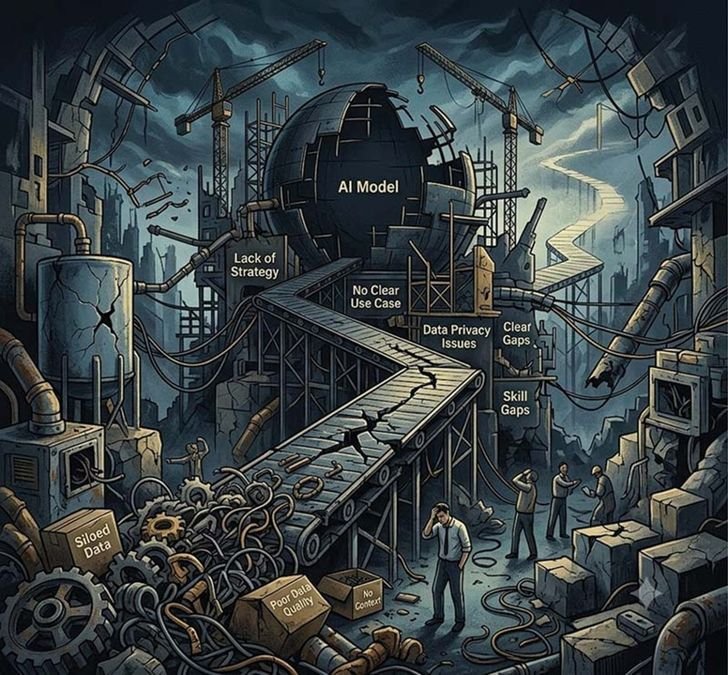
Chanakya Bellam of AION-tech Solutions argues that enterprise AI failures trace back to infrastructure and governance decisions, not model capability. The argument spans five failure modes: retrieval pipelines built on faulty data, observability frameworks that miss output quality entirely, AI-generated code entering production without rigorous review, AI agents inheriting overly broad human permissions, and silent “AI debt” accumulating across prompts, embeddings, and evaluation processes. The piece offers no benchmark numbers or named customer examples, but the taxonomy of failure modes is precise enough to function as an audit checklist for any enterprise AI program.
What this means for your business
The organizations most exposed here aren’t the ones that haven’t adopted AI. They’re the ones that have adopted it fast, particularly teams that built retrieval-augmented generation prototypes quickly in 2023 and 2024 and then pushed them toward production without rearchitecting the retrieval layer. If your RAG system (a setup where an AI model pulls from your internal documents before answering) was designed around a proof of concept, the chunking logic, metadata management, and reranking pipeline almost certainly weren’t built to enterprise tolerances. You’re not running a bad model. You’re running a good model on bad inputs.
The agent identity argument is the sharpest claim in the piece, and it deserves more weight than it usually gets in vendor conversations. The prevailing shortcut is to grant an AI agent whatever permissions the human it’s acting for already holds. That’s a governance disaster waiting to trigger. Every enterprise access-control framework is built on the principle of least privilege, giving any user or system only what it needs to complete a specific task. Agents need their own identities, scoped to individual workflows, with time-bounded access and policy engines sitting between intent and execution. That’s not a theoretical risk. Any agent connected to ERP or CRM platforms with inherited admin-level credentials is an incident waiting to happen, and the audit trail after the fact will point directly back to the architecture decision.
The “AI debt” framing, Bellam’s term for the invisible degradation that accumulates across prompts, vector stores, and evaluation pipelines over time, maps cleanly onto something CTOs already understand from software engineering. Technical debt in codebases becomes visible when systems fail under load or resist extension. AI debt becomes visible later, when a prompt that worked in 2024 quietly stops working as underlying models update and nobody has version control to diagnose why. The organizations that build prompt versioning, model lifecycle governance, and continuous evaluation benchmarks now will spend far less on emergency remediation in two years than the ones that treat those as future problems.
Bellam writes from the vantage point of a solutions vendor, which tilts the argument toward comprehensive governance frameworks rather than surgical fixes, but that framing doesn’t make the diagnosis wrong. The leading indicator to watch is whether your AI observability stack tracks output quality metrics like retrieval relevance and grounding accuracy alongside infrastructure metrics like latency and uptime. If your monitoring dashboard can tell you the system is up but can’t tell you whether its answers are correct, you’re flying blind on the dimension that actually matters to the business.
Concept deep-dive: Retrieval-Augmented Generation
Retrieval-augmented generation, commonly called RAG, is a technique where an AI model doesn’t answer from memory alone. Before generating a response, it searches a connected knowledge base, pulling in relevant documents or records to ground its answer in actual organizational data. Think of it as giving the model a research assistant that fetches source material before the model speaks. The business implication is that answer quality depends as much on what gets retrieved as on what the model does with it, which is why retrieval architecture is the real leverage point.
Based on reporting from Why Enterprise AI Fails Before the Model Runs, originally published 2026-07-25 05:17:00.