
Share with your CTO
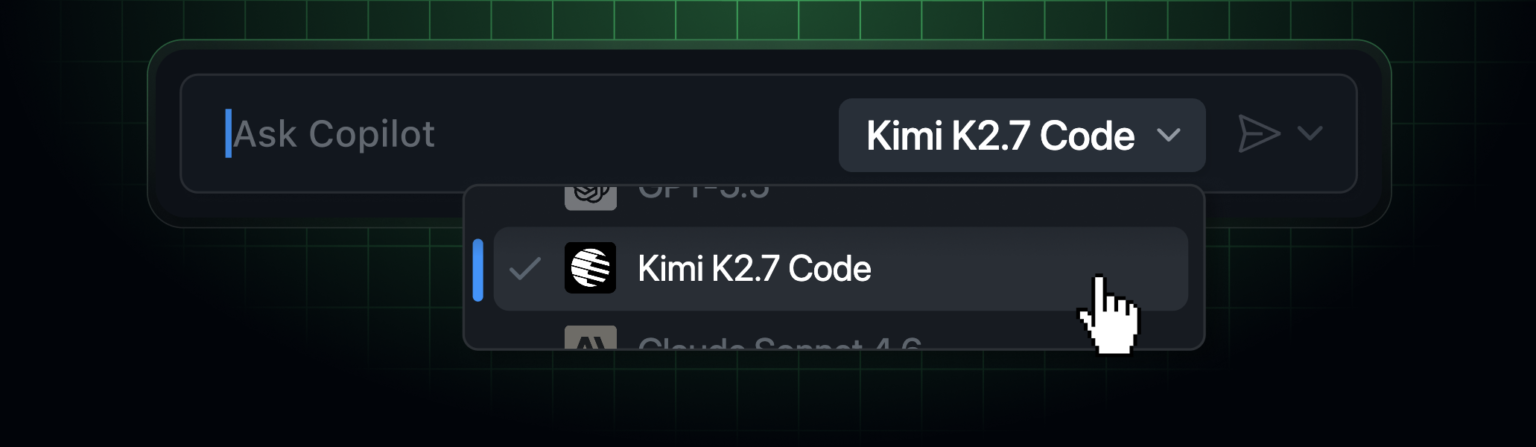
GitHub is making Kimi K2.7 Code, an open-weight model from Chinese AI lab Moonshot AI, available to Copilot Business and Enterprise plans as a selectable option in the model picker. It’s the first open-weight model offered this way inside Copilot, hosted by GitHub on Microsoft Azure under usage-based billing at provider list pricing. Administrators must explicitly enable it. GitHub’s own guidance tells admins to vet the model against their security, compliance, and data-governance requirements before flipping the switch.
What this means for your business
GitHub just introduced price competition into its own product. Open-weight models cost meaningfully less to serve than proprietary frontier models, and by putting Kimi K2.7 Code in the same picker as GPT-4o and Claude, GitHub is telling enterprise engineering teams they don’t have to pay frontier prices for routine coding tasks. A developer writing boilerplate, generating tests, or doing documentation passes is a genuinely different cost profile than one doing complex architectural reasoning.
The opt-in default is not just a compliance gesture. It’s a calculated hedge. GitHub gets to offer a lower-cost option without absorbing the reputational risk if an enterprise’s security team hasn’t stress-tested an open-weight model against their data-handling requirements. The practical effect is that the decision lands squarely on your engineering leadership, not on GitHub. CTOs who let administrators click through without a real governance review are accepting a risk transfer they may not have noticed.
The signal worth watching: this is the first open-weight model in Copilot’s picker, not the last. If Kimi K2.7 Code sees meaningful adoption, GitHub will add more. The model picker is quietly becoming a marketplace, and the long-term pricing pressure on Anthropic and OpenAI inside the Copilot ecosystem is real. Your current Copilot spend assumptions deserve a second look before your next renewal cycle.
Concept deep-dive: Open-weight models
An open-weight model is one where the trained model parameters are publicly released, so anyone can download, inspect, or run the model on their own infrastructure. It exists because some labs treat model weights as a distribution strategy rather than a trade secret. Think of it like the difference between a restaurant that shares its recipe versus one that keeps it locked away. For enterprises, the business connection is direct: open-weight models can be self-hosted, audited, and fine-tuned, but they also arrive without the indemnification and data-handling guarantees that come with proprietary API agreements.
Based on reporting from Kimi K2.7 now available for Copilot Business and Enterprise, originally published 2026-07-07 20:05:00.