
Share with your CTO
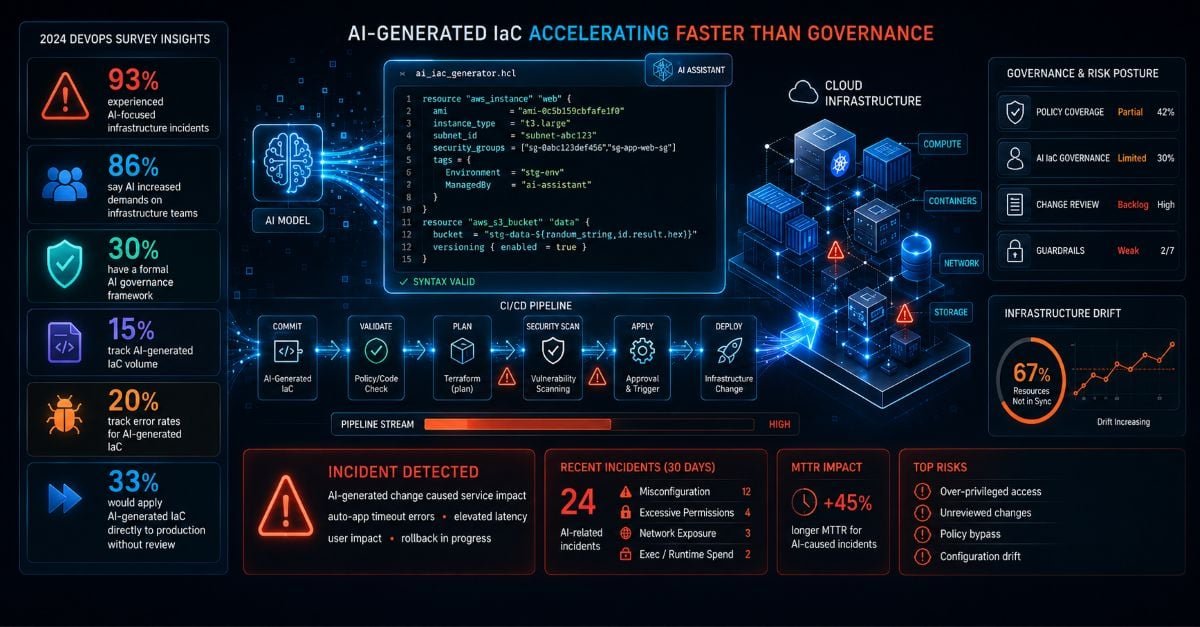
Vibe coding is breaking production infrastructure. A survey of 406 IT decision makers commissioned by infrastructure automation platform Spacelift finds 93% of organizations have experienced at least one infrastructure incident caused by AI tooling. More damning: 33% of infrastructure teams apply AI-generated configuration code directly to production with zero review, and another 43% do only a minimal pass. Only 15% track the volume of AI-generated code moving through their pipelines, and just 20% track error rates. The gap between AI adoption speed and governance readiness is no longer theoretical.
What this means for your business
The failure mode here is predictable. AI coding tools generate infrastructure configuration without runtime context, meaning they don’t know how your cloud environment is actually wired. A script that looks syntactically correct can misconfigure an S3 bucket, open an unintended network path, or simply fail silently at 2 a.m. When 76% of teams skip meaningful review and fewer than one in five track error rates, that’s not a tooling problem. That’s a process abdication.
The survey’s maturity segmentation is the most useful data point. Pioneer organizations vibe-code infrastructure at a higher rate than the least mature Exposed organizations (86% versus 69%), but they do it inside governed pipelines with automated validation and policy enforcement. The tool isn’t the differentiator. The guardrail architecture is. Organizations treating AI code generation as a productivity shortcut without building the policy layer around it aren’t moving faster. They’re accumulating technical debt that manifests as incident response costs, security remediations, and engineering time diverted from product work.
The confidence gap in this data should concern you directly: 86% of respondents say they’re confident in their organization’s ability to govern AI, while only 30% have a formal governance policy in place. That’s not confidence, that’s optimism without instrumentation. The signal worth watching is whether your security and DevOps teams are measuring AI-generated code as a distinct input category in your pipelines, because if they aren’t tracking it, they can’t govern it, and your incident rate will tell the story before your dashboard does.
Concept deep-dive: Infrastructure-as-Code (IaC)
Infrastructure-as-code means defining servers, networks, databases, and cloud services through configuration files rather than manual setup, using tools like HashiCorp’s Terraform or Pulumi. It exists because modern cloud environments are too complex and too dynamic to configure by hand reliably. Think of it as the architectural blueprint for your entire technical environment, version-controlled and repeatable. When AI generates these files without understanding your specific environment’s runtime constraints, the resulting misconfiguration doesn’t just cause a software bug. It can expose your entire cloud posture to attack or collapse a critical service dependency.
Based on reporting from Survey Surfaces Rise in IT Incidents Attributable to AI Coding Tools, originally published 2026-06-29 10:57:00.