
Share with your CTO
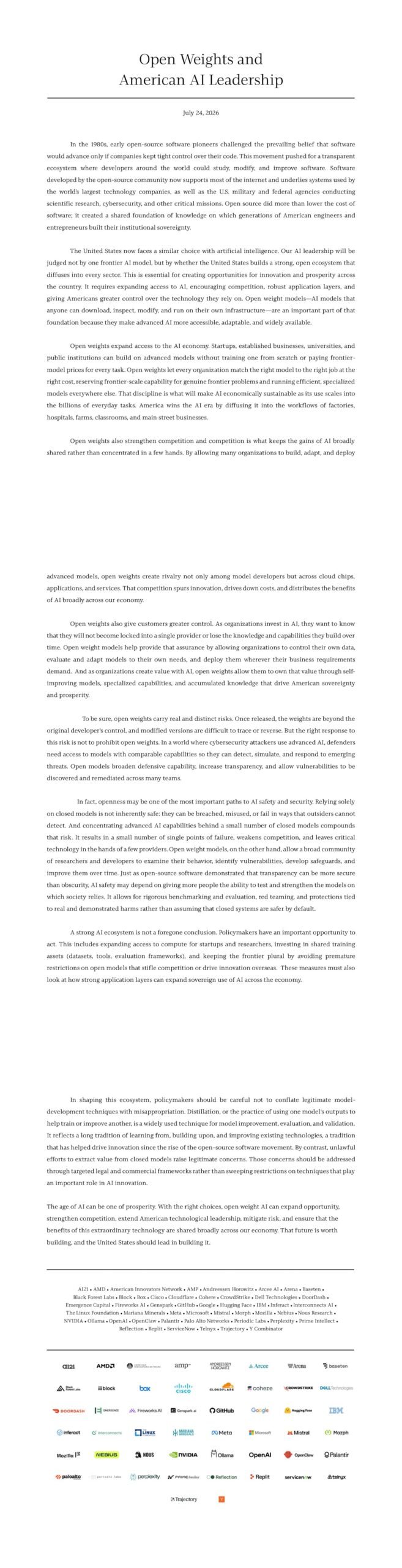
Jensen Huang published a public letter positioning open-weight AI models as the architecture of American strategic advantage, arguing that freely distributed model weights accelerate innovation, reduce vendor concentration, and give US allies a trusted alternative to Chinese AI infrastructure. Nvidia, which sells the hardware that trains and runs every major open-weight model, frames openness as a geopolitical good. StorageNewsletter’s commentary flags the letter’s US-centric framing, noting it effectively casts Europe, India, and Japan as consumers within an American-governed ecosystem rather than co-architects of it.
What this means for your business
If your organization is currently evaluating open-weight models like Meta’s Llama series against proprietary alternatives from OpenAI or Anthropic, Huang’s letter is less a neutral endorsement and more a supply-chain argument wearing ideological clothing. The technical case for open weights, including auditability, customization, and reduced lock-in, is real. But the governance layer beneath those weights, who sets the licensing terms, which foundations hold the IP, which companies dominate the contributor rankings, remains almost entirely American. That asymmetry matters if your board is asking about AI sovereignty, not just AI capability.
The recurring failure mode in enterprise AI procurement is conflating “open” with “neutral.” Open-weight models are auditable in ways that closed APIs are not, which is a genuine security and compliance advantage. But Huang’s framing, written by the CEO of the company that captures margin on every GPU used to fine-tune or serve those models, tilts toward a specific conclusion: that open weights governed by US norms are categorically safer than Chinese alternatives. That may be true. It still isn’t the same as saying open weights are free from geopolitical dependency. Your CISO and your CTO need to hold both claims at once.
The decision this letter quietly reframes is not “open versus closed” but “whose open.” Organizations in regulated industries, particularly those with European data residency requirements or government contracts that carry supply-chain scrutiny, are already being asked that question by auditors. The leading indicator to watch is whether EU AI Act enforcement starts treating model provenance, meaning where the weights were developed and by whom, as a compliance variable. If it does, the open-weight calculus shifts from a cost and flexibility argument into a vendor-selection decision with legal teeth, and the answer to “which open model” stops being purely technical.
Concept deep-dive: Open-weight models
An open-weight model is one where the trained parameters, the billions of numerical values that encode what the model has learned, are publicly released. Think of it like publishing not just a recipe but the fully prepped dish, ready to reheat and modify. Unlike open-source software, the training data and methodology are often still proprietary. For enterprises, the business relevance is control: you can run the model on your own infrastructure, fine-tune it on your own data, and audit its behavior without routing queries through a vendor’s API.
Based on reporting from “Open Weights and American AI Leadership” – A Letter by Jensen Huang, CEO and cofounder, Nvidia, originally published 2026-07-28 08:23:00.