
Share with your CTO
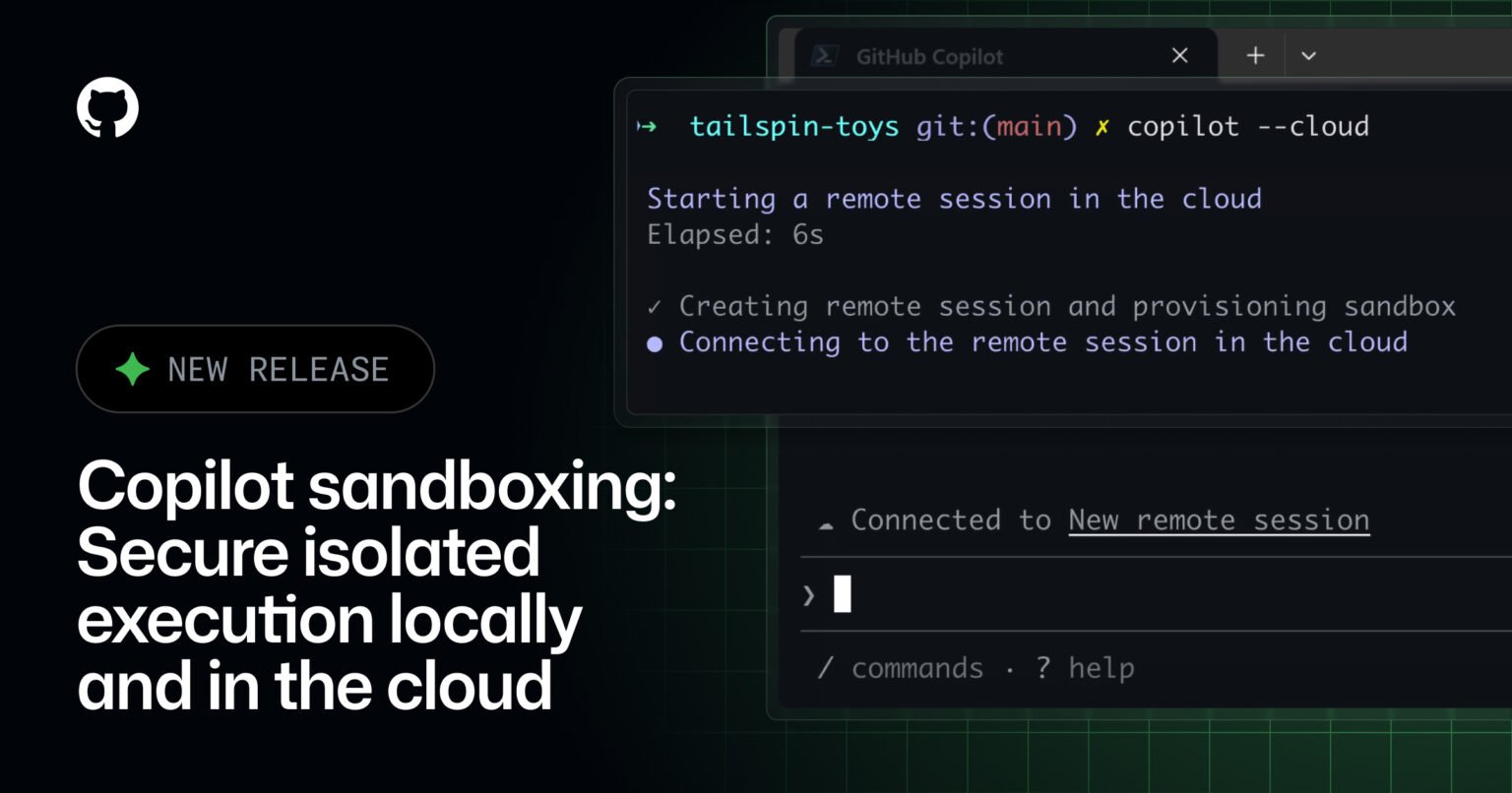
GitHub is making agentic coding infrastructure the center of its Copilot strategy. With cloud and local sandboxes for GitHub Copilot now in public preview, enterprises can let Copilot execute shell commands, modify files, and run tools without giving it unrestricted access to developer machines or production systems. Local sandboxes run on Microsoft MXC technology across macOS, Linux, and Windows, enforceable via Intune or any MDM platform. Cloud sandboxes spin up ephemeral Linux environments hosted by GitHub, inheriting existing Copilot policy controls on day one.
What this means for your business
The blocker for enterprise agentic AI adoption has never been the model quality. It has been the execution surface. When a coding agent can run arbitrary shell commands, the attack surface expands from “a developer made a mistake” to “an agent made a mistake at machine speed.” Sandboxed execution changes the risk calculus enough that engineering orgs that have been sitting on agentic workflows due to security objections now have a defensible answer to take to their CISO.
The Intune integration is the detail worth pausing on. Policy-managed local sandboxes mean your security team can define what Copilot can touch on a developer’s machine centrally, the same way they manage endpoint configurations today. That is not a developer productivity feature. It is an enterprise IT control feature, and it is the kind of governance surface that gets agentic tools off the pilot list and into approved vendor catalogs. GitHub is explicitly targeting the procurement and compliance gate, not just the engineering team.
The cloud sandbox’s session persistence, pick up a Copilot task on a different device where you left off, sounds like a convenience feature but points to something structural: GitHub is building toward a world where agentic workloads run continuously in the cloud, not episodically on developer laptops. That is the same architectural shift that happened when CI/CD moved off local machines. The question worth holding: how quickly does “cloud sandbox” become the default execution mode, and what does that do to your per-seat cost assumptions as compute usage scales independently of headcount?
Concept deep-dive: Agentic execution sandboxing
A sandbox is an isolated environment where code runs with strictly limited access to the surrounding system. Traditional sandboxes (think browser tabs or containerized apps) exist to contain untrusted third-party code. Agentic sandboxing applies the same principle to AI-generated actions: the agent can write a file or run a command, but only within boundaries the organization defines. The analogy is a valet with a key that only starts the car, not one that opens the glove box. For CTOs, the business connection is direct: it is the technical mechanism that makes autonomous AI actions insurable and auditable.
Based on reporting from Cloud and local sandboxes for GitHub Copilot now in public preview, originally published 2026-06-02 03:00:00.