
Share with your CTO
Meta is making a direct move into agentic software development with Muse Code, its first end-to-end AI coding agent, paired with the Muse Spark 1.2 model optimized for coding workloads. The product handles full software engineering workflows: planning, writing, and validating code, not just autocomplete. Pricing comes in at $1.25 per million input tokens and $4.25 per million output tokens, with a contributor tier priced lower in exchange for training data sharing. Enterprise zero-data-retention options are also available. The launch sits inside Meta Superintelligence Labs, the division Zuckerberg rebuilt after Llama underperformed against rivals.
What this means for your business
The coding agent market just got meaningfully more competitive for enterprise buyers. If your engineering organization is currently paying Anthropic or OpenAI rates for agentic coding workflows, Meta’s pricing creates immediate negotiating leverage, even if you never switch. The moment a credible third option exists at lower token costs, your existing vendor contracts become renegotiable. That’s not a future scenario. It’s happening now.
The more important signal isn’t price, it’s Meta’s architecture decision to build around a “coding harness,” a managed orchestration layer that routes tasks across models purpose-built for software development. That’s a different bet than Anthropic’s Claude-as-generalist or OpenAI’s Codex-style integrations. Purpose-built model routing for engineering workflows reduces context waste and error propagation across multi-step tasks. If Muse Spark 1.2 benchmarks credibly against Claude Sonnet or GPT-4o on real agentic coding runs, the TCO case for switching becomes hard to ignore inside a large engineering org running millions of tokens daily.
The question worth holding: Meta’s contributor tier, which trades lower cost for training data rights, is exactly the clause your legal and security teams will flag in any enterprise procurement review. Zero-data-retention enterprise options exist, but they’re not the default. The tradeoff is real: the organizations best positioned to get value fastest are also the ones most likely to be feeding Meta’s next model iteration.
Concept deep-dive: Agentic coding workflows
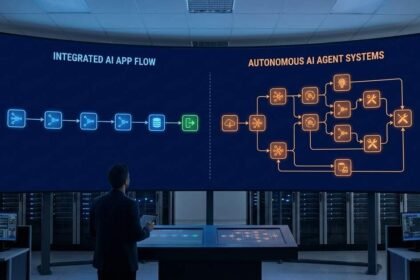
An agentic coding workflow is a system where an AI model doesn’t just respond to a single prompt but executes a sequence of interdependent tasks autonomously: reading a codebase, planning changes, writing code, running tests, interpreting failures, and iterating. Think of it as the difference between asking a contractor to install a single fixture versus handing them a renovation spec and a key. The business connection is direct: engineering throughput scales with how much of that loop runs without human intervention, and where in that loop errors compound.
Based on reporting from Meta Launches AI Coding Agent to Challenge OpenAI and Anthropic, originally published 2026-08-06 15:41:00.