
Share with your CIO
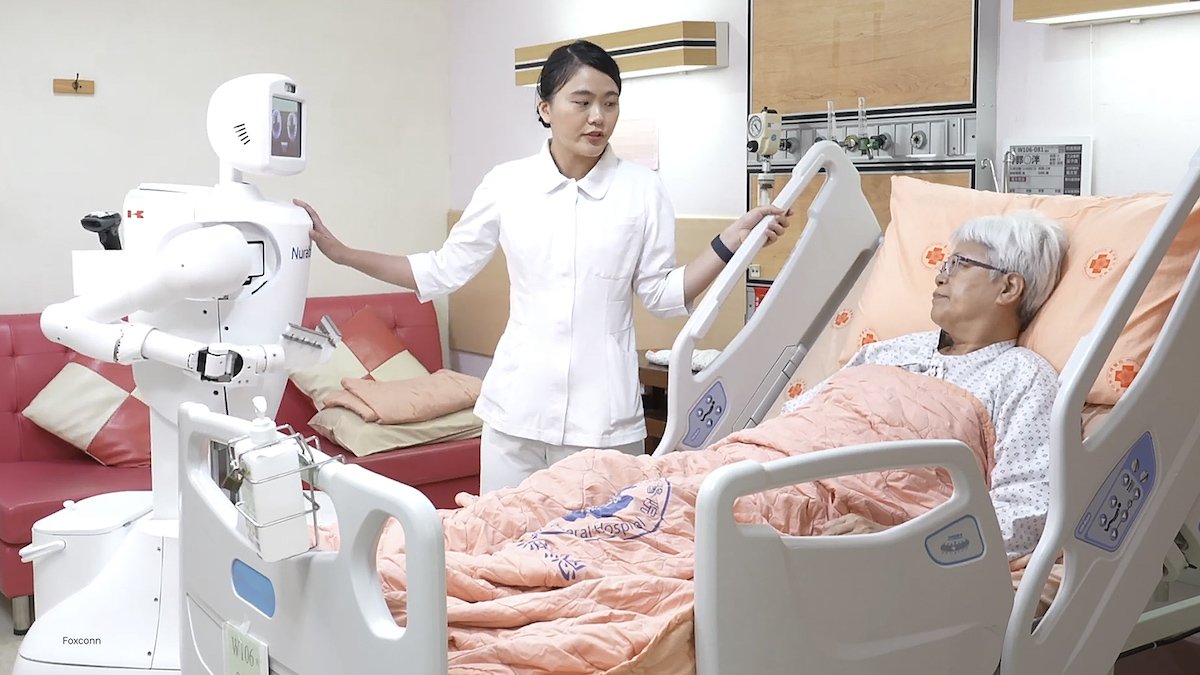
Taiwan is betting $1.5 billion on becoming the world’s first AI-native national health system, and Foxconn is positioning itself as the infrastructure integrator that makes it real. Under the government’s “Healthy Taiwan” program, Foxconn’s CoDoctor platform now deploys coordinated AI agents across cardiac, oncology, and ophthalmology workflows at major medical centers handling more than 14 million patient encounters annually. Its Nurabot nursing robot, validated at Taichung Veterans General Hospital, is expanding to additional sites. NVIDIA supplies the compute, simulation, and edge AI stack throughout. This agentic healthcare deployment represents one of the most operationally advanced national-scale rollouts yet attempted.
What this means for your business
The story that should concern health system CIOs isn’t the Taiwan-specific politics of the “Healthy Taiwan” program. It’s the operational specificity. Foxconn’s Corovia agent compresses a two-hour cardiac reconstruction workflow to one minute. Nurabot returns two to three hours per shift to frontline nurses. When a competitor health system or a government regulator starts citing those numbers, the organizations still running disconnected point solutions won’t be debating whether to adopt agentic AI, they’ll be defending why they haven’t.
The architecture here is worth scrutinizing carefully, because it signals where the industry is heading structurally. Foxconn isn’t deploying isolated AI tools; it’s running a multi-agent orchestration layer called CoDoClaw that coordinates specialized agents across a unified clinical interface. Think of it as an air traffic control system for AI decision-making inside a hospital, where individual agents handle specific domains and a central platform manages handoffs between them. That’s a fundamentally different procurement and integration challenge than buying a single diagnostic AI product. It means the CIO conversation shifts from “which AI vendor” to “which orchestration architecture,” and that shift hasn’t reached most health system technology roadmaps yet.
NVIDIA’s role here is the tell. The company isn’t just selling GPUs into a data center; it’s embedded across compute, edge inference, robotics simulation, and the NemoClaw language layer for future Nurabot deployments. That kind of vertical stack lock-in, supplied by a vendor whose pricing power is already well established, is the budget risk hiding inside what reads as a clinical success story. CIOs evaluating NVIDIA-dependent AI architectures should weigh now whether their current contracts create leverage for multi-year scaling, or whether they’re one successful pilot away from a renegotiation they’ll lose.
Concept deep-dive: Multi-agent orchestration
Multi-agent orchestration means multiple specialized AI systems, each trained for a narrow task like reading an ECG or reconstructing a coronary artery, coordinated by a supervisory layer that routes information between them and manages sequencing. The analogy is a hospital’s specialist referral system, except the handoffs happen in milliseconds. The business implication is that building or buying the orchestration layer, not the individual agents, becomes the strategic chokepoint, because whoever controls routing controls which agents get used and how outcomes get attributed.
Based on reporting from Foxconn, Taiwan hospitals tap NVIDIA for agentic and physical AI, originally published 2026-06-15 19:00:00.