
Share with your CHRO
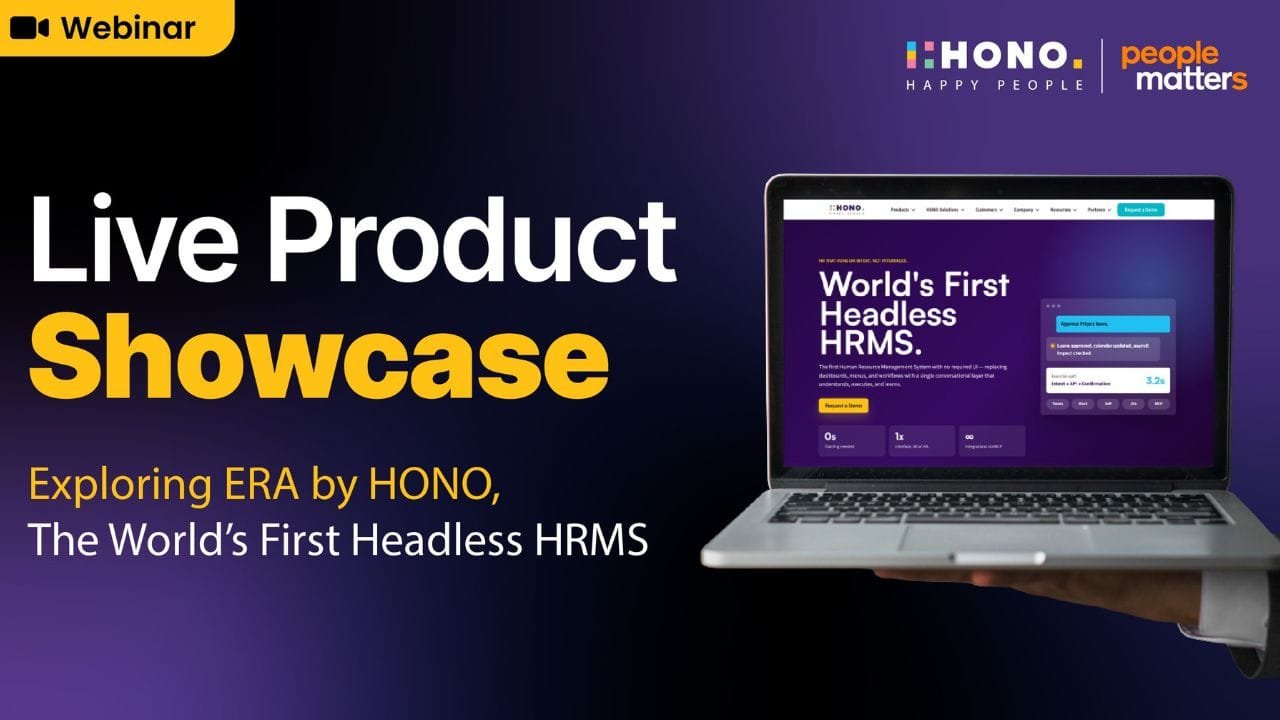
HONO is betting that the next competitive frontier in enterprise HR isn’t smarter workflows, it’s eliminating the interface entirely. The company’s Headless Zero UI HRMS platform, ERA, lets employees request leave, pull payslips, or surface workforce analytics through natural language conversation rather than portal navigation. Co-founder and CTO Prasanth Padharthi and EMEA presales head Amandeep Singh Minhas showcased the system live, demonstrating cross-system data retrieval, role-aware responses, and real-time chart generation, all without a traditional dashboard in sight.
What this means for your business
The chronic adoption problem in enterprise HR technology isn’t a feature gap, it’s a friction tax. Employees abandon self-service portals not because the capability isn’t there but because finding it costs more effort than asking a colleague or emailing HR directly. If ERA genuinely delivers role-aware, context-sensitive responses at the conversational layer, CHROs running large, distributed, or multilingual workforces are the ones with the most to gain, and the most to lose by waiting while adoption rates on their current platforms stay flat.
The governance story is where the architecture either holds or breaks, and HONO’s claim deserves scrutiny. ERA reportedly maintains existing role-based access controls (the permission rules that determine who can see what data), logs every interaction for audit purposes, and gives administrators tools to cap AI token consumption and set behavioral guardrails. That’s the right checklist. But “operates within existing access controls” describes an intention, not a proof. Any CHRO considering this should be asking which access control frameworks have been independently validated, what happens when the conversational layer misinterprets a query and surfaces data at the boundary of a permission, and whether the audit logs are exportable to existing SIEM or compliance tooling without custom integration work.
The deeper strategic signal here is that the interface layer is becoming a separable competitive asset, distinct from the HR data and workflow engine underneath. HONO is essentially arguing that Workday, SAP, and Oracle have built powerful engines wrapped in interfaces nobody enjoys using, and that a conversational skin on top of live enterprise data is now good enough to displace the portal entirely. Whether or not ERA specifically wins, that architectural argument is correct, and it means your next HRMS renewal conversation should include a hard question about whether your incumbent vendor’s interface strategy is keeping pace or just getting a chatbot bolted on as an afterthought.
Concept deep-dive: Headless architecture
A “headless” system decouples the back-end engine, data, logic, workflows, from the front-end presentation layer. Think of it like a restaurant kitchen that can serve food to a dining room, a drive-through, or a delivery app without changing the menu or the cooks. In HR software, headless means the payroll, compliance, and records engine runs independently while the interface, in ERA’s case a conversational AI layer, can be swapped or updated without rebuilding the underlying system. The business case is flexibility and faster experience iteration.
Based on reporting from The global HR revolution: How HONO’s Headless Zero UI HRMS is reshaping enterprise HR, originally published 2026-07-06 05:58:00.