
Share with your CTO
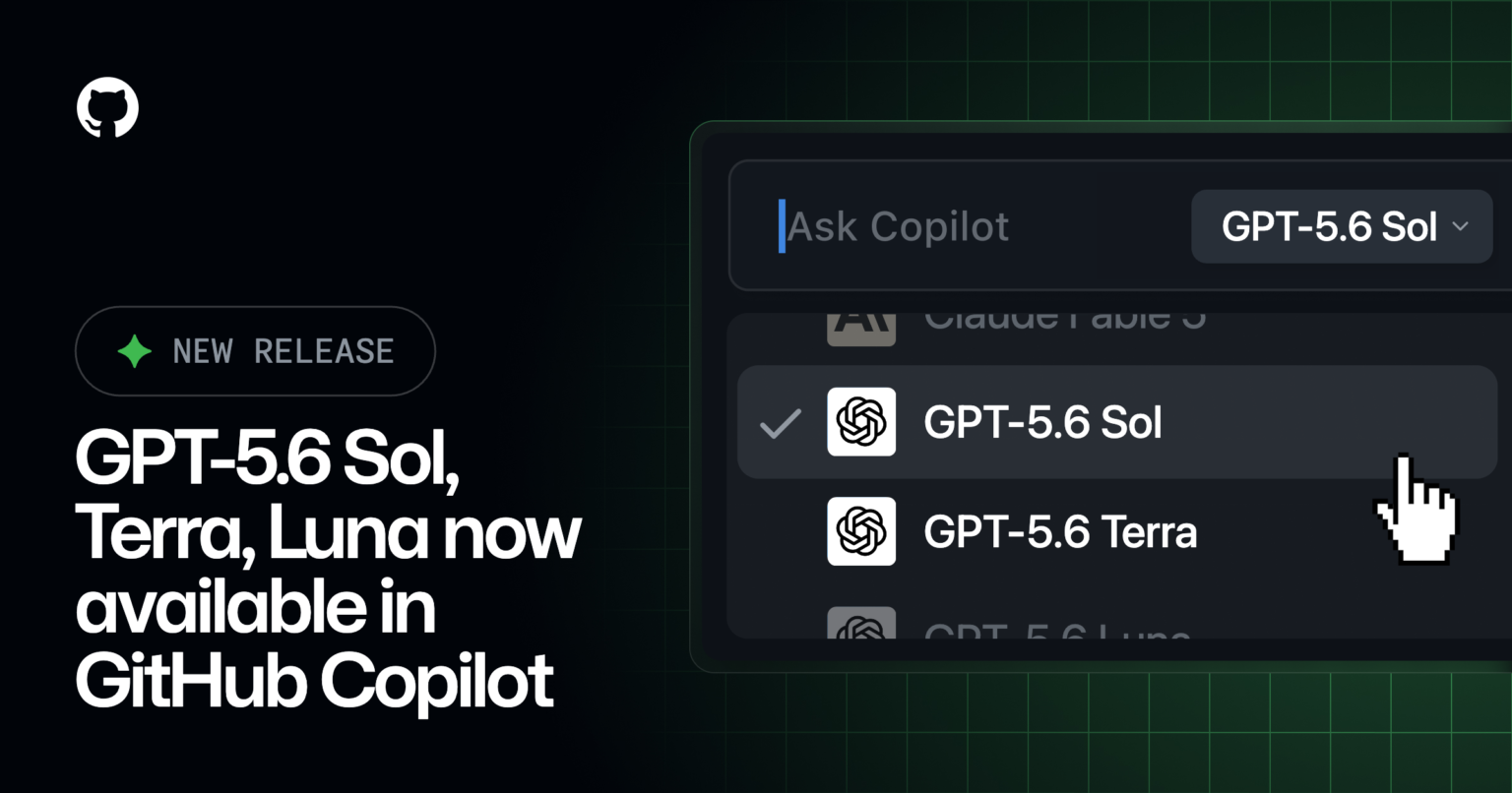
GitHub is positioning Copilot as a tiered AI coding infrastructure layer, not just an autocomplete tool. The GPT-5.6 family rollout across GitHub Copilot introduces three variants: Sol for complex, long-running agentic tasks over large codebases, Terra as the balanced everyday default, and Luna for fast, low-cost assistance. All three bill at provider list pricing under usage-based billing. Sol is restricted to Pro+, Max, Business, and Enterprise plans. Terra and Luna extend down to Pro. Enterprise and Business admins must explicitly enable access in Copilot settings.
What this means for your business
The shift from a single Copilot model to a named, tiered family changes how engineering leaders should think about developer tooling procurement. You’re no longer buying one AI assistant. You’re selecting a compute tier per task type, the same way you’d choose instance sizes in AWS. A junior engineer triaging bug reports runs Luna. A senior engineer doing multi-file refactors across a 2-million-line monorepo runs Sol. The billing model follows accordingly.
The policy-off-by-default decision for Enterprise and Business plans is the detail that will quietly cause the most friction. It means CTOs who don’t actively configure access will leave their teams on older models by default, while competitors who do configure it gain Sol’s agentic ceiling for the demanding work that compounds over time. The organizations that treat model selection as an IT checkbox rather than an engineering strategy call will fall behind not in a dramatic moment, but gradually, commit by commit.
The signal worth watching is how GitHub prices Sol relative to Claude Sonnet or Gemini 1.5 Pro when used in comparable agentic workflows. GitHub Copilot now competes not just on model quality but on model portfolio breadth, and that competition is intensifying fast. If usage-based billing for Sol runs materially cheaper than equivalent agentic capacity from Cursor or Windsurf, Microsoft’s distribution advantage through VS Code and JetBrains integration becomes a real cost story, not just a convenience story.
Concept deep-dive: Agentic coding
Agentic coding refers to AI that doesn’t just suggest the next line of code but executes multi-step tasks autonomously: reading files, writing tests, running builds, and iterating on failures without constant human prompting. It exists because LLMs now have enough context window and tool-calling capability to hold an entire workflow in memory. Think of it as the difference between a calculator and an accountant who completes the spreadsheet while you’re in a meeting. For engineering orgs, the business implication is that agentic capacity directly substitutes for sprint hours on well-defined, bounded tasks.
Based on reporting from OpenAI’s GPT-5.6 Sol, Terra, and Luna are now available in GitHub Copilot, originally published 2026-07-09 12:41:00.