
Share with your CIO
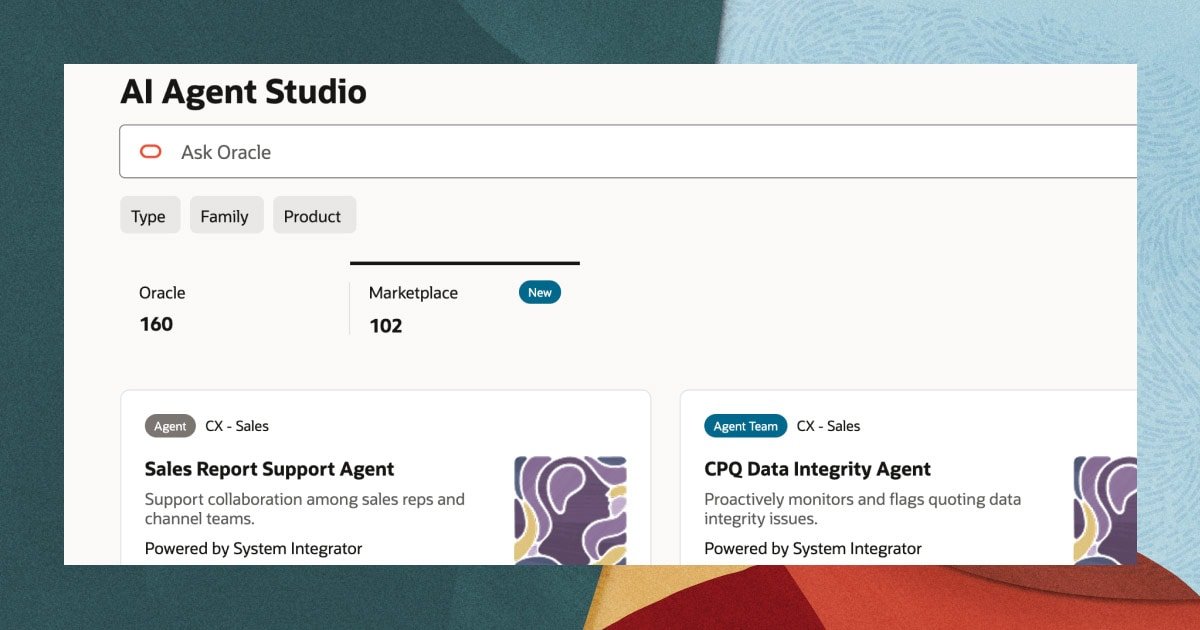
Oracle is betting that the fastest path to enterprise AI adoption runs through its existing Fusion Applications install base, not through standalone agent platforms. The company launched the Oracle Fusion Applications AI Agent Marketplace, embedding partner-built AI agents directly inside Fusion Cloud workflows across finance, HR, supply chain, and customer experience. Contributors include IBM Consulting, Infosys, KPMG, and Wipro on the system integrator side, plus ISVs like Box and Stripe. Agents deploy with one click, no custom code required, and Oracle backs every partner agent with its own enterprise support tier.
What this means for your business
If your organization runs Oracle Fusion, the calculus here is straightforward: Oracle just made it significantly harder to justify building custom agent integrations from scratch. The marketplace creates a ready-made library of validated agents that sit inside the platform you already pay for, which means the “build vs. buy” question now has a third answer, borrow from a vetted partner without leaving your existing environment. Organizations not yet on Fusion will feel this as competitive pressure from peers who can accelerate AI deployment without touching their core architecture.
The strategic weight of this announcement isn’t the agent catalog, it’s the distribution channel Oracle is handing its partner network. System integrators like Infosys and KPMG have always sold AI services, but those engagements typically required long implementation cycles and bespoke integration work. Oracle is now letting them package that expertise as a deployable template, turning a consulting engagement into a product. That changes the economics on both sides: clients get faster time-to-value, partners get a repeatable revenue motion inside a captive install base. Oracle, of course, deepens lock-in while the platform adoption story writes itself, which is precisely why the framing around “accelerating AI adoption” deserves some scrutiny alongside the genuine utility.
The indicator worth watching is whether the security validation process Oracle describes, a “comprehensive checklist” applied uniformly to partner and Oracle-built agents alike, holds up as the catalog scales. Marketplaces that grow fast tend to dilute quality controls quietly. If a KPMG procurement agent and a smaller SI’s agent carry the same Oracle support guarantee and trust badge, the weakest agent in the catalog sets the actual security floor for every customer who clicks install. CIOs evaluating this should ask Oracle specifically what the validation checklist covers and whether audit results are available, because that answer will tell you whether the trust framework is architecture or marketing.
Concept deep-dive: Embedded agent marketplace
A traditional software marketplace sits outside your core platform, requiring separate procurement, integration work, and vendor relationships. An embedded agent marketplace lives inside the platform itself, so discovery, deployment, and support all happen within the same environment where work is already occurring. The analogy is an app store built into the operating system rather than accessed through a browser. For enterprises, the business consequence is reduced integration overhead, but also reduced negotiating leverage, since switching costs compound every time you install another native agent.
Based on reporting from Oracle Launches Fusion Applications AI Agent Marketplace to Accelerate Enterprise AI Adoption, originally published 2025-10-15 03:00:00.