
Share with your CTO
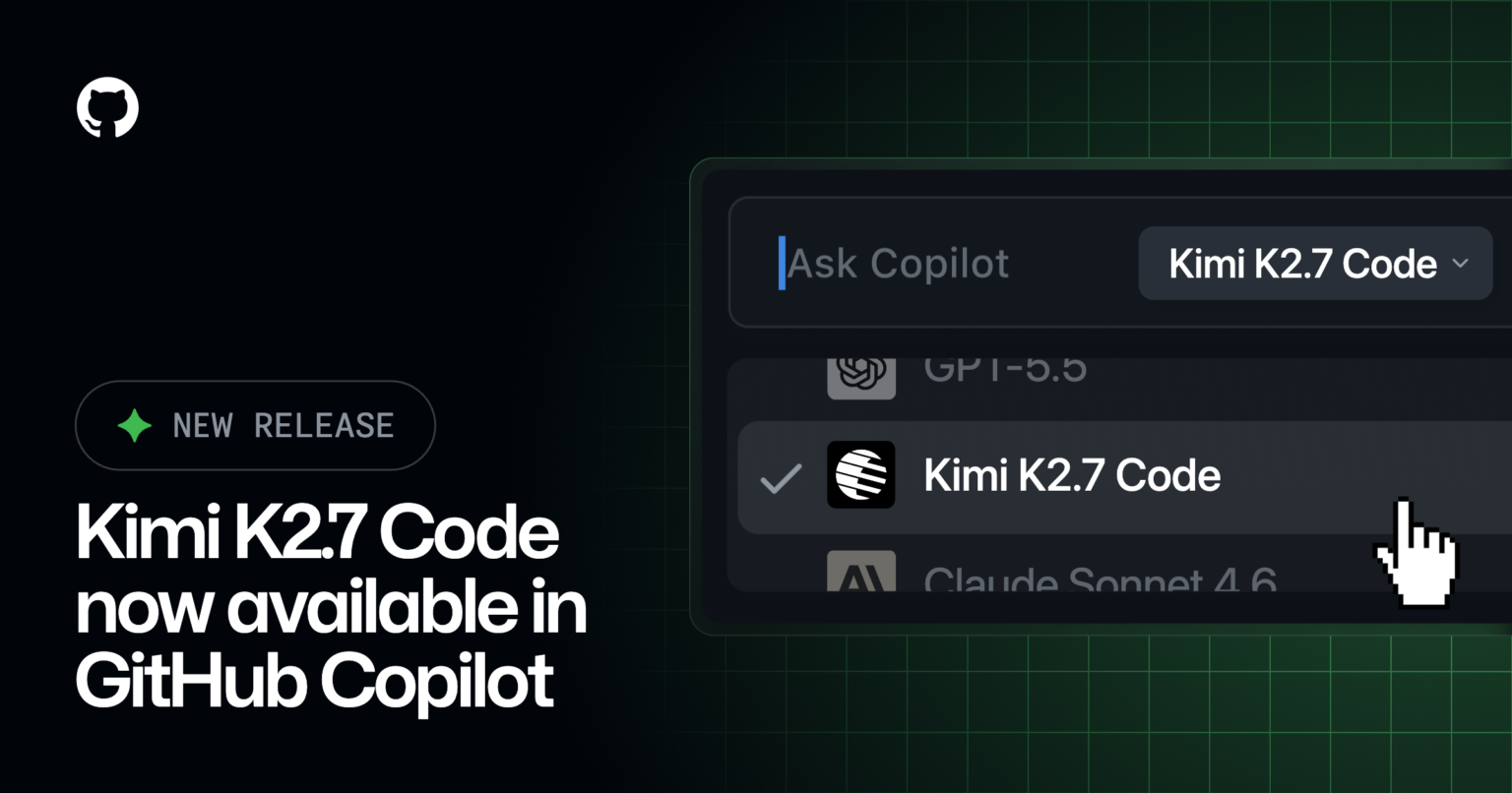
GitHub is moving to commoditize the model layer inside Copilot. Kimi K2.7 Code, a Chinese open-weight coding model from Moonshot AI, is now generally available in GitHub Copilot as the first open-weight model in the platform’s model picker. It runs on Microsoft Azure infrastructure, bills at provider list pricing under usage-based billing, and rolls out initially to Pro, Pro+, and Max plans before expanding to Business and Enterprise tiers. Admins on those higher tiers must explicitly enable the model; it’s off by default pending their own security and compliance review.
What this means for your business
The practical win for engineering leaders is cost arbitrage on routine tasks. Closed frontier models like GPT-4o and Claude Sonnet carry premium pricing justified by broad capability. For repetitive code completion, boilerplate generation, or test scaffolding, an open-weight model priced below frontier rates does the same job. Teams running high-volume agentic coding workflows, where token counts compound fast, will feel the difference in the monthly bill before they feel it anywhere else.
The deeper shift is architectural. GitHub is turning Copilot into a model-agnostic runtime rather than a vehicle for any single model vendor. That’s the same playbook Microsoft ran with Azure’s multi-cloud positioning: own the distribution layer, let the models compete inside it. Once developers get comfortable switching models per task, the switching cost migrates from “which AI coding tool do I use” to “which IDE integrates with the most models.” GitHub wins that contest by default. The model vendors, including OpenAI, are now tenants.
The off-by-default posture for Business and Enterprise is the signal worth watching. GitHub is handing administrators a governance checkpoint for open-weight models specifically, which implies the company anticipates enterprise legal and infosec teams will treat open-weight differently from closed hosted models. That distinction will harden into formal policy at large enterprises over the next 12 months. How you classify open-weight in your AI governance framework today will determine how fast your teams can access lower-cost options tomorrow.
Concept deep-dive: Open-weight models
An open-weight model is one whose trained parameters are publicly released, meaning any organization can download, inspect, and run the model on its own infrastructure. The contrast is with closed models, where the weights remain proprietary and access is only available via API. Open-weight exists because academic and commercial researchers want reproducibility and the ability to fine-tune without vendor dependency. Think of it like the difference between buying a car and leasing one: you can modify what you own. The business connection is control over cost, customization, and data residency, all of which matter at enterprise scale.
Based on reporting from Kimi K2.7 Code is generally available in GitHub Copilot, originally published 2026-07-01 03:00:00.