
Share with your CTO
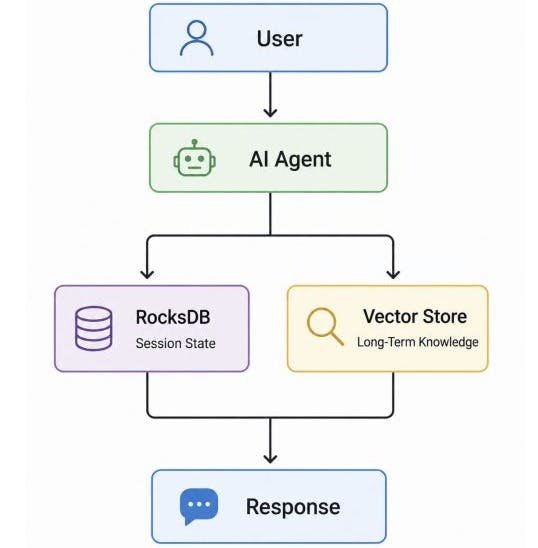
A development team building an enterprise AI platform found that the bottleneck wasn’t model quality or retrieval accuracy, it was session-state management. Thousands of small, rapid reads and writes for things like API specs, generated test cases, and multi-agent intermediate outputs made a centralized database the wrong tool. Their fix was RocksDB, an embedded key-value store originally built for storage engines, deployed as a local “working memory” layer per user session inside Kubernetes, with the vector database reserved strictly for long-term organizational knowledge.
What this means for your business
If your AI platform feels sluggish or loses context mid-session, the model is probably not the culprit. The teams most exposed to this problem are the ones that architected their AI stack by copying patterns from traditional SaaS applications, where writes are infrequent and reads are predictable. Agentic workflows invert that assumption entirely. Dozens of incremental state changes per minute, across multiple agents running in parallel, will punish any architecture that routes every update through a remote transactional database.
The architectural insight here is worth naming precisely: there’s a missing tier in most enterprise AI stacks, sitting between ephemeral in-process memory and durable long-term storage. Call it the active-state layer. RocksDB fills it well because its Log Structured Merge Tree design, which batches and sequences writes to minimize disk seeks, is tuned exactly for write-heavy, update-heavy workloads rather than the read-optimized patterns most databases assume. The author is a practitioner writing from a specific implementation rather than a vendor positioning a product, which makes the framing credible, though it also means the piece underplays the real operational challenges of managing per-session embedded storage at scale, including crash recovery, session hand-off across pods, and compaction overhead under high concurrency.
The honest falsification condition for this approach is multi-tenancy at scale. A single RocksDB instance per user session works cleanly when your concurrent session count is in the hundreds. If you’re running thousands of simultaneous agentic sessions in a shared Kubernetes cluster, the per-instance resource overhead and the lifecycle management complexity stop being minor footnotes and start being the main engineering problem. Teams evaluating this pattern should pressure-test it at their actual concurrency ceiling before committing it to production architecture, not after.
Concept deep-dive: Log Structured Merge Tree
A Log Structured Merge Tree (LSM tree) is a storage structure that handles writes by appending them sequentially to a fast in-memory buffer, then periodically merging and compacting data to disk in batches, rather than updating records in place. Think of it as a ledger that records every change in order and reconciles later, instead of erasing and rewriting the original entry immediately. For AI workloads generating constant small updates, this design delivers dramatically lower write latency than traditional B-tree databases built around random-access reads.
Based on reporting from RocksDB as the Memory Layer for an
Enterprise AI Platform, originally published 2026-07-26 12:48:00.