
Share with your CHRO
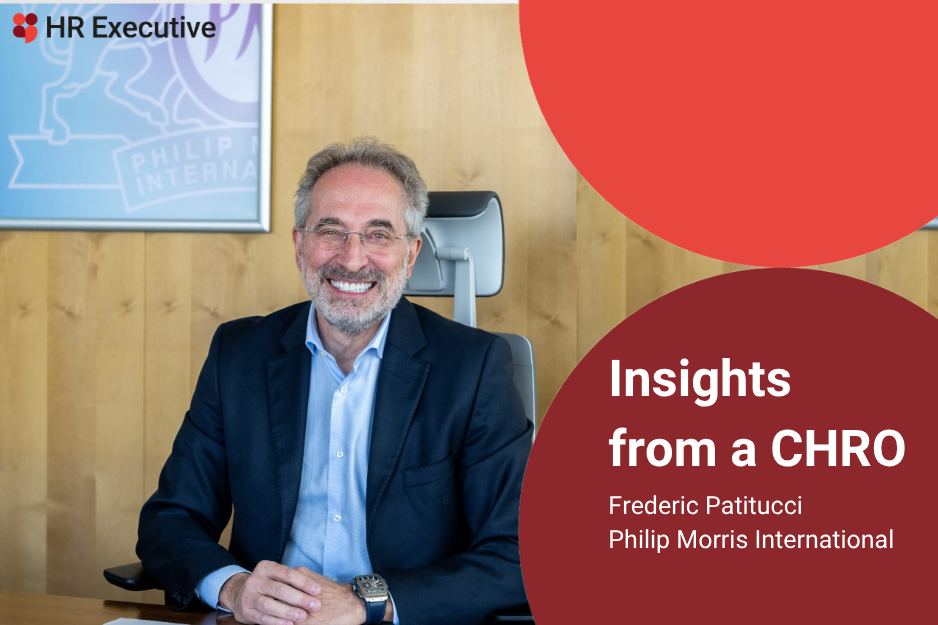
Philip Morris International is betting that culture change is the actual infrastructure for AI adoption, not a precondition to check off before the real work begins. Fredric Patitucci, PMI’s group chief people and culture officer and a 35-year company veteran, describes a three-year sequence: codify values, build a growth mindset, then introduce AI, staged as annual “roadshows” across an 80,000-plus employee base. PMI is explicitly not chasing near-term efficiency gains, prioritizing long-range workflow redesign instead, with global process owners required to take an end-to-end view across functions rather than optimizing their own vertical.
What this means for your business
The question PMI’s approach forces is whether your AI program has a sequencing logic or just a deployment calendar. Most enterprise AI rollouts land inside functions, optimizing what’s already there, because that’s where budget owners live and where ROI is easiest to demonstrate. PMI is doing something structurally different: treating cross-functional workflow redesign as the unit of analysis, which only works if employees already have the behavioral wiring to collaborate across silos. CHROs whose organizations skipped that wiring step are deploying AI into soil that won’t hold it.
Patitucci’s explicit rejection of efficiency as the primary metric is the sharpest claim in the piece, and it holds up under scrutiny. Organizations optimizing for short-cycle efficiency gains are essentially asking AI to do existing work faster inside existing structures. That’s a productivity play, not a capability play. PMI is betting that the companies building new cross-functional workflows now, even at the cost of slower near-term returns, will own structural advantages that efficiency-first competitors can’t replicate by accelerating later. The risk is that “we’re playing the long game” becomes a durable excuse for absent metrics, which is where boards should push back.
HR Executive publishes for an HR leadership audience with an obvious interest in elevating the CHRO’s strategic profile, so Patitucci’s framing of HR as the function best positioned to drive enterprise-wide AI adoption should be read with that tilt in mind. It flatters the readership’s ambitions. Even so, the underlying logic isn’t wrong: if AI adoption is primarily a behavior-change problem, then the function that owns culture, learning architecture, and change management has a genuine claim to lead it. The falsification condition is straightforward. If PMI’s workflow redesign program stalls or produces no measurable capability gains within two to three years, the “culture-first” sequencing was cover for slow execution, not strategy.
Based on reporting from How PMI is bringing together culture and AI transformation, originally published 2026-07-30 08:30:00.