
Share with your CTO
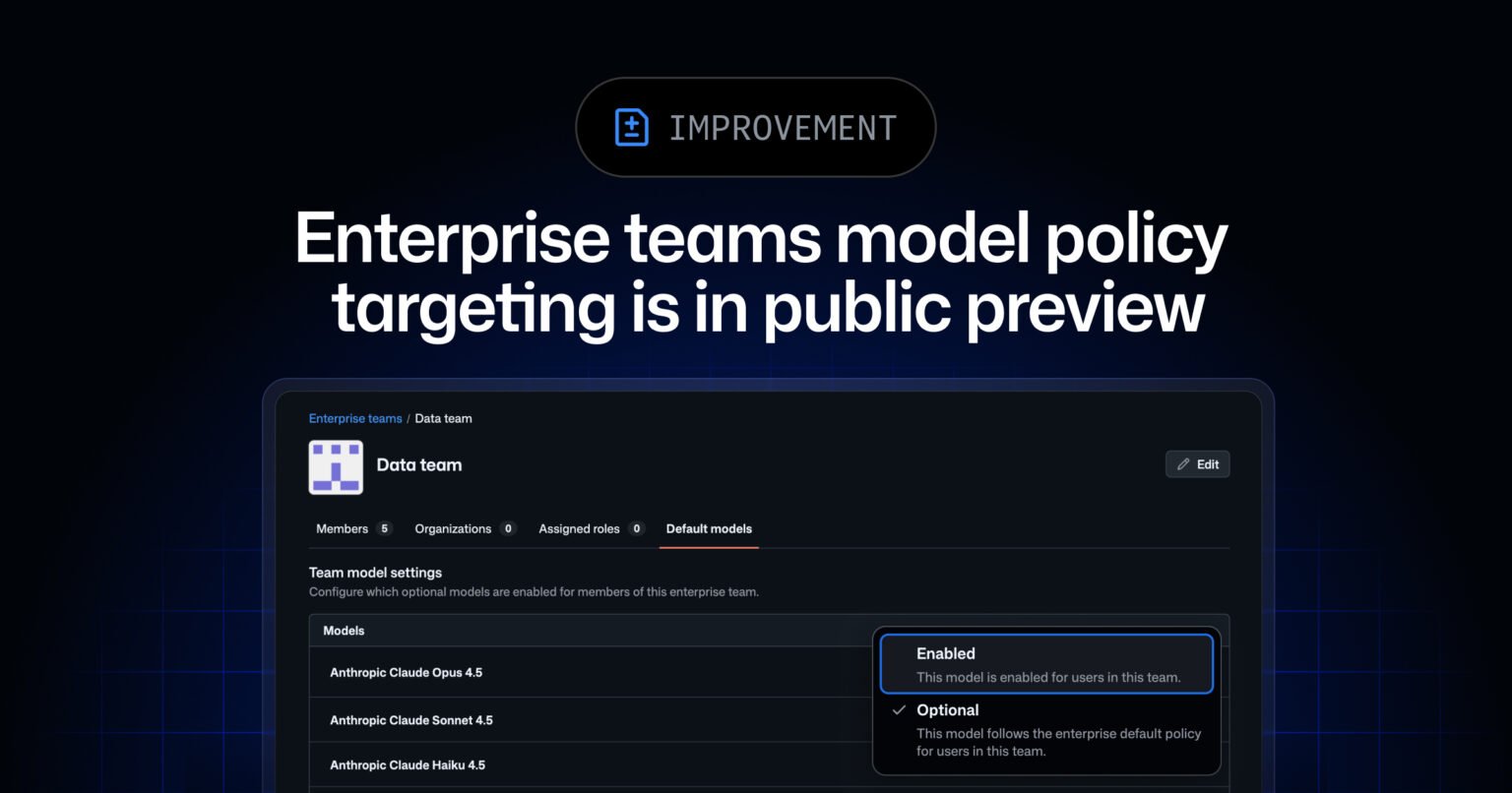
GitHub is shifting Copilot’s access control architecture from organization-level to user-level governance, and the implications run deeper than a settings toggle. The new enterprise teams model policy targeting feature, now in public preview for Copilot Business and Copilot Enterprise customers, lets AI administrators set a baseline model policy across the entire enterprise, then layer additional model access onto specific teams. A frontier engineering squad can get GPT-4o or Claude access while the rest of the org stays on a more conservative default. Most enterprise customers get preview access August 3rd.
What this means for your business
The org-level model control that GitHub has offered until now created a binary: either everyone in a business unit gets a model, or nobody does. That forced admins into a choice between locking down powerful models entirely or handing them to thousands of developers indiscriminately. Team-level targeting breaks that tradeoff. A security-cleared research team can get access to a frontier model without it cascading to contractors or junior developers who haven’t been trained on safe use patterns.
The “least-restrictive wins” evaluation logic is the detail that actually matters here. If a developer belongs to even one enterprise team that has been granted a model, that developer gets access everywhere inside Copilot. That design choice favors velocity over containment, which is reasonable during a preview but worth auditing carefully before you scale team membership. Any CTO who has watched shadow IT sprawl knows that access policies with additive inheritance tend to expand faster than anyone planned. Team membership management becomes a new governance surface the moment this goes GA.
GitHub is being explicit that this is “the first step in a broader shift toward team-level governance,” which signals that organization-level controls are heading toward deprecation over time. The question worth holding: how quickly will your current org-level policy configurations need to be rebuilt in a team-based model, and does your IAM infrastructure map cleanly enough to GitHub enterprise teams to make that migration low-friction or a significant project?
Concept deep-dive: Least-restrictive access evaluation
When a system resolves conflicting permissions, it can apply either the most restrictive or the least restrictive rule. GitHub chose least-restrictive here: a user’s model access is the union of everything any of their teams grants, not the intersection. Think of it like group discounts, where membership in any qualifying group gets you the rate. This exists to prevent team membership from accidentally blocking access a user already earned. The business implication is that controlling model access now depends heavily on controlling team membership, which is a people-ops and directory-hygiene problem as much as a security one.
Based on reporting from Enterprise teams model policy targeting in public preview, originally published 2026-07-31 14:11:00.