
Share with your CFO
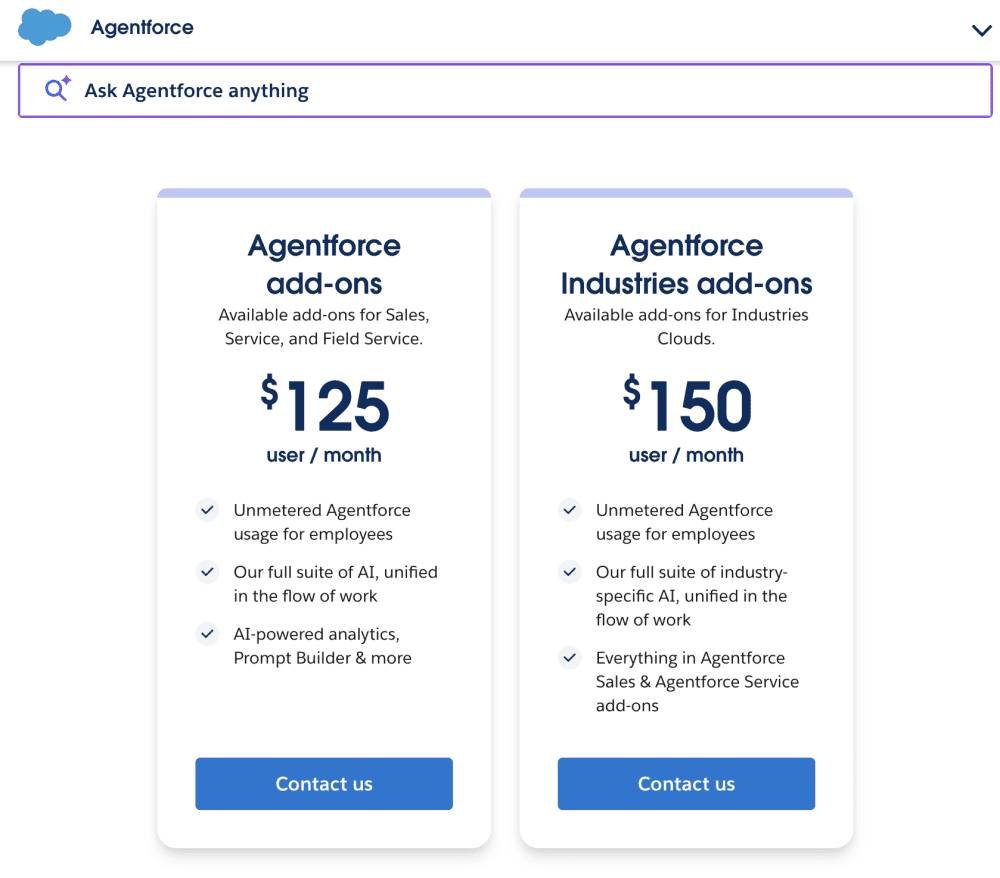
Salesforce is running three simultaneous pricing models for Agentforce, its AI agent platform: $2 per conversation (launched October 2024), Flex Credits at $0.10 per action (May 2025), and per-user licenses starting at $125 per month under the Agentic Enterprise License Agreement. The result is $540M ARR growing 330% year-over-year, with 18,500 total deals and 9,500 paying. The broader market confirms this isn’t idiosyncratic: the PricingSaaS 500 tracked 1,800 pricing changes across top B2B companies in 2025, with hybrid models surging from 27% to 41% market share.
What this means for your business
Every AI contract your organization is renewing or signing this year is being written under pricing conventions that the vendor invented in the last 18 months and may revise before the ink dries. That’s not a knock on vendor competence. It’s the actual state of the market. The CFO’s exposure here isn’t vendor instability, it’s commitment asymmetry: enterprise customers are being pushed toward multi-year Agentic Enterprise License Agreements precisely because they look like familiar seat contracts, while the underlying cost structure shifts toward consumption the moment agents start working at scale.
The seat cannibalization trap is real and already showing up in the data. Salesforce’s own sales engineers report a 10% reduction in customer service seats across 90 enterprise accounts as Agentforce handles more volume. Salesforce resolved 84% of its own internal support interactions through Agentforce without human escalation. If you’re buying an AI agent product on a per-seat model, the contract structure and the product’s success are pulling in opposite directions: the better the agent performs, the more it argues for fewer human seats and a smaller renewal. That’s the negotiating lever your procurement team should be pulling right now, not after the next renewal cycle.
Outcome-based pricing, where vendors like Sierra and Intercom charge per resolved issue rather than per user, is the model that eliminates the conflict of interest. Sierra crossed $150M ARR in roughly 21 months on that model alone. But outcome-based pricing requires a measurable definition of “success,” which is straightforward for customer support (ticket resolved, call deflected) and genuinely hard for productivity tools, decision support, or internal workflow automation. If your AI spend is concentrated in use cases where outcomes are ambiguous, credits are the least-bad proxy for value until attribution infrastructure matures. The question worth taking into your next vendor review isn’t which model you prefer, it’s whether your current contract rewards the vendor for outcomes you can measure or merely for access you’ve already paid for.
Concept deep-dive: Outcome-based pricing
Outcome-based pricing charges a vendor only when a defined result is delivered, rather than for access or activity. Think of it like a contingency fee arrangement: the vendor’s revenue is tied directly to measurable success events (a support ticket resolved without human intervention, a call deflected). It exists because AI agents can generate significant activity without producing value, making usage metrics a poor proxy for ROI. The business implication is structural alignment: the vendor’s incentive to improve the product never diverges from the buyer’s incentive to see it perform.
Based on reporting from Salesforce Now Has 3+ Pricing Models for Agentforce. And Maybe Right Now, That’s The Way to Do It., originally published 2026-02-17 08:45:00.