
Share with your CTO
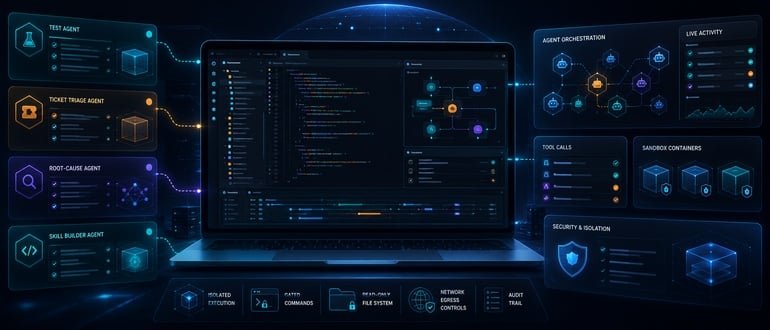
AWS is betting that agentic coding isn’t just about faster autocomplete. Kiro Crew, a new open source workspace extension for AWS’s Kiro AI coding tool, lets developers hand off asynchronous tasks to autonomous agents that coordinate via the Agent Client Protocol, preserve context across sessions, and surface their reasoning in real time. More than 500 internal AWS developers built it, and it’s already in use across thousands of AWS engineers. The security posture is notable: denied-by-default commands, credential redaction, suspicious-pattern blocking, and a signed audit log baked in from the start.
What this means for your business
The practical shift here is from AI-as-copilot to AI-as-concurrent-worker. A developer writing a new service can simultaneously have Kiro Crew triaging the ticket queue, running tests against the emerging codebase, and investigating a separate production incident. That’s not incrementally faster coding. That’s a different ratio of senior engineer attention to work output, and it changes how you staff and scope engineering projects.
The security architecture is the real differentiator worth examining. General-purpose agents like OpenAI’s Codex or Anthropic’s Claude in agentic mode operate with broad permissions and rely on prompt-level guardrails. Kiro Crew runs in an OS-level sandbox with denied-by-default commands and blocks any external agent that tries to install tooling. For enterprise engineering environments where supply-chain attacks increasingly originate in developer toolchains, that architectural choice isn’t a nice-to-have. It’s the condition under which your CISO will approve agentic coding at scale.
The deeper pattern: AWS is watching how its own developers use Kiro, extracting those workflows as reusable “AI skills,” and embedding them back into the tool. That’s a compounding loop, and whoever runs it longest on the largest developer base ends up with the most capable default agent. The signal worth watching is whether Microsoft responds with a comparable capability layer on top of GitHub Copilot, because that’s the competitive axis that will matter most to enterprises already committed to either the AWS or Azure development ecosystem.
Concept deep-dive: Agent Client Protocol (ACP)
ACP is an emerging open standard for how AI agents communicate with each other and with orchestration systems. It exists because multi-agent workflows break down when agents can’t consistently signal their state, hand off context, or report tool calls in a format the parent system can interpret. Think of it as HTTP for agent coordination: a shared grammar that lets a spawned sub-agent tell its orchestrator exactly what it’s doing and why. For enterprise CTOs, ACP matters because it’s the layer that makes agentic systems auditable and interoperable across vendors, rather than locked into proprietary orchestration stacks.
Based on reporting from AWS Adds Agentic Workspace to Kiro AI Coding Tool, originally published 2026-08-05 16:11:00.