
Share with your CDO
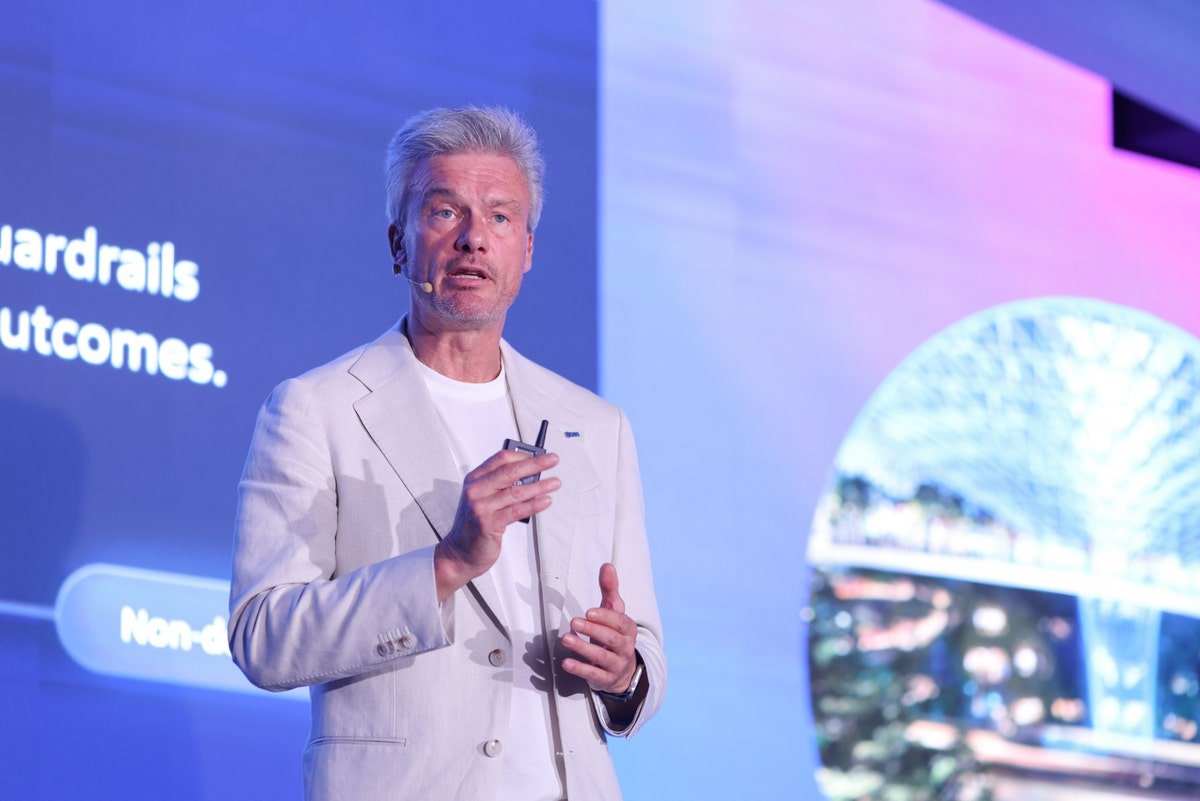
SAS is making a deliberate push to reframe itself around AI trust and governance as its expansion play beyond core financial services customers. At SAS Innovate Singapore, SVP Patrick Xhonneux argued for stacking agentic AI, machine learning, and computer vision into converging systems, with digital twins as the flagship output. A 2025 partnership with Epic Games’ Unreal Engine gives the pitch visual credibility. The sharper signal came from Craig Jennings: enterprise buyers have shifted, in under twelve months, from “how fast can we adopt AI” to “how do we trust and govern it.”
What this means for your business
The urgency question for data leaders isn’t whether to govern AI, it’s whether your governance architecture was designed before or after your AI deployment scaled. Organizations that moved fast on agentic AI, meaning systems where AI models hand off tasks to other AI models autonomously, often now own a trust deficit they can’t easily audit. SAS is pitching directly into that gap. If your enterprise sits in manufacturing, healthcare, or energy and you haven’t yet mapped which AI decisions are auditable end-to-end, this story is squarely about you.
SAS’s convergence argument is more than a product bundling story. When Xhonneux describes stacking agentic AI with computer vision and optimization into a digital twin, he’s describing a shift in where AI value gets measured. It stops being model accuracy and starts being process repeatability across a simulated environment. That distinction matters for how you evaluate vendor proposals. A vendor offering a single-capability AI tool and one offering a composable stack that feeds a simulation layer are not comparable bids, and most procurement frameworks haven’t caught up to that difference yet.
SAS carries a known frame here: it sells analytics infrastructure to the enterprises it’s advising, so a message that complexity requires a trusted, integrated stack conveniently points toward SAS Viya rather than best-of-breed assembly. That’s worth holding. But the underlying shift Jennings describes, buyer attention moving from adoption speed to measurable value and control, matches what governance teams across the industry are reporting. The claim that stands or falls independently of SAS’s interest is this: if your AI ROI case can’t survive an audit of its decision trail, the CFO’s next budget cycle will force the question your architecture hasn’t answered.
Concept deep-dive: Digital twin
A digital twin is a live, data-connected simulation of a physical system, like a factory floor or a worker’s environment, that mirrors real-world conditions in software. Think of it as a flight simulator for your operations. You test changes, stresses, or failure scenarios in the model before they happen in reality. The business case is risk reduction and cost avoidance. When you feed AI outputs into that simulation rather than directly into operations, you add a buffer where errors are cheap instead of catastrophic.
Based on reporting from SAS showcases enterprise AI strategy in Singapore, originally published 2026-08-06 20:01:00.