
Salesforce’s Ambient Intelligence Play: Real Enterprise Discipline or Rebranded Demo Theater?
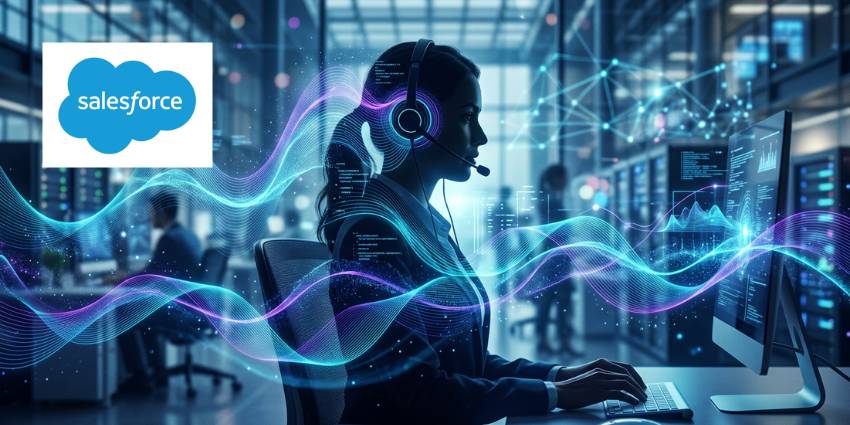
Salesforce held a research roundtable this week to formally position “ambient intelligence” as the next chapter of its enterprise AI story. The pitch: AI that listens, interprets, and acts during live sales calls and service interactions — not as a bolt-on feature, but as a workflow-native layer embedded inside Agentforce. Paired with that vision were concrete enterprise customer proof points from Uber, Southwest Airlines, and Adecco, and a pointed argument from Chief Scientist Silvio Savarese that enterprise AI is fundamentally a systems problem, not a model problem. That last claim deserves far more attention than the demo reel.
- Salesforce’s Ambient Intelligence Play: Real Enterprise Discipline or Rebranded Demo Theater?
- Why “Ambient Intelligence” Is a Strategic Label Worth Parsing
- The Demo That Actually Matters: What Ambient Listening Changes for CX and Revenue Teams
- The Proof Points: Impressive Numbers That Need Context
- The Governance Gap Is the Real Competitive Differentiator
- What Salesforce Is Actually Betting On
- The Bottom Line for Enterprise Leaders
Why “Ambient Intelligence” Is a Strategic Label Worth Parsing
Every enterprise software vendor eventually reaches for a new vocabulary word when a product category gets crowded. “Ambient intelligence” risks that fate. But beneath the branding is a genuinely important architectural bet: that the next competitive moat in enterprise AI is not the quality of the underlying model — which is increasingly commoditized — but the quality of the orchestration, memory, evaluation, and control layers sitting above it.
Savarese’s framing — “enterprise AI is not just about having a strong model, it’s about building a system you can trust in real workflows” — is the most strategically honest thing Salesforce said at the roundtable. It is also a direct acknowledgment that the company is not competing with OpenAI or Anthropic at the foundation model layer. It is competing with ServiceNow, Microsoft Copilot, and a rapidly maturing field of vertical AI point solutions on the integration and governance layer. That is the right fight to pick if you are Salesforce. The question is whether the product currently matches the positioning.
The Demo That Actually Matters: What Ambient Listening Changes for CX and Revenue Teams
The live sales scenario Salesforce demonstrated — an in-call assistant that extracts customer intent, surfaces next best actions, and reduces manual note-taking in real time — is not a novel concept. Gong and Chorus built entire companies on conversation intelligence. What Salesforce is adding is the CRM closed loop. If the ambient layer is natively integrated with the customer record, pipeline data, and service history, the value proposition shifts from insight generation to automated action. That is a meaningful step up in ambition.
For CIOs and CTOs, the architectural implication is significant. An AI system that listens during live conversations, summarizes outcomes, and triggers follow-up workflows is not a productivity tool — it is a data capture and process automation system operating at the speed of conversation. The infrastructure requirements, latency tolerances, and compliance obligations that come with that are categorically different from a post-call summarization tool. Enterprises evaluating this need to pressure-test Salesforce’s claims about what the system stores, how long it retains it, and what governance controls exist before a single call is processed.
The Proof Points: Impressive Numbers That Need Context
Salesforce leaned heavily on three customer outcomes to ground the ambient intelligence narrative in commercial reality. Uber scaling its ad business to $1 billion in revenue with a 70% faster sales process via Salesforce Media Cloud is a striking number, but it conflates platform capability with business outcome in a way that should make any analytically rigorous CFO or CRO pause. Faster sales process is a meaningful metric; attributing $1 billion in revenue directly to a CRM platform requires significantly more unpacking.
Southwest Airlines is the more instructive case. Twenty percent call deflection and up to 50% containment from an Agentforce FAQ agent deployed on self-help portals — and reaching the status of Salesforce’s highest-volume Agentforce customer globally within 90 days — is operationally verifiable and commercially meaningful. For a high-volume service operation, deflection and containment rates at that scale translate directly to cost reduction. That is the kind of proof point that moves a CISO or COO from pilot approval to enterprise rollout conversation.
Adecco’s use of Agentforce to personalize job seeker engagement and reduce time-to-hire is the most nascent of the three examples but arguably the most strategically interesting for CHROs. Recruiting is a workflow with high volume, high repetition, and deeply inconsistent human execution — precisely the conditions where ambient AI guidance and automated follow-up create compounding returns.
The Governance Gap Is the Real Competitive Differentiator
Here is the position worth taking clearly: the enterprise AI vendor that wins the next three to five years will not be the one with the most capable ambient listening technology. It will be the one that makes governance, observability, and control a first-class product feature rather than a compliance checkbox bolted on after the fact.
Real-time AI operating inside live customer conversations creates a compliance surface that most enterprise legal and security teams are not yet equipped to fully map. Consent frameworks vary by jurisdiction. Call recording laws differ across U.S. states, the EU, and APAC markets. Automated action triggered by AI inference — say, a next best action that commits a rep to a pricing term — creates liability questions that procurement and legal will escalate immediately. Salesforce acknowledged this directly, positioning its Agentforce controls and visibility improvements as essential for moving from pilots to scaled deployment in regulated environments. The acknowledgment is correct. The execution will determine whether the positioning holds.
For CISOs evaluating Agentforce ambient features specifically, the due diligence checklist should include: data residency controls for conversation transcripts, retention and deletion policy enforcement, model explainability for automated actions triggered mid-call, audit log completeness, and role-based access controls for who can review AI-generated call summaries. These are not exotic requirements. They are table stakes for any regulated industry deployment.
What Salesforce Is Actually Betting On
Salesforce’s strategic logic here is coherent and worth crediting. The company is not trying to out-model the frontier labs. It is trying to make AI feel inevitable inside the workflows where its installed base already lives — sales calls, service cases, recruiting pipelines, ad operations. Ambient intelligence is the product metaphor for that bet: AI that is present without being intrusive, useful without requiring explicit prompting, and trustworthy because it operates within enterprise-defined boundaries.
That is a defensible position if the controls layer is genuinely mature. It is a liability if the controls layer is marketing language that dissolves under enterprise security review. The Southwest and Adecco deployments suggest the product is past pure demo stage. The real test will be whether Salesforce can sustain those adoption curves in heavily regulated verticals — financial services, healthcare, government — where the compliance requirements are not optional and the tolerance for AI error is structurally lower.
The Bottom Line for Enterprise Leaders
Ambient intelligence as a concept deserves serious evaluation, not reflexive skepticism. The productivity case for workflow-native AI in live selling and service interactions is real. Shorter handle times, cleaner CRM data, consistent rep guidance, and automated follow-up are all measurable outcomes that justify investment analysis. The governance case deserves equal rigor. Any enterprise deploying real-time conversational AI needs a compliance framework that precedes the technology deployment, not one assembled reactively after the first legal inquiry.
Salesforce is making the right architectural argument — systems over models, controls over capabilities, trust over features. Whether the product currently delivers on that argument at enterprise scale, across regulated industries and global compliance environments, is the question every CIO, CISO, and COO should be asking in the evaluation process. The proof points suggest momentum. They do not yet constitute proof.
Based on reporting from Salesforce Ambient Intelligence: Agentforce Gets Enterprise Controls, originally published 2026-03-26 03:00:00.