
Share with your CISO
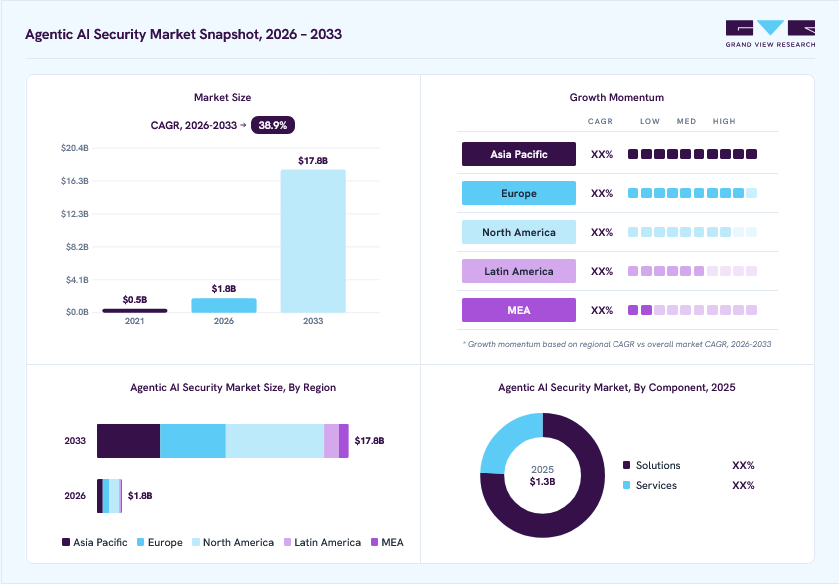
The agentic AI security market is on track to grow from $1.3 billion in 2025 to $17.8 billion by 2033, a 38.9% compound annual rate that reflects how fast enterprises are deploying autonomous AI agents, and how unprepared most security stacks are for them. Solutions (software platforms) hold 75.5% of current spend. Cloud delivery commands 57.5% of deployments. Large enterprises dominate today, but the SME segment is closing fast. North America leads with 39.3% of global revenue; Asia Pacific grows fastest. Vendors moving quickest include Palo Alto Networks, CrowdStrike, Cisco, and Zscaler.
What this means for your business
The security problem here is structural, not incremental. Traditional security tools were built around human users and fixed application boundaries. An AI agent, by contrast, can hold its own credentials, call external APIs, write to databases, and chain decisions across dozens of systems, all without a human approving each step. Every one of those capabilities is a new attack surface that legacy identity and access management systems were never designed to see, let alone control. Organizations already running agents in production are, right now, operating with identity and runtime gaps that their existing tools cannot close.
The market data points to a consolidation dynamic that will force vendor choices sooner than most security roadmaps anticipate. Palo Alto’s acquisition of Protect AI, CrowdStrike’s AgentWorks ecosystem launch at RSA 2026, and Cisco’s zero-trust extensions for AI agents all signal that the major platforms are racing to make agent security a bundled capability rather than a standalone purchase. That race tends to compress the window in which a specialized point solution can win a competitive evaluation. CISOs who are mid-contract with a niche AI security vendor should pressure-test whether that vendor’s differentiation survives eighteen months of platform bundling by the incumbents, because historically it doesn’t.
Grand View Research, whose business model depends on selling advisory services to the vendors it ranks, has an incentive to project aggressive CAGRs, and 38.9% sustained over seven years is a number that should be read as directionally correct rather than literally precise. But the underlying driver is real and not analyst-manufactured. Prompt injection, autonomous privilege escalation, and unaudited agent actions are confirmed attack vectors, not theoretical risks, and the EU AI Act is already forcing documentation and accountability requirements that most enterprises cannot currently meet for their agent deployments. The question for the CISO is not whether to budget for this category but whether the current security architecture can even enumerate what agents are running, what they can access, and what they did last Tuesday. If the answer is no, the governance gap is already a compliance liability, and the 2026 procurement cycle is the decision point that matters, not 2033.
Concept deep-dive: Agent identity
Agent identity refers to the credentials, permissions, and behavioral fingerprint assigned to an autonomous AI system, distinct from any human user. Think of it as a service account that can reason, plan, and act. Because agents can spawn sub-agents, call tools, and persist across sessions, a single compromised agent identity can propagate access far beyond what a stolen human password would reach. Managing these non-human identities, scoping their permissions tightly, and logging their actions is the core discipline the agentic AI security market is being built to deliver.
Based on reporting from Agentic AI Security Market Size & Share Report, 2026-2033, originally published 2026-08-06 08:51:00.