
Share with your CIO
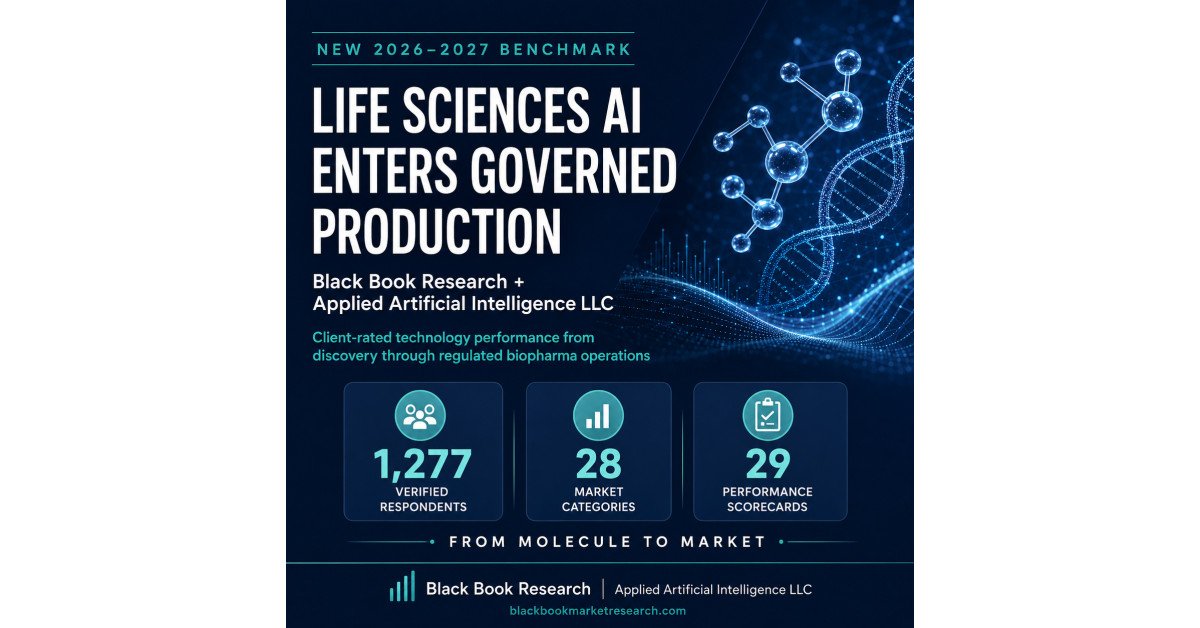
Black Book Research’s 2026-2027 Life Sciences AI Technology Performance Benchmark draws on 1,277 verified buyers and scores 254 vendors across 28 categories, spanning drug discovery through commercial manufacturing. The central finding: life sciences organizations are done piloting and now expect AI to run inside validated, audit-ready workflows with full data lineage. Vendors that can’t demonstrate GxP validation, model-change control, and explainable outputs are losing ground to those that can, regardless of raw model performance.
What this means for your business
If your organization still measures AI progress by the number of proofs of concept running, this report signals you’re behind the curve on how procurement conversations in regulated industries have shifted. The buyers driving this benchmark aren’t asking “does the model work?” They’re asking “can we trace every output, control every model update, and defend every decision to a regulator?” That’s a fundamentally different selection filter, and it rewards platform discipline over algorithmic cleverness. Organizations that built their AI stacks around model novelty now face a consolidation pressure they didn’t anticipate.
The governance layer is becoming the moat. Five investment clusters are pulling budget: evidence generation, clinical operations, AI-ready data foundations, regulated manufacturing, and enterprise AI governance itself. That last category showing up as a distinct purchasing market, not a feature on a checklist, is the tell. When buyers fund governance as its own line item, they’re signaling that the integration tax of stitching together ungoverned point solutions has become too expensive to ignore. The vendors winning here, Veeva in quality and commercial, Medidata in clinical development, Siemens across manufacturing, are winning on workflow integration and audit readiness, not model benchmarks.
The agentic AI signal buried in this report deserves more attention than it gets. The finding that agentic systems, where AI takes sequences of actions rather than answering single queries, are advancing only through bounded, reversible, human-approved workflows in regulated settings isn’t a temporary caution. It’s the durable constraint. Any CIO evaluating agentic platforms for drug development or manufacturing should treat “fully autonomous” as a disqualifying claim rather than a selling point. The vendors worth watching are the ones building approval gates and reconstructable audit trails into the agent architecture from the start, not bolting them on after a compliance scare.
Concept deep-dive: GxP validation
GxP is shorthand for a family of regulatory standards, Good Manufacturing Practice, Good Clinical Practice, Good Laboratory Practice, that govern how pharmaceutical products are made, tested, and documented. Think of it as the quality assurance operating system for anything that eventually goes into a patient. When applied to AI, GxP validation means the software itself must be qualified, its outputs traceable, and any model change formally controlled. It’s why “it works in the demo” is never sufficient for a regulated production deployment.
Based on reporting from From Molecule to Market: Life Sciences AI Enters Governed Production, originally published 2026-08-10 09:00:00.