


Share with your CTO
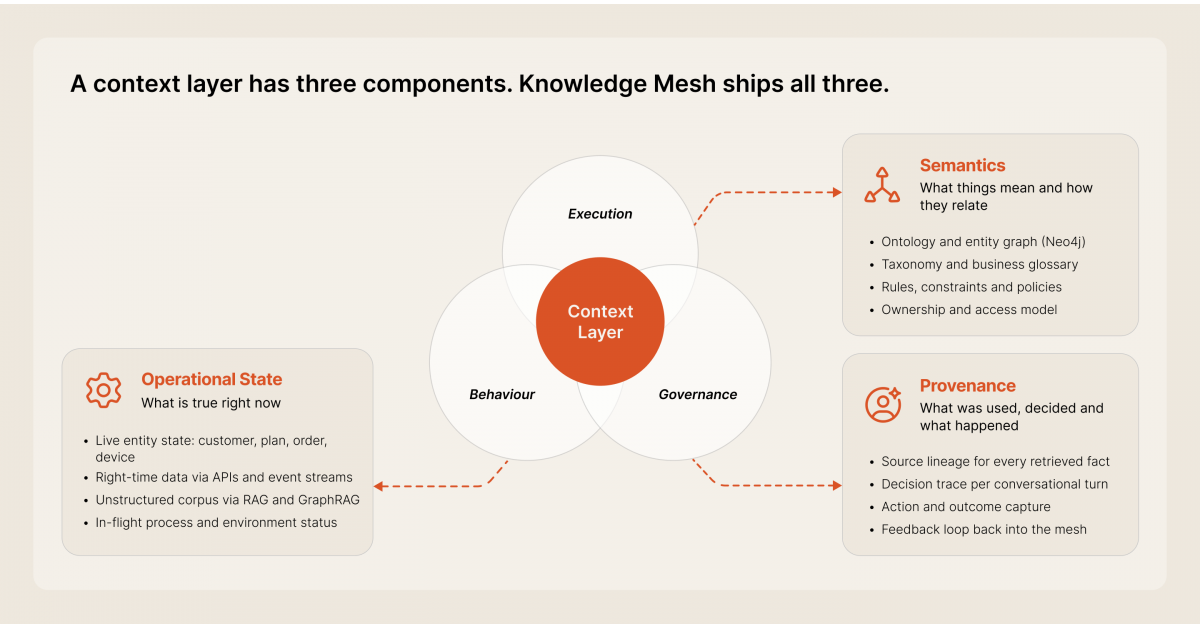
Voicing AI is betting that the enterprise AI deployment crisis is fundamentally an architecture problem, not a model problem, and it has launched Knowledge Mesh to prove it. The product is a governed context layer that resolves semantics, permissions, and data provenance at index time rather than at inference time, cutting the token burn that makes agentic AI unit economics collapse at scale. It is in production in financial services and telecom, reachable over the Model Context Protocol, and sized against a market analysts put at $28 billion today growing to $78 billion by 2030.
What this means for your business
The cleanest diagnostic for whether this story is yours is whether your AI pilots have passed month six. The recurring failure mode looks like a model problem but traces back to retrieval architecture: costs that seemed acceptable at one use case become unsustainable at five, because every agent is re-deriving relationships, re-checking permissions, and re-figuring out which retrieved fragments actually cohere, all at inference time, on every single request. Gartner’s prediction that 40% of agentic AI projects will be cancelled by 2027 is not a warning about bad models. It is a warning about bad plumbing.
The architectural claim Voicing AI is making is precise enough to test and worth taking seriously. Resolving entity relationships, access permissions, and document validity at index time, before a question ever arrives, converts what would otherwise be a runtime reasoning exercise into a constrained lookup. That is not just cheaper; it is also more accurate, because the agent is no longer synthesizing across ambiguous or contradictory fragments. Gartner puts numbers on the combined payoff: up to 80% accuracy improvement and up to 60% cost reduction for organizations that prioritize semantic organization in their AI-ready data. The accuracy and cost gains share a root cause, which is why optimizing one without the other is architecturally incoherent.
The compatibility observation buried near the end of the announcement is the sharpest thing in it. A context layer only delivers value to agents that can actually draw on it, and most off-the-shelf vendor agents are not architected for external context integration. Enterprises that build excellent retrieval infrastructure and then run closed vendor agents on top of it will get almost none of the benefit. That is a vendor selection criterion that most procurement processes are not currently evaluating. The question worth asking before any contact center or agentic platform renewal is not whether the vendor supports RAG (retrieval-augmented generation, where the model pulls relevant documents rather than relying on training data alone), but whether it exposes enough of its retrieval and permission model to connect to governed external context at all.
Voicing AI’s self-interested framing here, a vendor that built both the agent and the context layer arguing that native integration beats bolt-on, is a real tilt in the argument, but the underlying logic survives it. If the agent and the context layer share one retrieval engine and one permission model, the consistency guarantees are structural rather than operational. The falsification condition is straightforward: if enterprises running heterogeneous agent stacks on top of MCP-connected context layers report equivalent accuracy and cost outcomes to native integrations, the native-beats-bolt-on claim collapses. Until that data exists, the architectural argument holds.
Concept deep-dive: Index-time resolution
Index-time resolution means doing the expensive interpretive work when content first enters a system, rather than when a question arrives. Think of it as the difference between a library that catalogs, cross-references, and stamps an expiration date on every book as it arrives versus one that hands a patron the whole stacks and asks them to figure out what’s current and relevant on the spot. For AI agents, resolving entity relationships, permissions, and document validity in advance shrinks every live request from a reasoning problem to a filtered lookup, which is both faster and harder to get wrong.
Based on reporting from Voicing AI Launches Knowledge Mesh, a Context Layer for Enterprise AI Agents., originally published 2026-09-07 12:45:00.