

Share with your CHRO
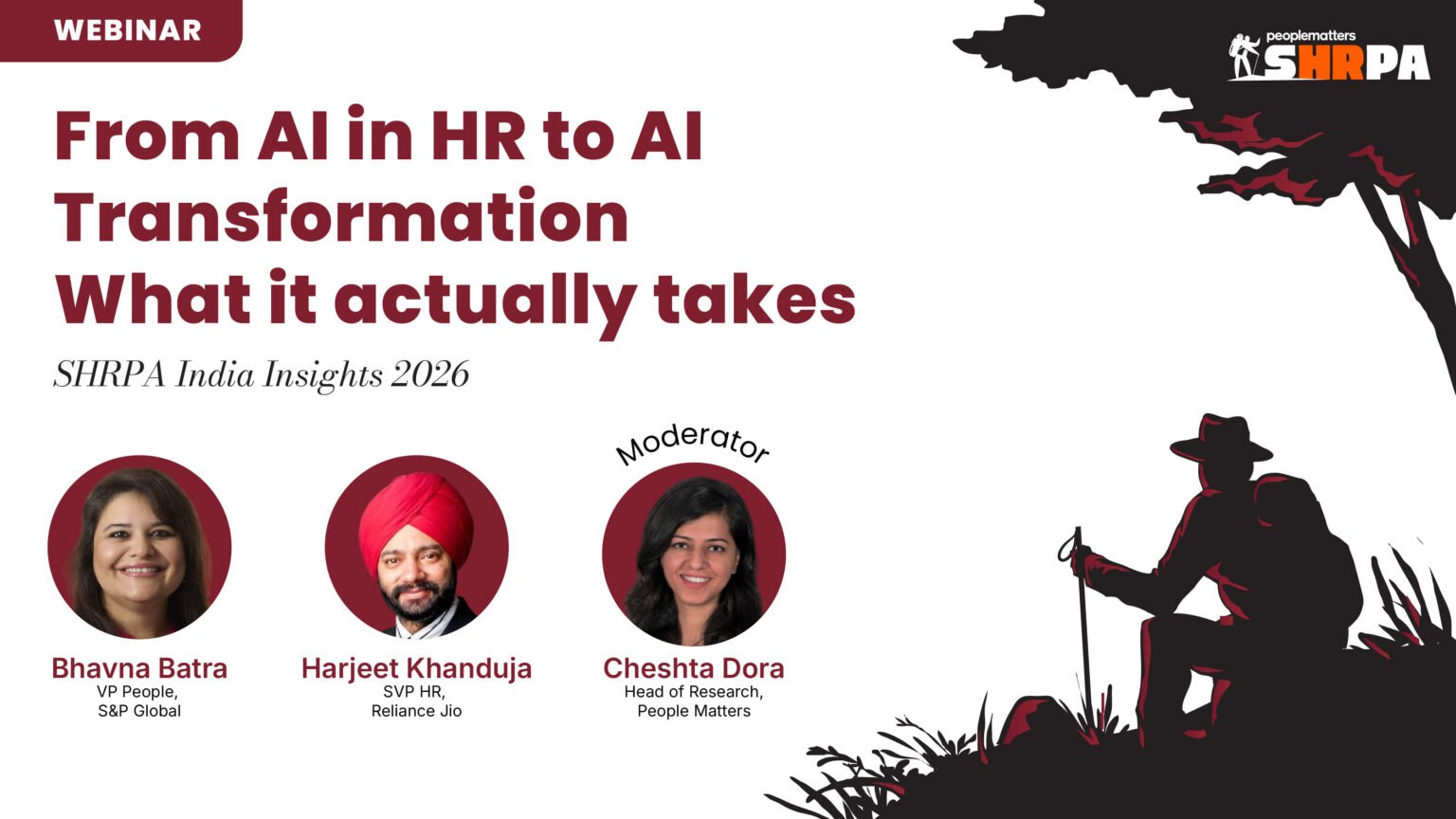
Indian enterprises are stalling at the pilot stage of AI adoption, and the gap between ambition and execution is measurable. SHRPA 2026 India research finds 46% of organisations are still running disconnected pilots without enterprise-scale deployment, while only 22% have reached genuine AI maturity. At a People Matters webinar, HR leaders from S&P Global and Reliance Jio pointed to fragmented tooling, weak data foundations, and short-termism in ROI measurement as the compounding reasons most AI programmes in HR never graduate beyond the experiment phase.
What this means for your business
The 46-to-22 split is a credibility problem as much as a capability one. If your AI programme is built around metrics that can be explained in a quarterly review, it is almost certainly optimised for the wrong horizon. CHROs whose AI investment cases live or die on near-term, easily quantifiable wins are not making a conservative bet; they are making a structurally different bet than the 22% who are scaling, and the gap between those two positions is widening with every pilot cycle that doesn’t convert.
The integrated-ecosystem argument from the webinar panellists deserves more weight than it typically gets in HR tech procurement conversations. The recurring failure mode in enterprise HR AI looks like this: a team buys a pointed solution for recruiting, another for performance, another for learning, and then discovers the AI outputs are only as good as the data flowing between systems that were never designed to talk to each other. Clean, interoperable data is not a prerequisite that gets handled once; it is ongoing infrastructure work that has to be owned, budgeted, and governed continuously. People Matters, whose business depends on HR leaders continuing to invest in this category, has an obvious interest in framing AI maturity as achievable, but the data architecture argument holds regardless of the framing, because the failure cases are well-documented across global enterprises, not just Indian ones.
The harder call for CHROs right now is whether their organisation’s AI training programmes are role-specific or merely widespread. Blanket AI literacy programmes produce compliance numbers that look good in a board deck and produce almost no change in how work actually gets done. The enterprises pulling away from the 46% majority are building AI readiness around specific job contexts, training both the workforce on usage and the AI systems on organisational data. That dual-direction training model, employees learning the tool while the tool learns the organisation, is the design choice that separates pilots from platforms. If your current programme can’t name which roles are being trained on which AI tasks, that budget renewal deserves harder scrutiny than it’s probably getting.
Based on reporting from From AI in HR to Enterprise AI maturity: SHRPA 2026 India Insights Webinar, originally published 2026-09-15 09:22:00.