

Share with your CRO
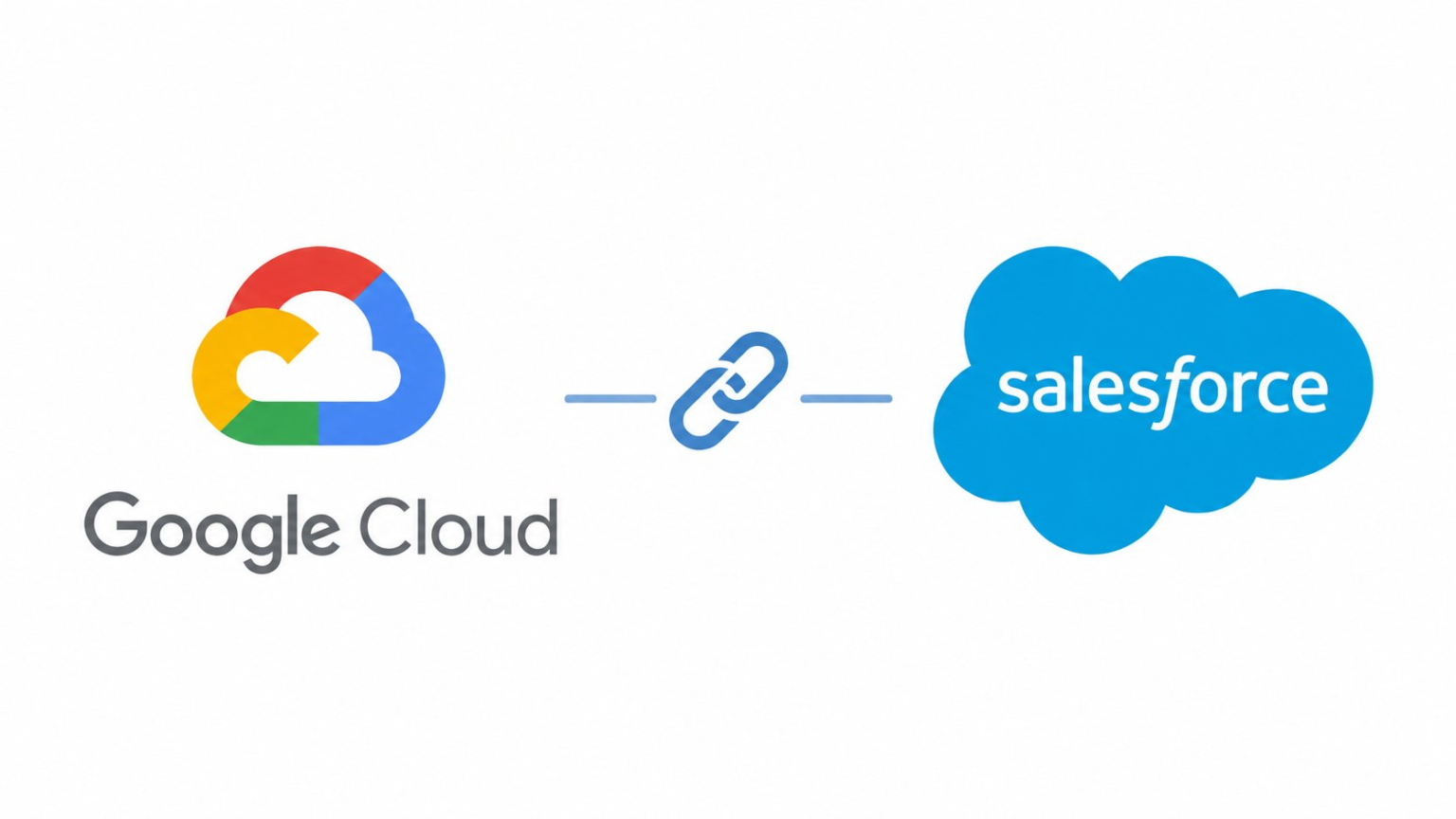
Google Cloud and Salesforce are betting that tighter native infrastructure ties will make their joint customers less likely to stray. Announced at Dreamforce 2026, the expanded partnership runs Salesforce’s Hyperforce storage layer on Google Cloud production infrastructure today, lets Agentforce users call Gemini models directly, and pipes Tableau analytics into Gemini Enterprise for conversational CRM data queries. A handful of integrations, including the Agentforce Reasoning Engine with Gemini, are already generally available. The rest arrive in waves through 2027. Details on the Google Cloud and Salesforce expansion are sparse on customer names and benchmarks.
What this means for your business
The companies most immediately affected are those already paying for both Salesforce and Google Cloud, and the question isn’t whether to adopt this stack but how much of their current integration debt it actually retires. The article is careful to note that agent configuration, governance policies, and workflow design still fall on enterprise IT teams, which means the value proposition is “less custom glue code,” not “no glue code.” Revenue leaders who sold internal stakeholders on Agentforce or Gemini Enterprise individually now have a cleaner consolidation argument, but they should not walk into renewal conversations claiming the integration work is behind them.
The Tableau-in-Gemini Enterprise piece deserves more attention than it’s getting. Context switching, the productivity tax of jumping between a conversational AI tool and a BI platform to answer the same business question, is a real friction cost for commercial and sales ops teams. If a revenue analyst can ask a Gemini chat interface about pipeline health and get a Tableau-backed answer without opening a second tab, that’s a workflow compression that’s easy to undervalue in a press announcement and easy to overvalue in a demo. The deciding factor is data freshness and permission fidelity: whether the Gemini interface reflects the same row-level security and real-time sync that Tableau Cloud enforces natively.
The deeper play here is platform lock-in dressed as interoperability. Both companies are defending against the scenario where an enterprise decides one strong ecosystem, Microsoft’s or AWS’s, is simpler than two. Every native connection they add raises the switching cost for joint customers and shrinks the attack surface for competitors. For CROs negotiating enterprise software renewals in the next 12 months, the right lens isn’t “is this integration good” but “does this make our total Salesforce and Google Cloud spend harder to unwind, and do I want it to be.”
Concept deep-dive: Hyperforce
Hyperforce is Salesforce’s architecture for running its platform on public cloud infrastructure rather than Salesforce’s own proprietary data centers. Think of it as Salesforce agreeing to be a tenant in someone else’s building instead of owning the property. The business reason it matters: enterprises can store CRM data in a specific cloud region, satisfying data residency regulations, while building adjacent services on the same infrastructure, which eliminates a class of cross-cloud latency and compliance overhead.
Based on reporting from Google Cloud, Salesforce Tie Gemini Enterprise to Agentforce and CRM Data, originally published 2026-09-17 13:55:00.