

Share with your CISO
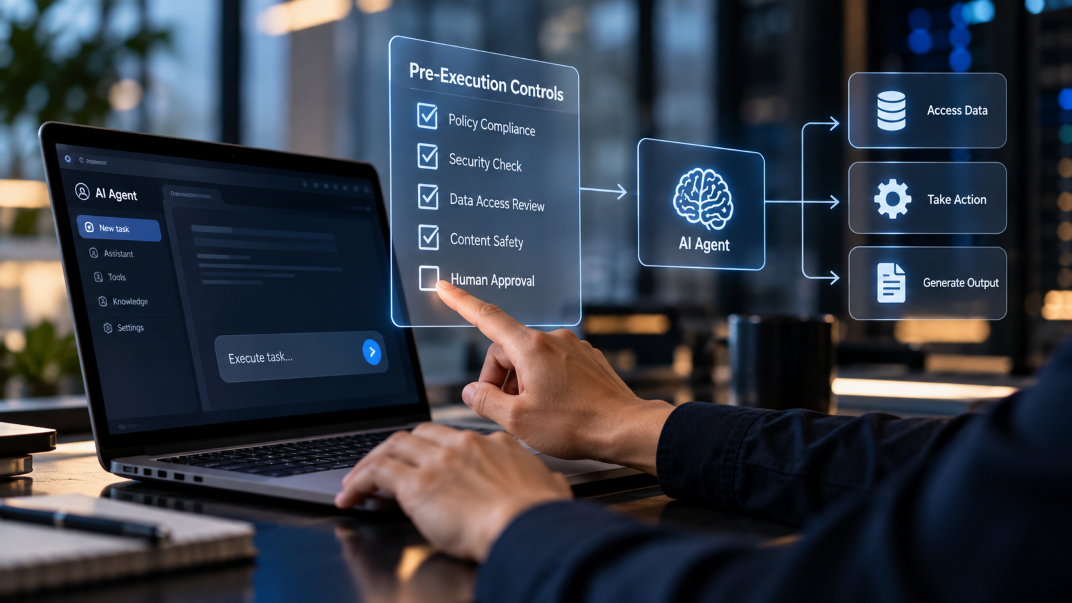
Enterprise AI governance is shifting from policy documents and after-the-fact monitoring to a new control layer sitting directly at the moment an agent is about to act. The core problem is structural: agentic AI systems can now delete records, trigger payments, call APIs, and spawn other agents, and neither a compliance policy nor an observability dashboard stops a bad action before it lands. Pre-execution governance is the emerging answer, with Broadcom, Drata, and Citrix each approaching the same control boundary from different directions.
What this means for your business
The question worth asking right now is whether your organization’s current AI controls are designed for systems that produce text or for systems that take actions. Most enterprise security programs were built around the former, and that distinction is no longer academic. If your agents can write to a database, invoke a payment workflow, or call an external API, then governance that fires after execution is governance that arrives too late. Organizations with broad agentic deployments are the most exposed; those still running AI as a read-only research layer have more runway.
The four capabilities the article identifies, deterministic tool-call decisions, risk-based human escalation, connected enforcement and audit evidence, and cross-platform policy durability, are a useful self-assessment frame. Most security teams can probably check one or two of those boxes today. The gap tends to be the third one: organizations can log that an agent acted, but they can’t reconstruct why the action was permitted, which policy governed it, or who approved an exception. That reconstruction gap is exactly what auditors under the EU AI Act will probe, and it’s the hardest thing to retrofit after the fact.
The article is written by a publication whose advertising base skews toward security vendors, which pushes the argument toward urgency and away from the legitimate counterpoint that most agentic deployments aren’t yet sophisticated enough to need a dedicated pre-execution control plane. That’s fair skepticism to hold. But the underlying architecture claim is correct regardless of the commercial motive: Model Context Protocol, which gives AI agents a standardized handshake to reach external tools and data, has genuinely collapsed the boundary between an AI output and an enterprise system action. When that boundary collapses, the window for human review collapses with it, and the only place to put a control is before the call goes out. The vendor that earns the pre-execution layer earns something close to a chokepoint on every agentic workflow in the enterprise, which is why identity, GRC, and API security vendors are all building toward it simultaneously. The CISO whose budget renewal is six months out should be asking vendors, right now, whether their roadmap includes enforcement at the tool-call boundary, not just logging after it.
Concept deep-dive: Model Context Protocol (MCP)
MCP is an open standard that gives AI agents a consistent way to discover and call external tools, databases, and services, roughly analogous to USB for hardware peripherals: one interface, many devices. Before MCP, connecting an agent to an enterprise system required custom plumbing for every integration. MCP standardizes that handshake, which accelerates interoperability but also means a single policy gap can expose every connected system simultaneously. Governance built around one model or one application stack doesn’t survive it.
Based on reporting from Why AI Governance Is Moving to the Moment Before Execution, originally published 2026-09-26 12:32:00.