
Share with your CTO
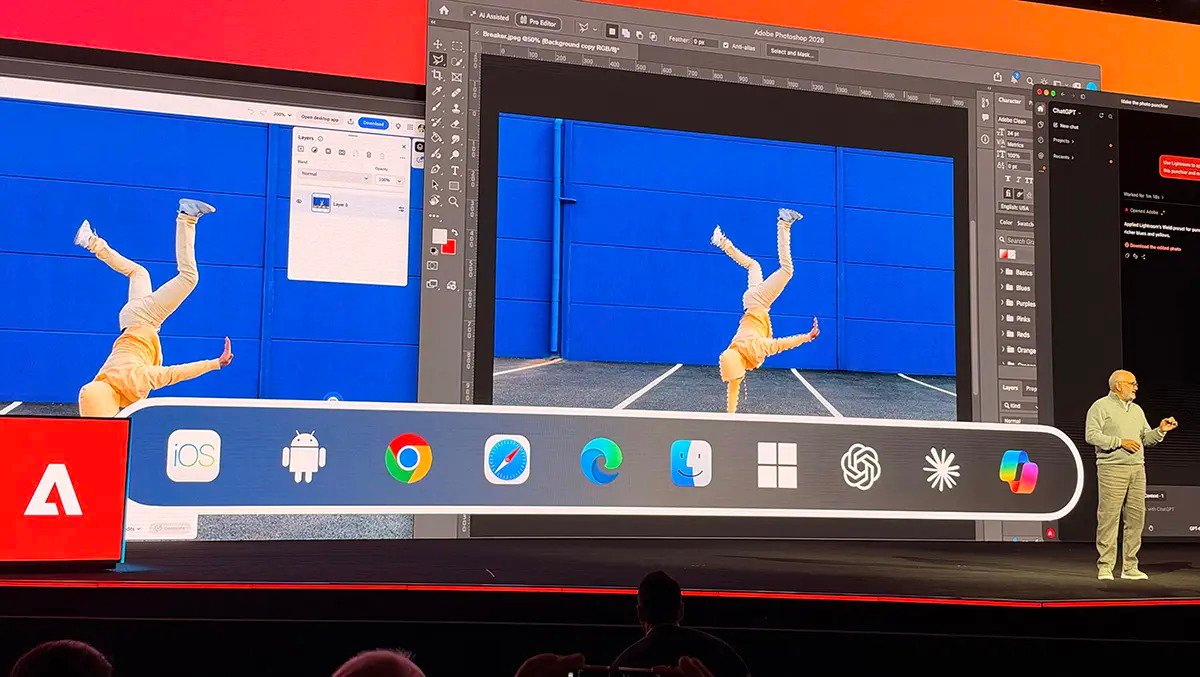
Adobe is betting that openness beats lock-in. CTO Ely Greenfield confirmed that MCP integrations for Photoshop, Illustrator, Premiere, and After Effects will let external agents like ChatGPT, Gemini, and Claude edit native project files directly on customer machines, with a private beta targeted for early 2027. The logic is explicit: if users are routing third-party agents through Adobe’s MCP endpoints, they still need Adobe’s tools installed, so Adobe keeps the customer relationship even as the workflow moves elsewhere.
What this means for your business
Creative tooling is about to split into two distinct layers, the application and the interface, and Adobe is consciously choosing not to own the second one. That’s the meaningful signal here. Organizations running large creative operations, in-house agencies, brand teams, content factories, need to decide whether their current Adobe contracts price in a world where half the actual work gets orchestrated by an agent that Adobe didn’t build and doesn’t control. If your creative stack is Adobe-heavy, you’re not insulated from this shift; you’re the target audience for it.
The hardest part of Greenfield’s argument isn’t the MCP plumbing, it’s the creative judgment problem he names directly. An agent that can open a Photoshop file and move layers around is relatively straightforward engineering. An agent that can evaluate whether the output actually serves a brand campaign, the feedback loop that separates a true agent from a fancy macro, is a much higher bar. Greenfield admits most humans aren’t good at that evaluation task. The practical implication is that early agentic creative workflows will still need a human in the loop for quality judgment, which means the productivity gains will be real but narrower than the demos suggest, at least through 2027.
Adobe’s actual competitive moat in this architecture isn’t the application features, it’s the context layer Greenfield describes: accumulated knowledge of a customer’s brand guidelines, creative style, and campaign history. That’s the data that makes an agent trustworthy enough to hand off decisions to. Whoever owns that context layer owns the relationship. If your organization lets that data sit inside a general-purpose agent like Gemini rather than inside Adobe’s context store, you’re effectively training a competitor’s model on your brand. That’s the renewal conversation worth having before early 2027, not after.
Concept deep-dive: Model Context Protocol (MCP)
MCP is an open standard that lets AI agents communicate with external software tools using a consistent set of connection points, think of it as a universal adapter that lets a ChatGPT or Claude session reach into Photoshop and issue commands, rather than just generating text about what someone should do manually. It matters for enterprise buyers because it determines which applications an AI agent can actually control, and on whose terms those connections are made and audited.
Based on reporting from Adobe CTO on plans for AI agents to access Adobe tools, originally published 2026-11-12 16:30:00.