
Share with your CFO
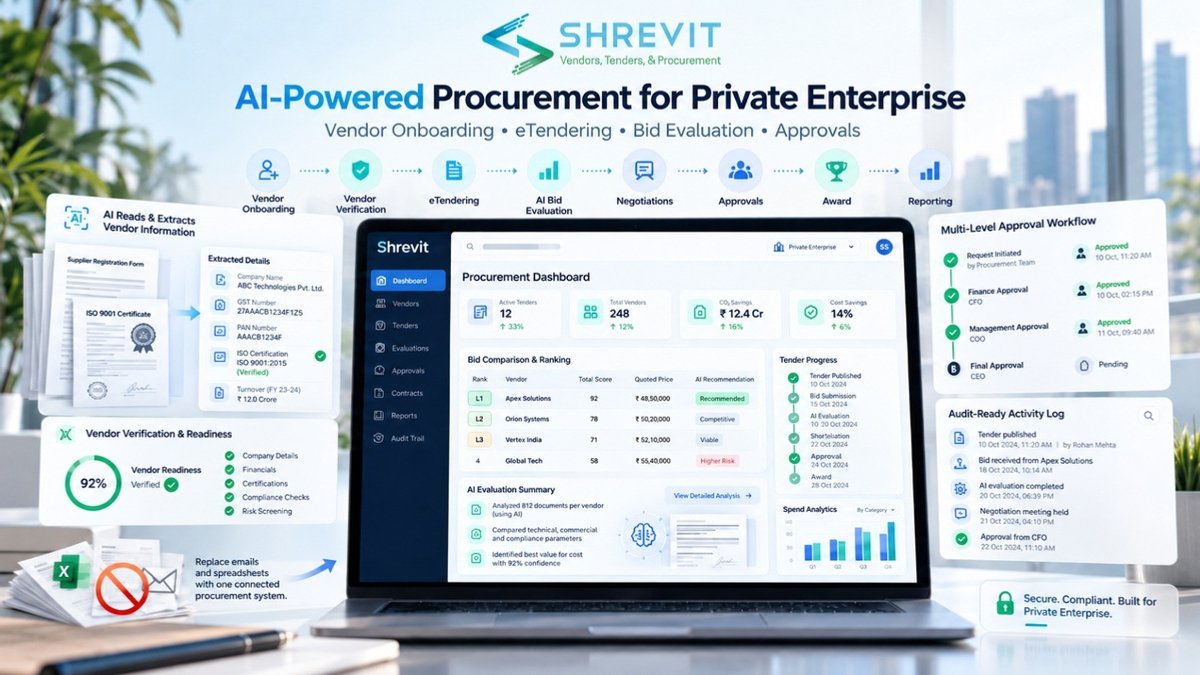
NWDCo Software Solutions, a Mumbai-based enterprise technology firm with 25 years of history, is betting that private companies are ready for the kind of structured, auditable procurement environment that India’s Government e-Marketplace forced on public buyers. Its Shrevit AI procurement platform covers the full sourcing lifecycle, from AI-driven vendor verification and document extraction through eTendering, bid ranking, reverse auctions and multi-level approvals, all inside a single time-stamped audit trail. It integrates with SAP S/4HANA, Oracle and Microsoft Dynamics, runs on private cloud deployments, and targets sectors including real estate, manufacturing, hospitality and healthcare.
What this means for your business
The CFO who still can’t answer “which vendor bids were compared before this award, and who approved it” without digging through three inboxes is exactly who Shrevit is priced against. If your enterprise procurement runs on email threads and versioned spreadsheets, the compliance exposure is real and growing, because boards and auditors increasingly treat procurement opacity as a governance failure, not just an operational inefficiency. If you already run a mature procure-to-pay system inside SAP or Oracle, the question is narrower: whether Shrevit’s AI bid-ranking and vendor risk scoring (a supplier readiness score built from GST, PAN, bankruptcy and foreign-directorship checks) adds enough on top of what your ERP already does.
The GeM analogy that NWDCo leans on is analytically honest in one direction and flattering in the other. GeM worked because government buyers had no choice; adoption was mandated, not sold. Private enterprise procurement platforms live or die on change management, and the article, written by a company pitching its own product, quietly skips over the stickiest part of the problem: getting procurement managers, finance teams and department heads across multiple locations to actually route approvals through a new system instead of defaulting to the email thread that’s always worked before. The ISO 27001 certification and named cloud partners answer the security objection, but the organizational adoption question goes unaddressed.
The vendor verification layer is the most defensible differentiator here. Automated extraction of GSTIN, PAN and bank ownership details, combined with bankruptcy and statutory compliance checks before a vendor is invited to bid, compresses a process that typically takes days into something closer to minutes. For a CFO managing supplier risk across 50-plus active vendors, that’s a real audit position improvement, not just a workflow convenience. I’d revise this read if Shrevit publishes named enterprise customers with before-and-after cycle time data, because right now the claims rest entirely on feature description rather than demonstrated outcomes.
Based on reporting from Shrevit AI Procurement Platform: Revolutionizing Enterprise Buying With Smart Automation & Verification, originally published 2026-11-02 05:12:00.