
Share with your CDO
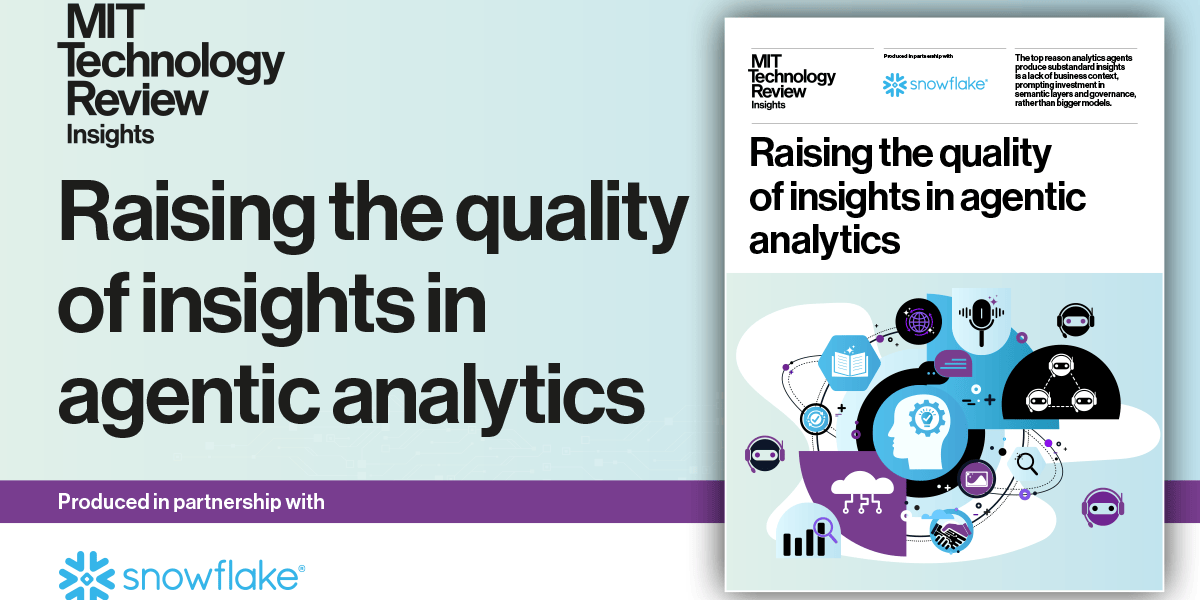
Only 48% of insights generated by analytics agents today actually lead to actions that improve the business, up from 37% a year ago, according to a new MIT Technology Review Insights survey sponsored by Snowflake. A small cohort of “insight leaders” clears 70%, driven by better business context and semantic data layers. The majority of surveyed organizations (52%) report their agents produce more insights than humans can evaluate, and 55% cite missing business context as the primary quality killer. The full findings are in this agentic analytics quality report.
What this means for your business
The 48% action rate is the number to sit with. It means the median enterprise running analytics agents is spending real money to generate recommendations that fail more often than they succeed. If your data organization is measuring AI value by volume of insights produced rather than percentage that drive decisions, you are optimizing for the wrong metric and your agents are, in practical terms, a coin flip with overhead attached.
The gap between insight leaders and the rest narrows down to two things: context and semantics. “Business context” here means agents understand not just what the data says but what the company cares about, its KPIs, its risk tolerances, its strategic priorities. A semantic layer, the translation table that maps raw data fields to business-meaningful definitions (“revenue” means this, not that), is what makes that context machine-readable at scale. The survey, commissioned by Snowflake, which sells exactly this kind of data platform capability, has an obvious interest in prescribing an architectural solution it happens to provide, but the diagnosis of context starvation is well-supported by independent practitioner experience and is not a finding you should dismiss on that basis alone.
The insight overload finding is underappreciated. When 52% of organizations say agents generate more insights than teams can evaluate, the bottleneck is no longer data or model quality but human attention. More agent output without a triage mechanism compounds the problem: low-confidence recommendations pile up alongside high-confidence ones, and humans default to ignoring all of them or cherry-picking based on instinct rather than signal quality. The organizations pulling ahead are not just getting better insights, they are building prioritization logic into the agent layer itself so humans review what matters, not everything.
The decision this reframes is not whether to invest in agentic analytics but whether your data governance and semantic infrastructure can support it. If your organization is planning an agent deployment against a data architecture that still has fragmented definitions, inconsistent business logic, or no unified context layer, the 48% action rate is probably your ceiling. The falsification condition is simple: if insight leaders show materially better outcomes without semantic layers or governance investment, the architectural argument collapses. The survey shows they don’t.
Concept deep-dive: Semantic layer
A semantic layer sits between raw data and the applications or agents that consume it, translating technical data fields into business-defined terms everyone agrees on. Think of it as a shared vocabulary contract: “margin” means gross margin excluding returns, always, for every agent and every report. Without it, agents draw on inconsistent definitions and produce insights that conflict with each other or with human judgment. It is the infrastructure reason some organizations get 70% action rates and others get 48%.
Based on reporting from Raising the quality of insights in agentic analytics, originally published 2026-11-02 12:00:00.