
Share with your CHRO
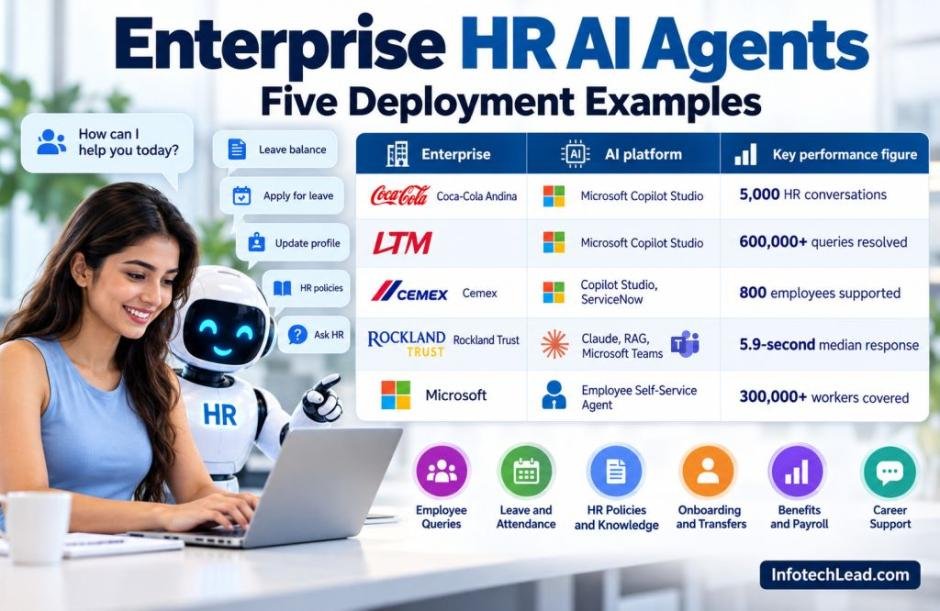
Five enterprises have moved HR AI agents past pilot into production at meaningful scale, and the numbers are specific enough to anchor a business case. LTM (formerly LTIMindtree) has resolved over 600,000 employee queries through its RAIma assistant, with 78,000 monthly active users and a reported 90 percent reduction in manual onboarding effort. Microsoft’s Employee Self-Service Agent now covers 300,000 workers and has cut IT support tickets by 30 percent. These enterprise HR AI deployments span Coca-Cola Andina, Cemex, and Rockland Trust, each on different platforms and at different deployment scales.
What this means for your business
The question isn’t whether HR AI agents work. It’s whether your current HR service model can survive the comparison employees are about to make. LTM’s response times dropped from days to seconds. Rockland Trust’s assistant answers in under six seconds with full document citations. Any CHRO still routing routine policy questions through a shared inbox or a static intranet portal is about to have an employee experience problem, not just an efficiency problem, and the gap will widen as agent capabilities compound.
The pattern across all five deployments is consistent: agents built on Microsoft Copilot Studio or Claude, integrated into channels employees already use (Teams, WhatsApp), connected to backend systems like ServiceNow and SAP SuccessFactors. The architectural choice that actually matters isn’t the AI model, it’s the depth of system integration. Coca-Cola Andina’s Andi can retrieve employee-specific data by location and role. Cemex’s Consult HR routes reimbursement requests directly into ServiceNow for processing. Agents that only answer questions are already the floor, not the ceiling.
None of these deployments disclose full implementation costs or independently verified ROI, a gap worth flagging before the CFO asks. What they do show is a credible measurement framework: ticket deflection rates, monthly active users, satisfaction scores, and cost per resolved request. CHROs who don’t already have baseline numbers on HR service volume and cost per contact will find it difficult to build a compelling case for budget, and harder still to know whether the deployment is actually working once it goes live.
Concept deep-dive: Retrieval-Augmented Generation (RAG)
RAG is the technique that lets an AI assistant answer questions grounded in your actual documents rather than its general training, similar to giving a new hire instant access to every policy manual with a built-in search engine attached. The AI retrieves the relevant passages first, then constructs its answer from them, which means it can cite the source and stay current when policies change. Rockland Trust’s deployment uses RAG specifically to handle distributed policy repositories with traceable, auditable responses.
Based on reporting from How HR Teams Use AI Agents in 2026: 5 Enterprise Deployments for Employee Support, Onboarding and Cost Savings, originally published 2026-10-16 05:25:00.