
Share with your CTO
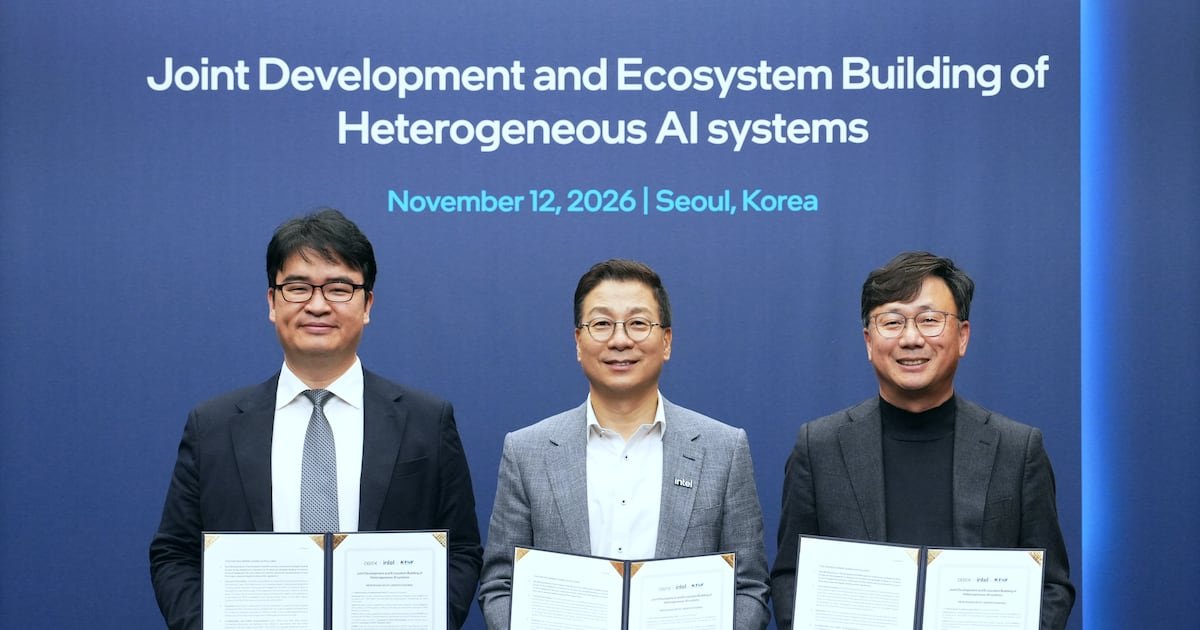
Korean AI chip startup DeepX is betting that the fastest path to enterprise adoption runs through Intel’s existing software ecosystem rather than asking developers to abandon it. The company signed an MOU with Intel Korea to integrate its NPU (a chip purpose-built for AI inference, meaning running trained models rather than training them) into Intel’s OpenVINO toolkit, plus a separate three-party deal with Intel Korea and server maker KTNF to build on-premises AI inference servers pairing Intel CPUs with DeepX silicon. The company’s next chip, the DX-M2, targets LLM and vision-language model inference at roughly 5 watts on Samsung’s 2nm process.
What this means for your business
The story that actually matters here isn’t a bilateral partnership announcement. It’s the emerging architecture pattern where inference workloads get disaggregated from general compute, and vendors race to claim the NPU slot in that stack. If your team is already standardized on OpenVINO for model deployment, a DeepX NPU that plugs into that environment without a toolchain rewrite is a materially lower-friction option than alternatives requiring new SDKs. If you’re not on OpenVINO, the integration story is largely irrelevant to your near-term roadmap.
The 5-watt target for DX-M2 is the most consequential specific in this release, and it deserves scrutiny. Running LLMs at that power envelope would be a genuine architectural shift for edge and on-premises deployments where cooling and power budgets constrain GPU use. The qualification is that DX-M2 is still under development, Samsung’s 2nm process is itself not in mass production, and “targets” in chip announcements routinely slip 12 to 24 months. The robotics angle, where Intel x86 handles control logic while the DeepX NPU handles perception, is the more near-term validation path and the one worth watching for published benchmark results.
The competitive read is that Intel benefits from any NPU that extends the relevance of its CPU platforms and OpenVINO software, which means Intel’s incentive here aligns with DeepX’s go-to-market interest but doesn’t guarantee DeepX survives the consolidation that’s coming in AI silicon. The decision this reframes for infrastructure leaders isn’t whether to buy DeepX today. It’s whether your on-premises inference architecture is modular enough to swap NPU silicon as that market shakes out, or whether you’re building in a dependency you’ll pay to unwind in two years.
Concept deep-dive: Heterogeneous computing
Heterogeneous computing means routing different types of work to chips designed specifically for each task, rather than running everything through a single general-purpose processor. Think of it like a commercial kitchen where a specialist handles pastry while another runs the grill. In AI servers, the typical split is a CPU managing orchestration and system logic while an NPU or GPU handles the matrix math intensive inference workloads demand. The business case is efficiency: purpose-built silicon does the same work at a fraction of the power cost.
Based on reporting from DeepX to integrate NPU with Intel OpenVINO, expand to robots and enterprise servers, originally published 2026-11-12 19:58:00.