

Share with your CHRO
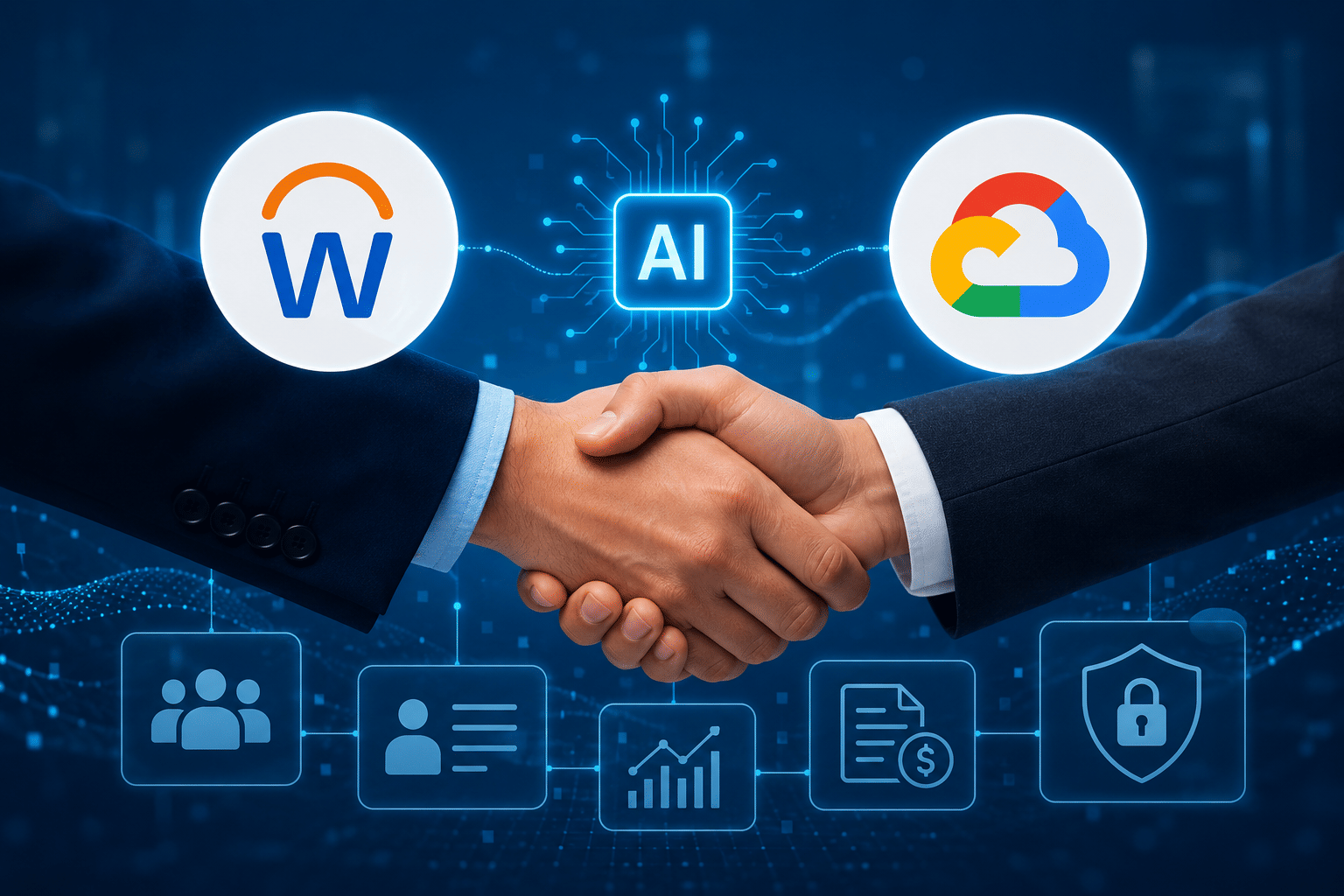
Google Cloud and Workday are betting that the next HR productivity gain comes from eliminating the app-switching tax entirely. Their expanded partnership embeds Workday’s Sana Self-Service Agent directly into Gemini Enterprise, so employees handle leave requests, payslips, and performance reviews without ever leaving Google’s AI interface. Gemini becomes the default model powering Sana, while a zero-copy data-sharing bridge between Workday Data Cloud and Google Cloud Lakehouse lets analysts query across both environments without duplicating data. Accenture, Deloitte, and KPMG are already aligned as implementation partners. Early access for eligible Workday customers is open now.
What this means for your business
The strategic pressure here isn’t really about AI features. It’s about where HR’s surface area lives. If your workforce already runs on Google Workspace and your HRIS is Workday, this integration collapses a friction point that has quietly taxed employee experience for years. CHROs who’ve watched adoption of self-service HR portals plateau should read this as a structural explanation for that failure: people don’t go to a separate system for routine tasks when a conversational interface in their daily tool can handle it instead.
The governance architecture is the part worth examining before anyone signs up for early access. Workday says the integration preserves existing permissions and approval workflows, and the zero-copy data approach, where data is queried in place rather than moved or copied to a new location, is specifically designed to avoid creating a shadow data layer outside your security perimeter. That’s the right design choice. But “preserves governance controls” in a press announcement and “preserves governance controls” in a production environment with 50,000 employees are different claims, and your CISO will want to interrogate the boundary conditions before Gemini Enterprise becomes the front door to Workday data.
The Alphabet self-deployment detail buried near the end of this announcement is the leading indicator worth watching. Google’s own HR and admin teams are building a customized Workday agent on this platform, which means the integration’s real-world stress test is happening inside one of the most scrutinized tech employers on the planet. If that deployment surfaces friction, it will surface publicly. If it works cleanly, Alphabet becomes the reference customer that shortens every enterprise procurement conversation. The CHRO decision this reframes isn’t whether to explore the integration, it’s whether your current Workday contract cycle and Google Workspace renewal timeline can be coordinated so you’re not paying for capabilities that arrive six months after you’ve locked in pricing.
Concept deep-dive: Zero-copy data sharing
Zero-copy data sharing lets two separate data systems query each other’s information without physically moving or duplicating the underlying records, think of it as giving a trusted colleague read access to your filing cabinet rather than handing them a photocopy of every file. The business relevance is governance: every copy of sensitive HR or financial data is another surface for a breach or a compliance gap. Keeping data in place while enabling cross-platform analysis is increasingly the architectural standard for enterprise AI integrations handling regulated information.
Based on reporting from Google and Workday target HR transformation with enterprise AI agents, originally published 2026-05-28 03:00:00.