


Share with your CHRO
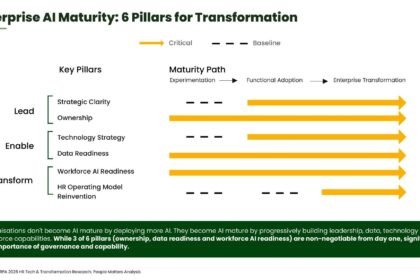
New i4cp research covering 1,338 business and HR leaders finds that HR involvement in enterprise AI implementation produces dramatically different outcomes depending on who owns the work. When HR co-leads AI deployment, 58% of respondents report meaningful gains in HR’s strategic impact. That figure falls to 39% when IT leads alone, and collapses to 20% when a cross-functional team runs the effort without HR. Workforce AI readiness shows an even starker gap: HR-led organizations are four times more likely to describe their workforce as mostly or fully AI-ready compared to cross-functional teams without HR representation.
What this means for your business
The 34% of large organizations still running IT-only AI implementation are carrying a structural liability, not just a coordination gap. The workforce readiness numbers make this concrete: 56% AI-ready when HR leads, 18% when IT leads alone. That gap doesn’t close by buying better tools or expanding licenses. It closes by changing who has defined accountability before deployment decisions lock in. If your organization falls into the IT-led bucket, the research isn’t a nudge toward better collaboration, it’s a diagnosis of why AI investments are underperforming.
The Moderna example is worth examining closely. Combining the chief people and chief digital technology roles under one executive isn’t a structural novelty, it’s an answer to a specific architectural problem. When workforce strategy and AI deployment live in separate organizational trees, the integration work that should happen at the design stage gets deferred to the change management stage, which means it arrives too late to shape job redesign, skills requirements, or governance. Allianz Life’s AI Transformation Office with formal HR representation solves the same problem at a lower organizational cost, which makes it the more replicable model for most enterprises.
The statistic that quietly deserves more attention is this one: only 1% of HR functions describe AI as core to how HR itself operates, and 57% haven’t moved past pilots. CHROs arguing for a seat at the enterprise AI table while running HR on isolated use cases are making a credibility claim the data doesn’t support. The organizations that will pull ahead aren’t the ones with the most sophisticated AI governance charter on paper, they’re the ones where HR has already demonstrated measurable AI-driven impact inside its own function. That internal track record is the business case, not the research findings.
Based on reporting from AI works better when HR helps lead it, new research finds, originally published 2026-07-31 03:00:00.