

Share with your CTO
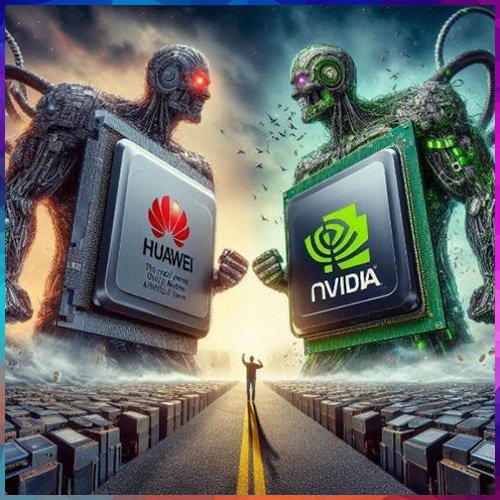
Huawei is betting that domestic chip self-sufficiency is an existential priority, not a competitive nice-to-have. At its Connect conference in Shanghai, the company confirmed it pulled its Ascend 960DT chip release forward nine months to Q1 2027, with successive Ascend generations mapped through 2029. The Atlas 960 SuperPoD cluster is designed to connect up to 1 million processors, a deliberate architectural answer to US export controls that cap individual chip performance. Over 5,200 developers now work monthly on Ascend software, and 40-plus AI models have trained on the platform.
What this means for your business
The split in the global AI compute market is now structural, not cyclical. If your organization sources AI infrastructure with any exposure to Chinese supply chains, Chinese cloud providers, or multinational vendors serving both markets, Huawei’s accelerated roadmap isn’t background noise. It’s the signal that two distinct compute ecosystems are hardening in parallel, and decisions about which architecture you build on will become progressively harder to reverse as the ecosystems diverge.
The Peerium cluster architecture deserves attention beyond the geopolitics. Connecting 1 million processors in a single fabric is a different engineering philosophy than stacking faster individual GPUs. Nvidia’s dominance has always rested partly on its CUDA software ecosystem, the decades of developer tooling and model optimization that makes switching painful. Huawei’s 5,200 monthly active Ascend developers are tiny by comparison, but the 40-plus trained models show the ecosystem has crossed from theoretical to functional. The question for any CTO is whether CUDA lock-in, which felt absolute two years ago, is actually as durable as it seemed when there was only one credible alternative.
The falsification condition here is software, not silicon. Huawei can compress its hardware roadmap, but if Ascend’s developer tooling stays narrow and the model-training results don’t replicate at scale outside a controlled showcase, the cluster ambition stalls regardless of the chip schedule. Watch whether the 950DT training deployments Xu cited for the coming year produce public benchmark data or stay inside China’s closed ecosystem. If the benchmarks surface and hold, every hyperscaler and sovereign AI program outside the US will face a genuine two-vendor world. That changes procurement leverage in ways that benefit buyers, but only if the buyer’s architecture can actually move.
Concept deep-dive: Cluster-scale interconnect
When individual chip performance is capped by regulation, the engineering response is to link thousands of chips so tightly they behave like one giant processor. Think of it as replacing a single powerful engine with a finely coordinated fleet. Huawei’s Peerium architecture targets 1 million connected processors precisely because US export controls restrict peak chip speed, not the number of chips. The business implication is that raw compute capacity can still scale even when single-unit performance is legally constrained.
Based on reporting from Huawei Accelerates AI Chip Race Against Nvidia, originally published 2026-09-18 02:51:00.