

Share with your CDO
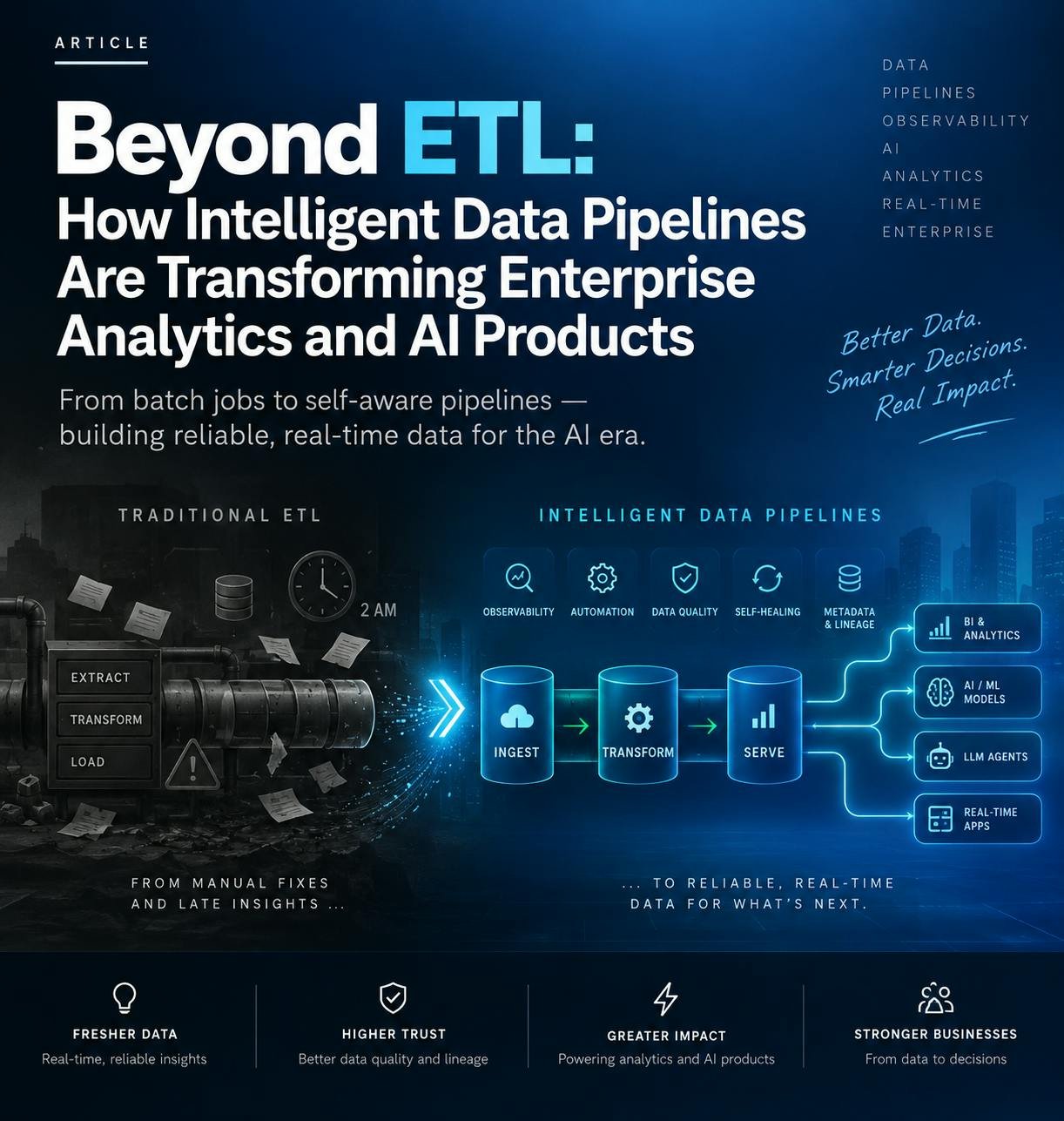
The case for rethinking data pipeline architecture isn’t about ETL being broken. It’s about what’s consuming the output. When AI models, fraud detection systems, and LLM agents sit downstream instead of a Tuesday morning dashboard, a stale or silently corrupted table stops being an inconvenience and becomes a correctness failure. This practitioner-level breakdown of intelligent data pipelines argues that the difference between old ETL and modern pipeline design isn’t ML bolted on, it’s continuous self-monitoring baked in from the start.
What this means for your business
The dividing line isn’t company size or data volume. It’s what’s downstream. A team whose pipelines feed BI dashboards reviewed by analysts can tolerate a morning’s lag and a patched schema. A team whose pipelines feed a real-time fraud model or a retrieval-augmented LLM agent, where the system pulls relevant data to answer questions on the fly, cannot. If you’re in the second camp and still running the first camp’s observability stack, you already have a gap worth pricing out.
The honest operational tension here is that adding anomaly detection to a pipeline creates something that needs its own monitoring, which is genuinely recursive overhead. The author’s caveat lands correctly: tools like Monte Carlo or Great Expectations get most teams eighty percent of the way without custom ML models. The remaining twenty percent only pays off when a pipeline failure has real, measurable cost attached to it, a fraudulent transaction that clears settlement, a model decision made on stale features. The investment case for full observability infrastructure is proportional to that failure cost, not to how modern the tooling sounds.
The CDO who should worry most is the one managing a medallion lakehouse, a layered architecture where data moves from raw to refined to production-ready, where gold-layer tables serve both a human analyst and a production AI system simultaneously. That dual-consumer architecture breaks the old assumption that a data quality alert to an engineer is sufficient. If the AI system consuming that table doesn’t receive a signal that something is wrong, it keeps running on bad data quietly. The decision this reframes isn’t whether to buy an observability tool. It’s whether your current alerting architecture even knows which consumers are human and which are models, because those two audiences need completely different response paths.
Based on reporting from Beyond ETL: How Intelligent Data Pipelines Are Transforming Enterprise Analytics and AI Products, originally published 2026-09-27 07:33:00.