
Share with your CDO
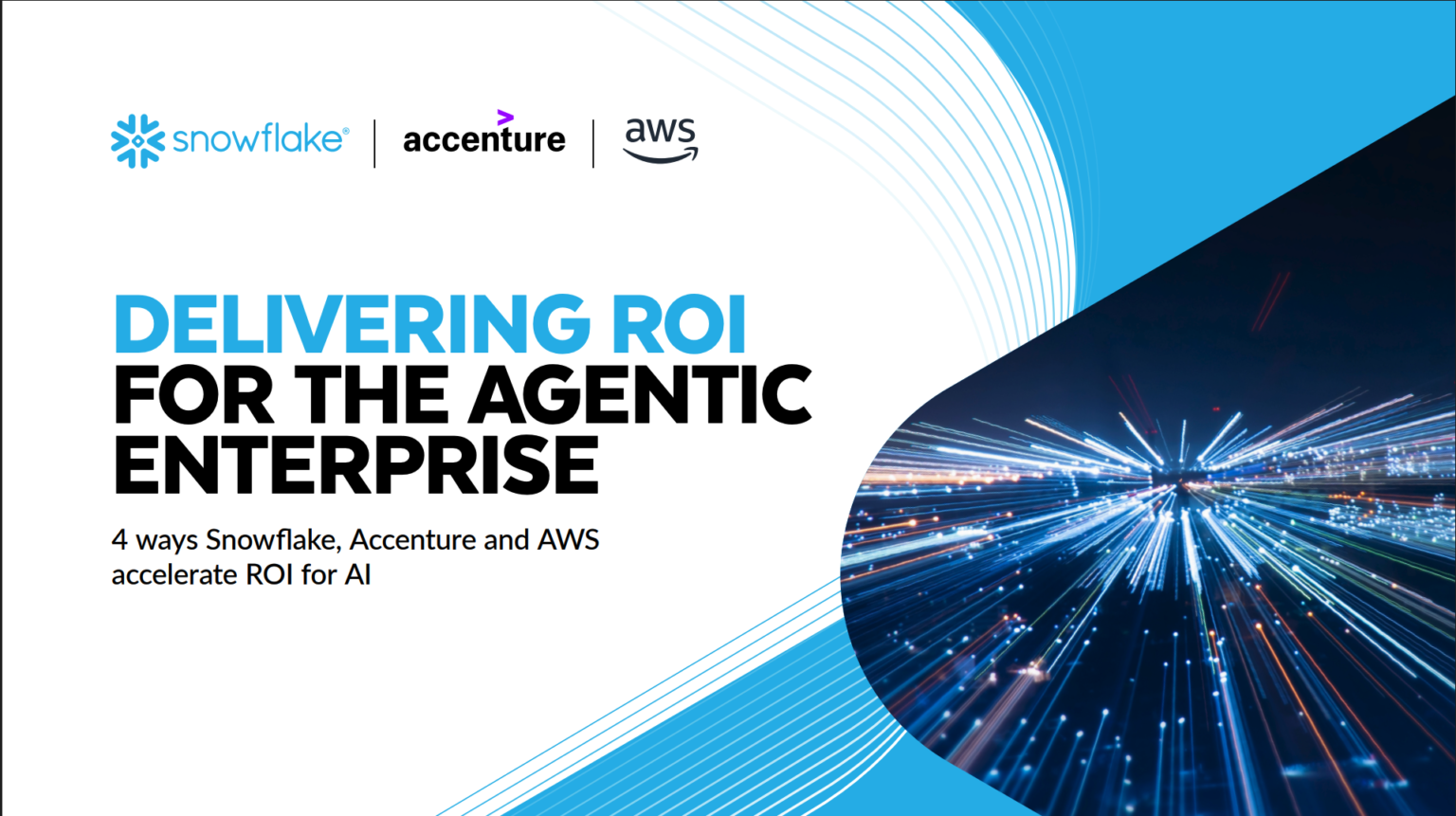
Snowflake is betting that the agentic AI wave breaks on a data problem, not a model problem. Co-produced with AWS and Accenture, this guide to agentic enterprise ROI argues that autonomous AI agents, systems that execute multi-step decisions without human hand-holding, fail not because the technology is immature but because enterprise data is ungoverned and fragmented. The hook is a striking number from a third-party report: organizations expect a 41% failure rate for agentic initiatives launched over the next three years.
What this means for your business
The 41% failure figure is doing a lot of work here. If you accept it, the argument follows cleanly: agents stall when they can’t access clean, governed data at the moment of decision, and a unified data platform is the fix. The organizations most exposed to that failure rate are the ones running agents against siloed, poorly catalogued data stores, which describes most large enterprises that assembled their data infrastructure incrementally over the past decade.
The frame matters, though. Snowflake, AWS, and Accenture each sell directly into the infrastructure and services layer this ebook recommends, so the diagnosis that agents need a unified platform rather than better orchestration tooling or model fine-tuning is exactly the diagnosis you’d expect from vendors whose products are the prescribed cure. That tilt toward platform consolidation as the primary lever probably overstates how much data unification alone can close the ROI gap, and understates how much organizational readiness, process redesign, and agent quality contribute to whether agentic initiatives deliver.
The deeper pressure the ebook points at, even if it undersells its complexity, is real. Governance reviews blocking agents mid-execution is not a theoretical problem. It’s the recurring failure mode in every enterprise automation wave, from RPA to early generative AI pilots, where technical capability outpaces the control structures that would let it run unsupervised. If your data governance posture isn’t built for machine consumers, agents will expose that gap faster and more publicly than any prior automation layer. The budget question worth revisiting isn’t whether to invest in agents, it’s whether your data infrastructure can support accountability at agent speed.
Concept deep-dive: Agentic AI
Agentic AI refers to systems that don’t just generate a response but plan and execute a sequence of actions to complete a goal, think of it as the difference between a calculator and an employee who reads your request, pulls the relevant data, drafts the output, and files it. The business significance is that agents create new categories of operational risk because they act, not just advise, which is why data governance and access controls become load-bearing infrastructure rather than compliance overhead.
Based on reporting from Enterprise AI ROI: Guide to the Agentic Enterprise, originally published 2026-07-17 01:28:00.