
Share with your CIO
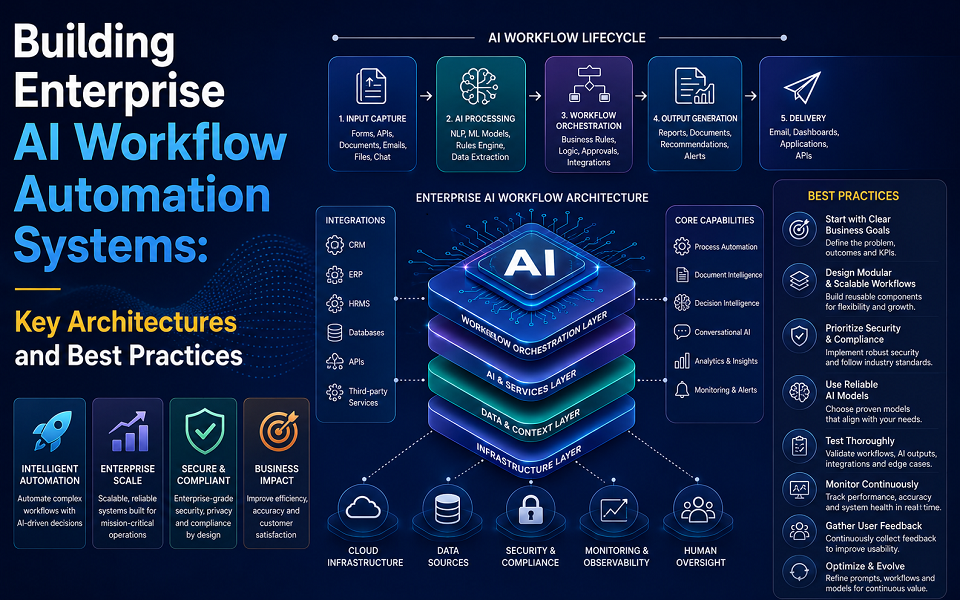
Enterprise AI workflow automation, the practice of chaining AI models into end-to-end business processes that run without manual handoffs, is moving from pilot curiosity to architectural commitment across industries. A Nasscom community overview of AI workflow automation systems lays out the full stack: input collection, AI-powered parsing, intelligent processing, output generation, automated delivery, and secure storage. The piece covers applications across healthcare, finance, insurance, and HR, and maps an eight-step build sequence from use-case definition through continuous deployment.
What this means for your business
The organizations most exposed to this shift aren’t the ones without AI yet. They’re the ones that bought point solutions, an AI tool for contracts here, a chatbot for support there, and now own a portfolio of islands that can’t talk to each other. The architecture described here is explicitly end-to-end, which means the competitive pressure isn’t just to automate tasks but to automate the handoffs between tasks. That’s a fundamentally different infrastructure problem, and it’s one your current vendor map may not solve.
The challenge Nasscom’s framing quietly glosses over, written as it is by a trade body with an interest in positioning Indian tech services as the natural implementation partner, is the data quality problem underneath all of it. Every benefit listed, faster operations, better accuracy, lower costs, assumes clean, well-structured inputs. In practice, most enterprises run on fragmented data spread across ERPs, CRMs, and legacy systems that weren’t designed to feed an AI orchestration layer. The eight-step build roadmap includes “assess feasibility” and “maintain data quality” as discrete steps, but neither gets the weight they deserve. Garbage-in-garbage-out doesn’t get less dangerous just because the pipeline is automated; it gets faster.
The piece’s most useful signal is buried in its challenges section: “not every decision should be fully automated.” Confidence-based decision models, where the system routes low-certainty outputs to a human reviewer rather than executing autonomously, are the design pattern that separates automation that scales gracefully from automation that fails at scale quietly. If your team is evaluating workflow automation vendors right now, the question to ask isn’t what the system can automate. It’s what the system does when it isn’t sure, and whether that behavior is configurable or fixed.
Based on reporting from Building Enterprise AI Workflow Automation Systems: Key Architectures and Best Practices | nasscom, originally published 2026-10-09 05:52:00.