
Share with your CDO
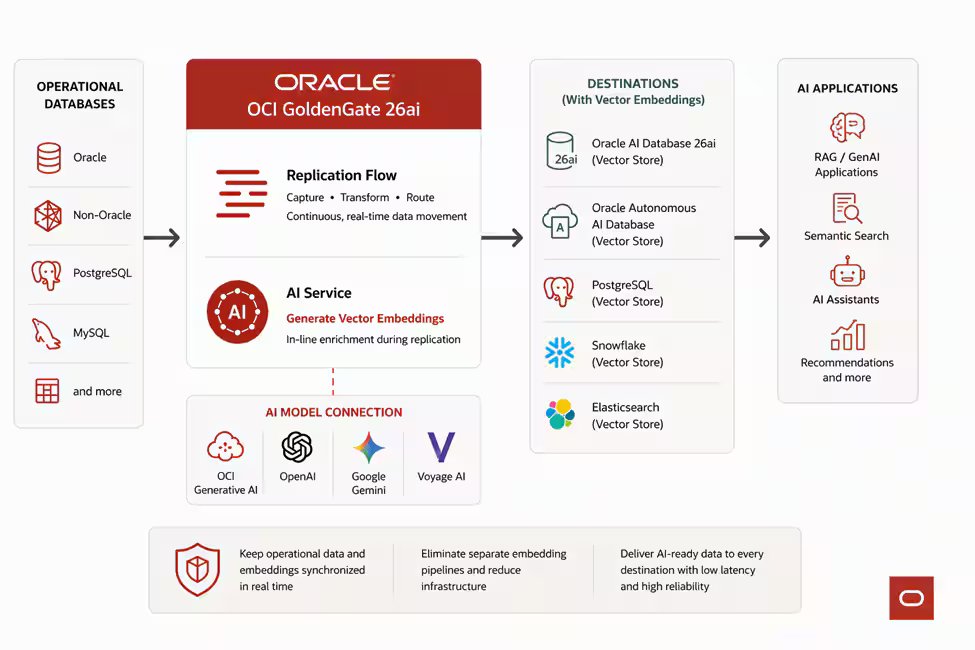
Oracle is betting that the next logical step in data replication isn’t just moving data faster, it’s making that data AI-ready in transit. The latest OCI GoldenGate enhancements embed vector generation directly inside the replication pipeline, connecting to models from OCI Generative AI, OpenAI, Google Gemini, and Voyage AI. The release also adds connectivity for Google Cloud Managed Kafka, Oracle Exadata Exascale, and expands Apache Iceberg support to OCI Object Storage and Amazon S3 Tables.
What this means for your business
The two-step problem this solves is real and underappreciated. Most RAG pipelines today replicate operational data to a destination, then fire a separate job to generate vector embeddings (numerical representations of text that allow AI models to find conceptually similar content). That gap means embeddings are stale the moment new records land. If your team is already running GoldenGate for CDC (change data capture, the technique that streams only changed rows rather than full table copies), and you’re also managing a vector database for any AI application, this release collapses two operational concerns into one.
The catch worth naming is that Oracle, whose incentive runs toward keeping enterprise workloads inside OCI, frames inline embedding as an architectural simplification, which it genuinely is, but only if your target vector store is already one of the supported destinations: Oracle AI Database 23ai, Autonomous Database, PostgreSQL, Snowflake, or Elasticsearch. Organizations with embeddings flowing into Pinecone, Weaviate, or Qdrant get nothing from this release today. The model support list is also narrow. Four providers is a defensible start, but enterprises running fine-tuned private models on-premises are excluded from the inline path entirely.
The broader connectivity additions matter more than they look in a product announcement. Apache Iceberg on S3 Tables is Oracle explicitly supporting AWS-native lakehouse patterns, a quiet acknowledgment that multicloud data architectures aren’t a phase customers will grow out of. If you’re in a GoldenGate renewal cycle, the Iceberg and Kafka additions shift the comparison set; alternatives that don’t natively write CDC into open table formats now carry a visible architectural cost. The question to weigh isn’t whether Oracle’s roadmap is credible, it’s whether your embedding workload is concentrated enough in supported targets to justify consolidating on this path rather than keeping a purpose-built vector pipeline you already control.
Concept deep-dive: Vector embeddings
A vector embedding is a list of hundreds or thousands of numbers that a machine learning model assigns to a piece of text (or an image, or a product description) to capture its meaning. Similar concepts end up with numerically similar vectors, which is what lets an AI assistant answer “shipping delay” questions by retrieving tickets about “delivery problems” without any keyword match. The business dependency is simple: if those numbers are generated from stale data, the AI’s answers are wrong.
Based on reporting from New OCI GoldenGate enhancements introduce AI-ready data pipelines and expanded connectivity, originally published 2026-07-29 06:35:00.