
Share with your CTO
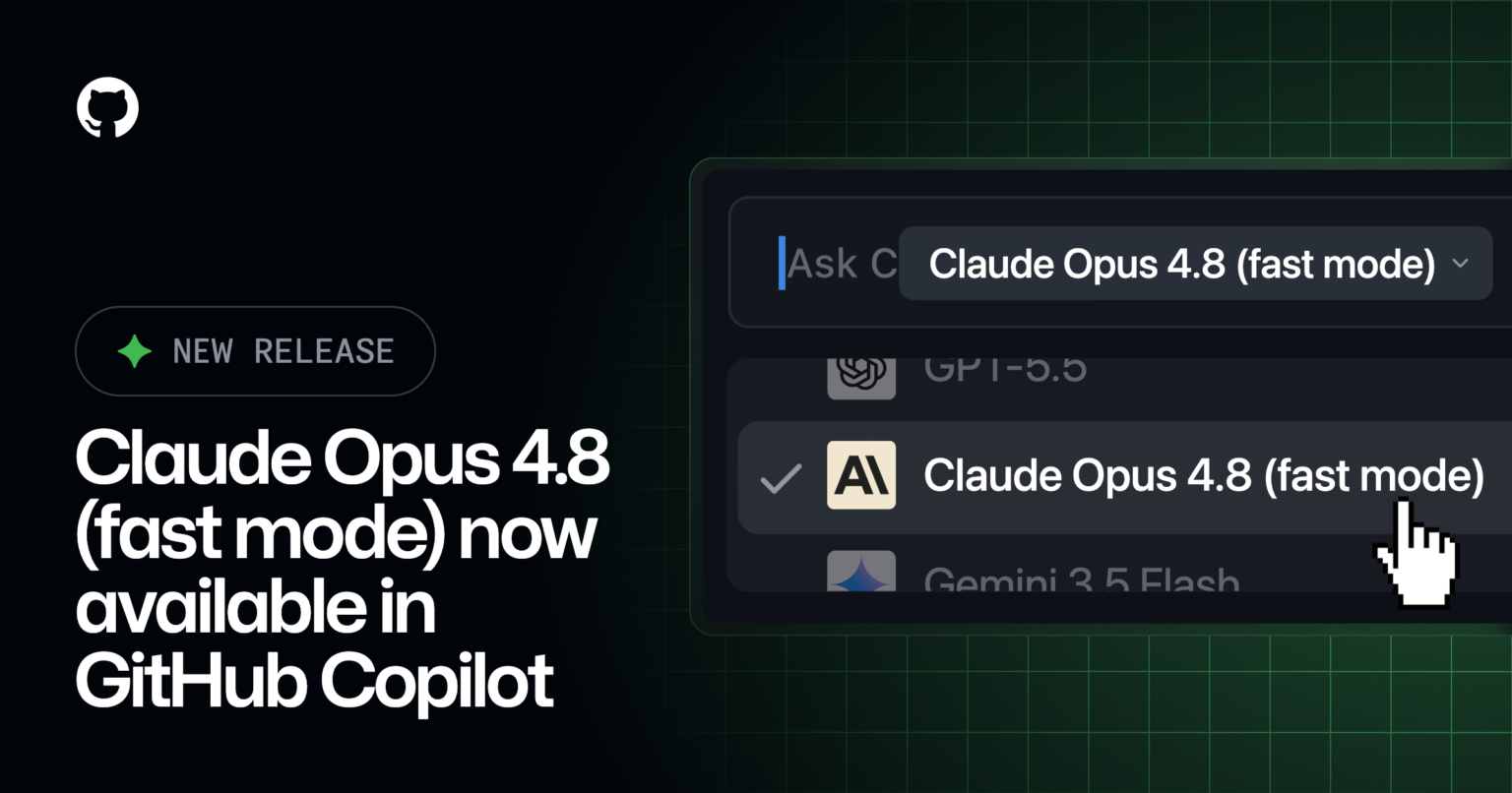
GitHub is betting that latency, not intelligence, is the binding constraint on developer productivity. The company has rolled out Claude Opus 4.8 in fast mode as a preview inside GitHub Copilot’s model picker, available across Visual Studio Code, JetBrains, Xcode, Eclipse, and the Copilot CLI. The model delivers the same reasoning quality as standard Claude Opus 4.8 but at significantly faster output speeds. It’s priced above standard Opus 4.8 but below previous fast-mode offerings, and it’s off by default for Enterprise and Business plans, requiring an administrator policy change to enable.
What this means for your business
Agentic coding workflows collapse when the model pauses. A developer waiting two seconds per completion will tolerate the lag in autocomplete, but an autonomous agent running dozens of sequential code-generation and test-execution steps compounds that latency into minutes of dead time per task. Fast mode is purpose-built for that second scenario, and if your engineering teams are running Copilot’s cloud agent for anything beyond simple suggestions, the speed delta is worth measuring in wall-clock hours, not percentages.
The pricing structure here tells you something about where the market is heading. GitHub is offering fast mode at a reduced cost compared to prior fast offerings while still charging a premium over standard Opus 4.8. That’s not a discount strategy, it’s a segmentation strategy: GitHub is carving out a distinct tier for interactive and agentic use cases and pricing it to capture the value those workflows generate. The pattern looks familiar. The same tiering logic ran through cloud compute when reserved and on-demand instances split into separate pricing tracks. Speed becomes a product feature, not a performance attribute.
The signal worth watching: the policy-off-by-default design for Enterprise and Business plans is a governance lever, not an afterthought. Administrators have to actively enable fast mode. That means usage-based billing for a premium model won’t silently balloon your Copilot spend. Whether your procurement team has modeled the cost ceiling for an engineering org running agentic workflows at fast-mode rates is a different question, and probably worth asking before the preview graduates to general availability.
Concept deep-dive: Agentic coding workflows
An agentic coding workflow is one where an AI model doesn’t just respond to a single prompt but executes a sequence of steps autonomously: writing code, running tests, reading error output, and revising, all without a human in the loop between steps. Think of it as the difference between a calculator and a junior developer who takes a task ticket and returns a pull request. The latency of each model call multiplies across the chain, which is why output token speed becomes a systems constraint, not just a comfort preference.
Based on reporting from Claude Opus 4.8 (fast mode) is now in preview for GitHub Copilot, originally published 2026-06-29 03:00:00.