
Share with your CTO
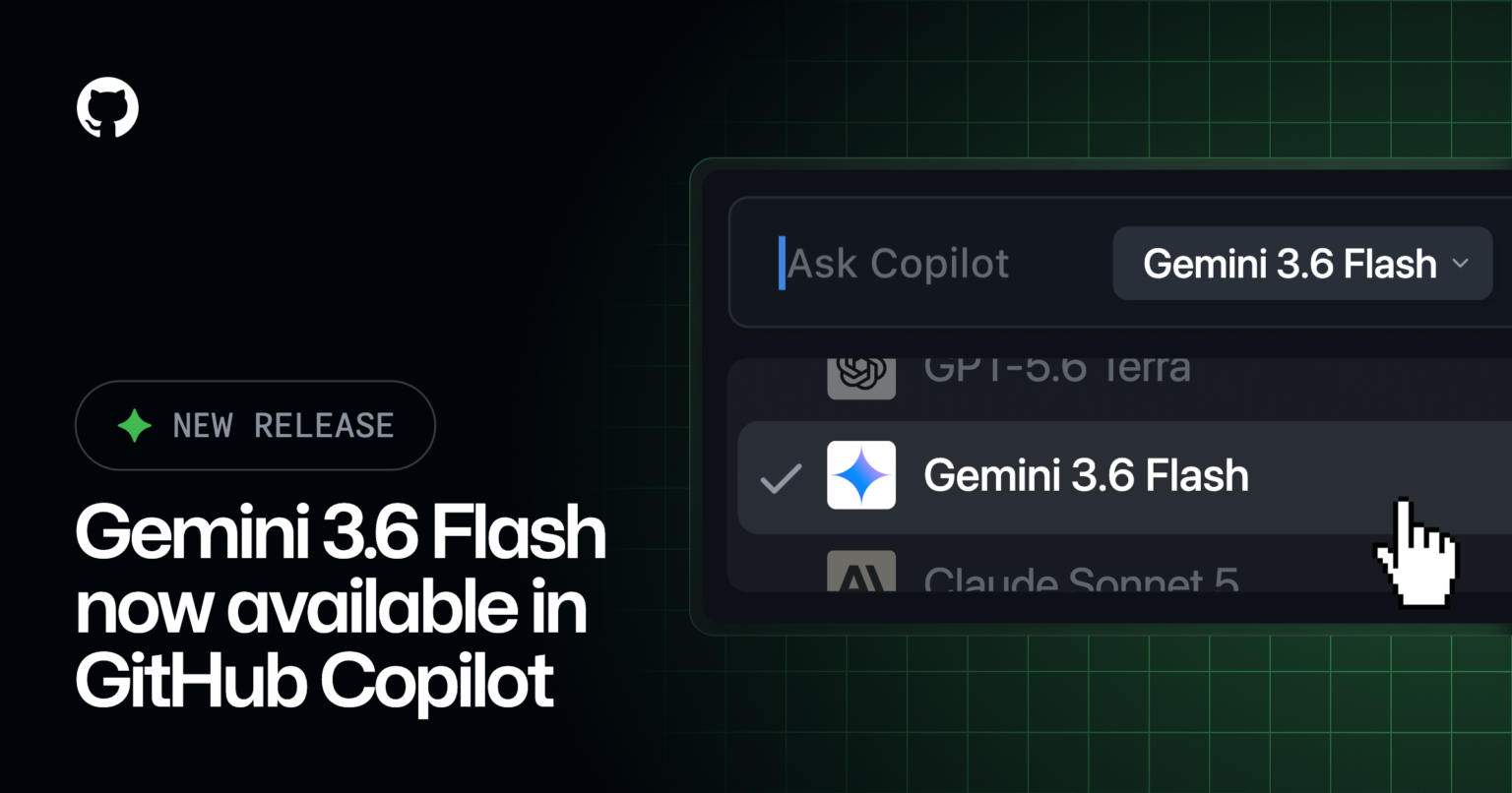
Google’s Gemini 3.6 Flash is now rolling out inside GitHub Copilot’s model picker, available across Visual Studio Code, JetBrains, Xcode, Eclipse, and GitHub’s own cloud agent. The model targets coding and longer-horizon agentic tasks, with configurable reasoning effort and parallel tool use. Early testing showed higher task-completion rates and better token efficiency than its predecessor, Gemini 3.5 Flash. It’s available to Copilot Pro, Pro+, Max, Business, and Enterprise tiers, billed at provider list pricing. Enterprise and Business admins must explicitly enable it via a policy toggle before engineers can select it.
What this means for your business
The admin policy gate is the detail most engineering leaders will overlook and shouldn’t. GitHub isn’t auto-enrolling enterprise organizations into Gemini 3.6 Flash. A CTO whose teams are running agentic coding workflows, where the model orchestrates multi-step tasks across a codebase rather than answering a single prompt, needs to make an active decision here. Leaving the toggle off means your engineers are running older models while competitors’ engineers aren’t.
The competitive dynamic in AI coding tools has shifted from “which assistant autocompletes best” to “which model completes longer, more complex tasks with fewer human interruptions.” Configurable reasoning effort is the tell. It means developers can dial up the model’s deliberation for a hard refactor and dial it down for a boilerplate generation, paying only for the compute the task actually warrants. That’s not a feature for individual contributors. That’s an infrastructure pricing decision that compounds across thousands of daily tasks.
GitHub is now effectively running a model marketplace inside Copilot, and the number of providers (Google, Anthropic, OpenAI, and others) is accelerating. The tradeoff is real: more model choice gives enterprises better price-performance matching, but it also creates a fragmentation problem where different teams converge on different defaults, making it harder to benchmark productivity gains or enforce consistent output quality. The signal worth watching is whether GitHub adds policy controls that let CTOs set model guardrails by repository, team, or task type.
Concept deep-dive: Configurable reasoning effort
Reasoning effort controls how much computational work a model does before generating a response. Standard models respond immediately; high-reasoning modes run internal “thinking” steps, weighing alternatives before committing to output. The analogy is a contractor who can either frame a wall from memory or stop to re-read blueprints before cutting. The business connection is direct: more reasoning costs more tokens and takes longer, but produces fewer errors on complex tasks. Configurable effort lets teams match cost to task complexity rather than paying full deliberation cost for every autocomplete suggestion.
Based on reporting from Gemini 3.6 Flash is now available in GitHub Copilot, originally published 2026-07-21 11:04:00.