
Share with your CTO
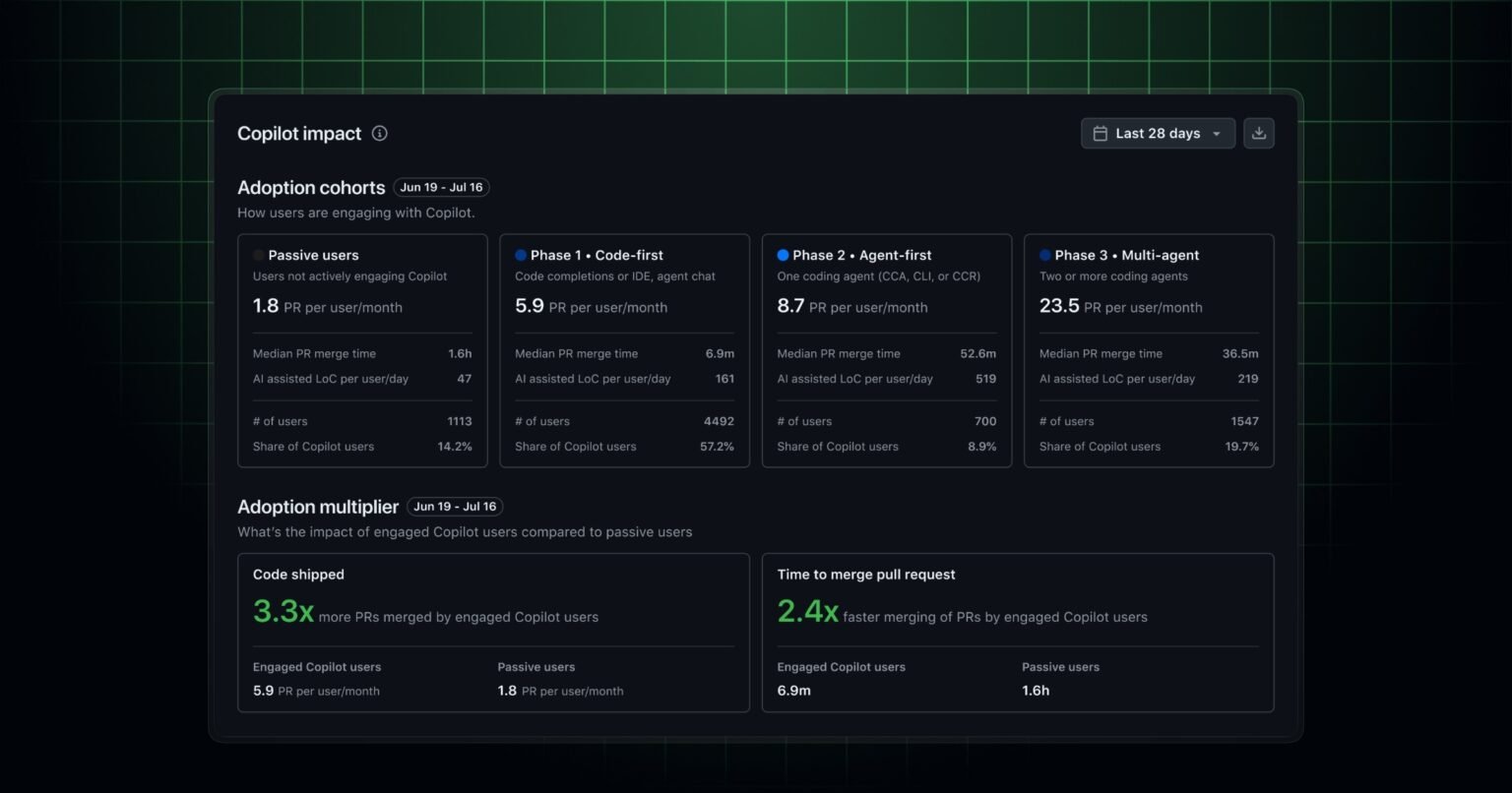
GitHub is pushing past vanity metrics with a new Copilot usage metrics impact dashboard for enterprise administrators and organization owners. Rather than reporting who holds a Copilot license or who clicked it once this month, the dashboard segments developers into three adoption phases: code completion users, agent-first users, and multi-agent or Copilot app builders. Each cohort surfaces pull requests merged per user per month, PR merge velocity, lines of code per day, and a head-to-head throughput comparison between passive license holders and actively engaged users.
What this means for your business
Most enterprise Copilot rollouts are quietly stalled at Phase 1. Developers use autocomplete, feel mildly faster, and the program gets counted as a success. That’s the measurement trap: active-user counts reward seat occupancy, not capability progression. A team where 80 percent of licensed developers never advance beyond code suggestions is burning budget on a sophisticated tab-completion tool, not an AI-augmented engineering organization.
The adoption multiplier metric, which compares passive cohort throughput against engaged cohort throughput, is the number that will hurt to look at. If your passive segment is large and that multiplier is high, you now have a defensible, board-ready number showing the productivity gap your enablement program hasn’t closed. The six-month cohort trend charts make that gap longitudinal, which means the conversation shifts from “are we using AI” to “why aren’t we progressing faster.” That is a harder, more useful question.
GitHub is also building an implicit argument about platform lock-in here. An enterprise that orients its engineering KPIs around GitHub’s three-phase taxonomy is an enterprise that frames its developer productivity story entirely inside GitHub’s measurement framework. The recommended next steps feature deepens that dependency by having GitHub prescribe the enablement roadmap. The signal worth watching: whether competing platforms like GitLab or JetBrains respond with comparable maturity frameworks, or cede this governance layer to GitHub entirely.
Concept deep-dive: AI adoption phase cohorts
GitHub’s cohort model classifies each licensed developer into one of three phases based on actual product usage over a rolling 28-day window. Phase 1 is code-first: inline completions and basic chat. Phase 2 is agent-first: using Copilot to autonomously execute multi-step tasks like writing tests or refactoring a module. Phase 3 is multi-agent or Copilot app workflows. Think of it like a manufacturing line: the raw material is a licensed seat, and the finished product is a developer orchestrating AI agents. Most enterprises ship a lot of raw material and very little finished product.
Based on reporting from New Copilot usage metrics impact dashboard, originally published 2026-07-22 12:21:00.