
Share with your CIO
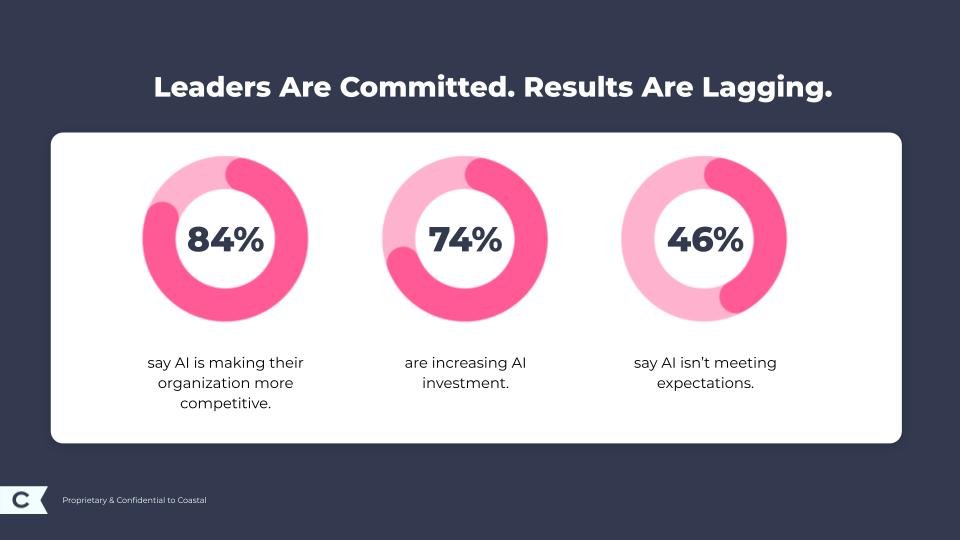
Nearly half of enterprise AI initiatives are failing to meet expectations even as budgets keep climbing, according to Coastal’s 2026 AI Operations Report, a survey of 800 U.S. business and technology leaders conducted with Oxford Economics. Seventy-four percent of organizations are increasing AI investment, yet 46% say results have fallen short. Data problems persist in 73% of production deployments, only 26% of initiatives start with a clearly defined business problem, and just one in six organizations has a dedicated AI or transformation team running the work.
What this means for your business
The organizations most exposed here are not the ones that skipped AI. They are the ones that shipped it. Launching a model into production and actually operating it are two different disciplines, and most enterprises built capacity for the first without planning for the second. If your AI portfolio looks like a collection of pilots that graduated to production but never graduated to ownership, this report is describing your situation. The question is not whether you recognize the pattern but how far the gap has already widened between what you told the board AI would deliver and what it is actually producing.
The data quality finding deserves more attention than it usually gets. Seventy percent of organizations hit data access or quality problems during AI setup, and 73% hit them again in production, meaning the setup problems were not solved at setup. They were deferred. This is the recurring failure mode in enterprise AI programs: teams treat data readiness as a launch prerequisite, clear it well enough to go live, and then discover that production AI creates continuous data demand that no one budgeted for operationally. The system is not broken at deployment; it degrades over time because the data feeding it was never put on a maintenance schedule.
Worth noting: Coastal is a Salesforce and Snowflake consultancy, now part of TCS, and its business grows when enterprises conclude they need outside operational help to run AI at scale. That incentive tilts the report toward framing the operations gap as larger and more structurally intractable than a purely neutral read might, which is worth weighing. But the directional finding still holds. The specific numbers may flatter the consultancy’s pitch, yet the underlying dynamic, that AI in production requires ongoing management that most internal teams were not staffed to provide, matches what is showing up across the industry broadly.
The adoption number that should worry a CIO most is not the 46% shortfall. It is that 77% of employees say they are ready to use AI while 73% of organizations report adoption failures tied to poor workflow fit or unclear outputs. That gap means the bottleneck is not human resistance; it is product design and deployment quality. The organizations that close this first will not be distinguished by which models they chose but by whether they assigned someone accountable for AI performance after go-live, a decision most CIOs have not yet made explicitly, and one that belongs on the next budget cycle’s org chart before it shows up as another shortfall statistic.
Based on reporting from Enterprise AI Is Stalling: 46% of Initiatives Fall Short, originally published 2026-05-11 03:00:00.