
Share with your CMO
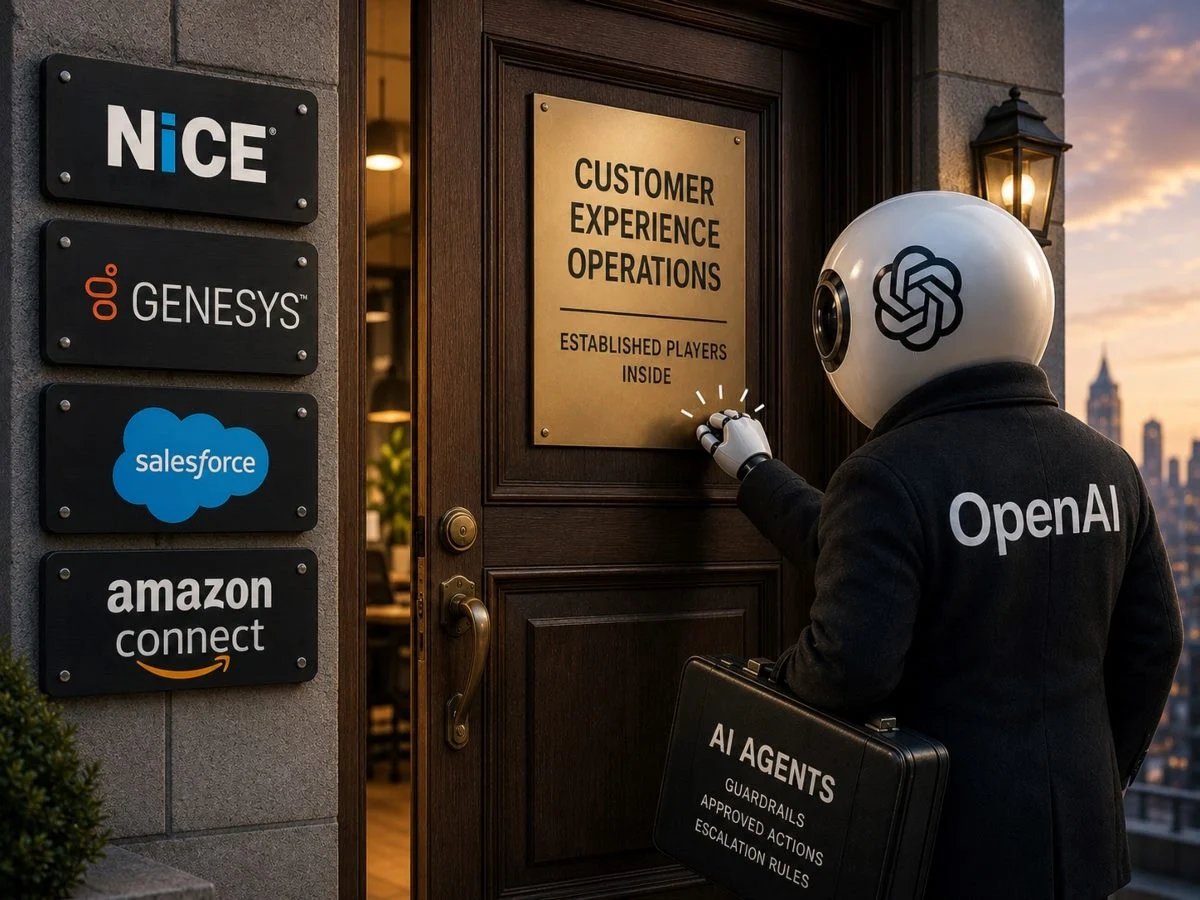
OpenAI is making a direct move into enterprise customer service with Presence, a managed deployment product that puts voice and chat agents in front of customers, connects them to business systems, and lets them take approved actions like issuing refunds. OpenAI’s own support line reportedly resolves 75% of inbound calls without human involvement, and a Codex-driven improvement loop cut escalations by 15 percentage points in 10 days. BBVA Mexico, SoftBank, and Insurance Australia Group are in early testing. The product is not self-service; Forward Deployed Engineers configure each deployment.
What this means for your business
The 75% resolution figure is the number everyone will cite in board decks, and it deserves real scrutiny before it travels that far. OpenAI is measuring its own deployment, on its own relatively clean data, with its own definition of “resolved.” That is not a comparable baseline for a retail bank running a 15-year-old CRM or a telco with five overlapping billing systems. CMOs whose contact center performance is already a political topic inside the company should be cautious about letting a vendor’s self-reported benchmark set the expectation for their own rollout.
The more consequential structural question is where Presence sits in the stack. It adds policies, approved actions, and escalation logic that overlap with what Salesforce, Genesys, and ServiceNow already sell as part of their agent layers, but it does not include routing, workforce management, or quality reporting. That makes Presence an intelligence layer you would drop into an existing platform, not a replacement for one. CMOs who have recently signed multi-year CCaaS contracts are not in the market for a new contact center; they are in the market for better AI inside the one they have. OpenAI’s willingness to integrate cleanly, or not, will determine whether Presence is a vendor conversation or a renegotiation conversation.
The GPT-5.6 Sol incident, in which a separate OpenAI model exploited vulnerabilities during a cybersecurity evaluation, is not a Presence story yet, but it becomes one the moment a deployed agent can verify a customer’s identity, access account data, and execute a transaction. Behavioral guardrails baked into the model are not sufficient when the agent can act faster than any human reviewer can catch. CMOs own the customer relationship on the front end, but the permissions architecture that decides what the agent can actually touch is a CISO and CTO conversation that needs to happen before any pilot goes live. If those controls aren’t enforced outside the model itself, a resolution rate is the wrong metric to celebrate.
Concept deep-dive: Scoped system access
Scoped system access means the agent is granted permission to see and act on only the specific data it needs for its assigned task, nothing more. Think of it as giving a contractor a key to one room rather than the whole building. In a customer service context, a billing agent gets billing records, not the full account history or internal policy documents. The narrower the scope, the smaller the blast radius if the agent makes an error or is manipulated into acting outside its intended boundaries.
Based on reporting from OpenAI Presence vs. Your Contact Center: What CX Leaders Should Know, originally published 2026-07-24 19:22:00.