
Share with your CIO
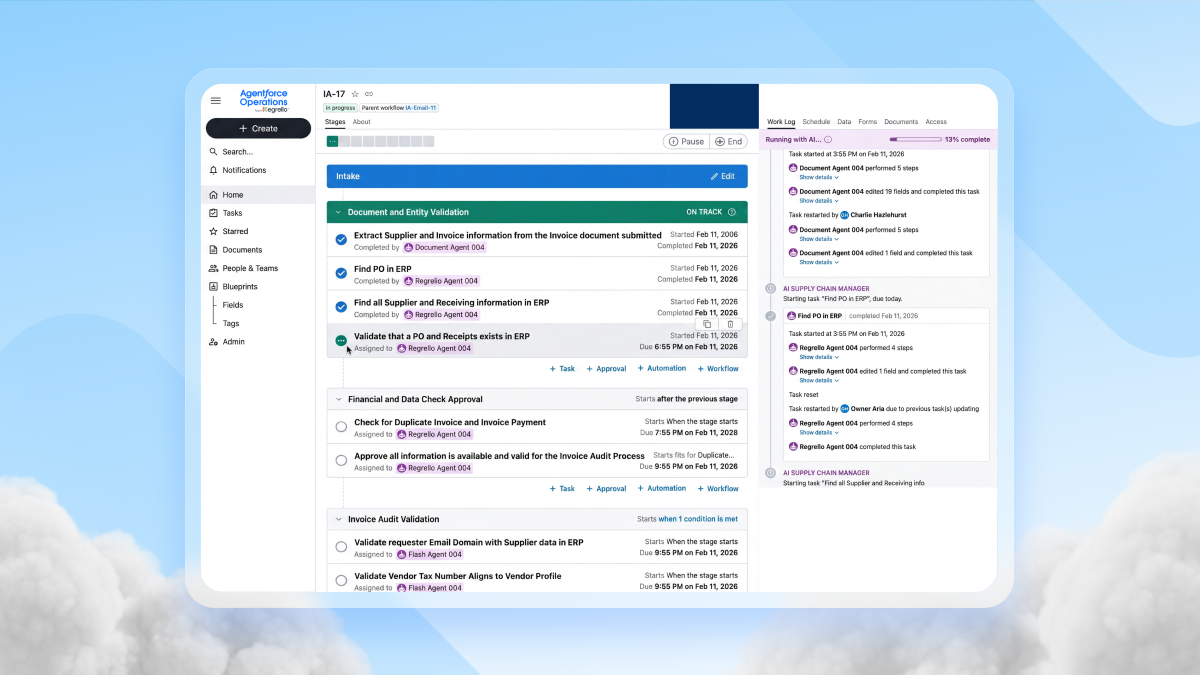
Salesforce is betting that the back office, not the front, is where agentic AI delivers its next convincing win. The company’s Agentforce Operations launch, built on its 2025 Regrello acquisition, puts specialized AI agents to work inside supply chain, procurement, finance, and HR workflows, promising 50-70% cuts in process cycle times and an 80% reduction in manual data entry. The platform converts unstructured process documents into executable “digital blueprints” in minutes, works across existing systems without replacement, and is generally available now, with deeper Salesforce Flows integration entering beta in May 2026.
What this means for your business
The companies most exposed here are those already running Salesforce in the front office while their back-office operations run on a patchwork of ERPs, spreadsheets, and email chains. For them, this isn’t a greenfield AI decision, it’s a gravitational pull toward extending a platform they’ve already bought. If your operations teams are measured on cycle time and your IT team spends meaningful hours maintaining brittle point-to-point integrations, the calculus for piloting Agentforce Operations is straightforward. If you’re on a competing platform stack, this raises the switching cost for anyone considering a move to Salesforce.
The genuinely interesting architectural claim here is the shift from workflow orchestration to workflow completion. Legacy automation tools like RPA (robotic process automation, bots that mimic human clicks through existing software) and older BPM platforms route tasks between people; they don’t resolve them. Agentforce Operations is positioning agents as the resolution layer, not the routing layer, handling document extraction, compliance validation, and approval chasing without a human handoff. That’s a real capability difference, not a marketing distinction, and it’s where Regrello’s supply chain DNA earns its keep. The risk is that “completion” gets defined narrowly in practice and the hard exception cases still land on a human desk, just with less visibility than before.
The five partner quotes from Deloitte, PwC, OSF Digital, and others read as channel priming more than proof, but the Asymbl and Siemens examples point at something worth tracking. If Salesforce can genuinely replace BPO (business process outsourcing, where companies hire third parties to run back-office functions) contracts with agents running inside the platform, the ROI story writes itself for any CFO reviewing an outsourcing renewal. The decision this reshapes for most CIOs isn’t whether to adopt agentic AI in the back office, it’s whether Salesforce is the vendor to do it with, or whether a best-of-breed approach using ServiceNow, SAP, or a vertical specialist holds up as differentiation narrows.
Based on reporting from Salesforce Launches Agentforce Operations – Salesforce, originally published 2026-04-29 03:00:00.