
Share with your CTO
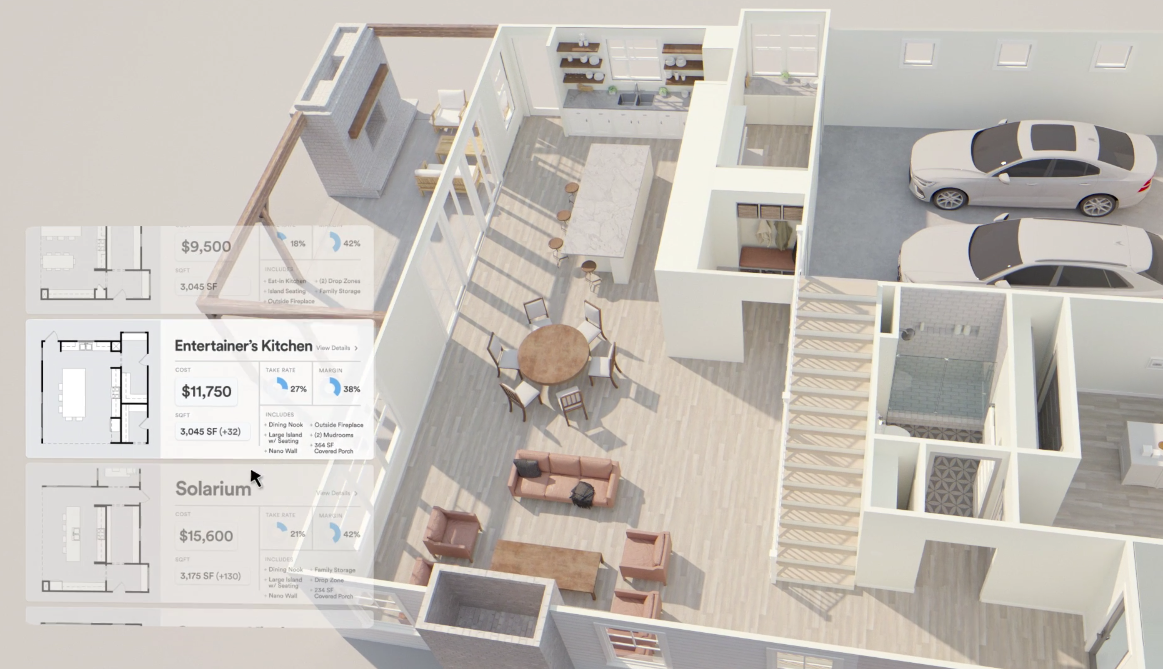
Higharc is betting that general-purpose AI is structurally unfit for construction, and $95 million from Insight Partners, Wellington Management, and Fifth Wall is backing that thesis. The homebuilding AI startup has built spatial AI models trained exclusively on residential architectural drawings, enabling them to ingest 2D floor plans, generate 3D models, auto-update cost estimates when designs change, and now produce material takeoffs tied directly to distributor catalogs. A new partnership with US LBM, the largest privately owned building materials distributor in the U.S., marks Higharc’s first move beyond builders into the supply chain.
What this means for your business
The construction industry’s pre-build planning phase, which can consume a full year before a foundation is dug, is a workflow coordination problem that general LLMs cannot solve because they have no native understanding of three-dimensional physical constraints. If your organization operates in, finances, or supplies construction at scale, the relevant question isn’t whether AI can help here; it’s whether domain-specific spatial models trained on real architectural drawings will outcompete generic AI wrappers quickly enough to matter before your current vendors copy the capability.
Higharc’s multimodel validation architecture, where layered models cross-check each other’s outputs and flag discrepancies before a human expert reviews them, is the engineering decision that makes this defensible in a high-stakes environment. A wrong material takeoff, a missed load-bearing wall, an underestimated cost, any of these can stall a job site for weeks. The Signature Homes testimonial isn’t marketing decoration; it’s the signal that the hallucination problem is controlled enough for production use. That’s the bar generic AI tools haven’t cleared in construction, and it’s why the domain-trained approach commands a premium.
The supply chain extension is where the compounding logic becomes clear. Once Higharc owns the authoritative 3D model of a home, every downstream party (estimator, distributor, permit reviewer) becomes a potential integration point rather than a separate workflow. US LBM gets automated takeoffs tied to its own product catalog; Higharc gets distribution-side data that makes its models more accurate over time. The builders who adopt this early will embed Higharc deeply enough that switching costs rise fast. For CTOs evaluating construction tech stacks now, the renewal conversation is already about whether your current estimating and documentation tools can survive a competitor who arrives with a pre-built spatial model of the same project.
Concept deep-dive: Spatial AI
Spatial AI refers to models trained to understand physical environments in three dimensions rather than processing text or images in isolation. Where a large language model predicts the next token in a sequence, a spatial model understands that a load-bearing wall cannot be removed without structural consequence, and that moving a window changes framing, insulation, and code compliance simultaneously. The business case is tight wherever decisions depend on physical geometry, construction being the clearest example, because errors compound into real-world delays and cost overruns rather than just wrong answers.
Based on reporting from Homebuilding AI startup Higharc bags $90M in Series C funding, originally published 2026-07-01 03:00:00.