
Share with your CTO
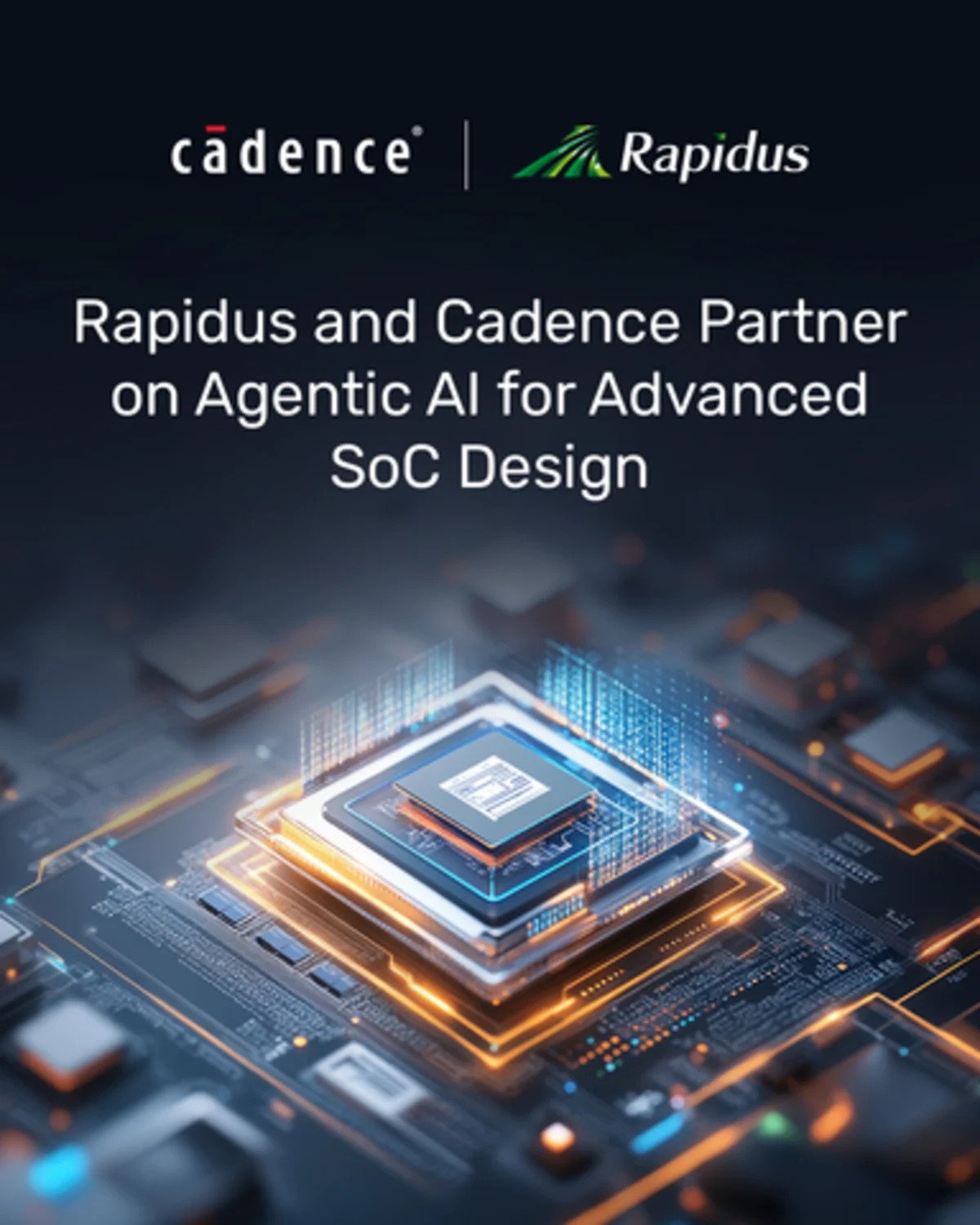
Rapidus, Japan’s government-backed advanced-node foundry, is embedding agentic AI directly into its chip design pipeline through a partnership with Cadence that integrates the Cadence InnoStack AI Super Agent into Rapidus’s own Raads design platform. The target is a 2X reduction in design turnaround time, the elapsed time from initial chip specification to a verified, manufacturable layout. Two new Raads tools, Navigator and Indicator, automate quality assurance and issue resolution across the full SoC workflow, from early architectural exploration through final signoff.
What this means for your business
The companies most exposed to this announcement are not chip designers at big fabless houses, who have their own EDA relationships and internal tooling. The exposure sits with the engineering organizations considering Rapidus as a manufacturing partner for next-generation silicon, where design turnaround time is a real cost variable. If Rapidus can compress that cycle materially, the calculus for routing advanced-node tape-outs to a non-TSMC foundry changes, and CTOs evaluating custom silicon timelines should factor that into their 2027 roadmap conversations now.
The deeper claim here is that agentic orchestration, where AI agents hand work between design stages rather than just optimizing a single step in isolation, is becoming a foundry-level differentiator, not just a point-tool feature. Cadence’s Anirudh Devgan said precisely this: orchestrating across the lifecycle, not optimizing individual tasks. That framing matters because it shifts the competitive question away from which EDA tool runs fastest and toward which foundry ecosystem integrates them most coherently. Rapidus, positioning its facility as “AI-native” from the ground up, is making a structural bet that this integration layer is where design wins will actually be decided.
The honest skepticism to hold is that “up to 2X” is a ceiling claim attached to no published benchmark, customer validation, or process node specification, and Rapidus is still building out its Chitose fab. Cadence, whose business depends on EDA adoption at every foundry, has an obvious interest in painting the most optimistic productivity picture for any new ecosystem partner. Watch for whether early Rapidus customer tape-outs on its 2nm-class process post actual cycle-time results. That’s the signal that converts this from a strategic narrative into a procurement argument.
Concept deep-dive: Agentic AI orchestration in chip design
Traditional EDA software requires engineers to run discrete tools sequentially, place-and-route, timing analysis, power verification, checking outputs manually between steps. Agentic orchestration means AI agents handle those handoffs autonomously, deciding which tool runs next, interpreting the output, and triggering downstream corrections without a human in the loop at each stage. Think of it as the difference between a surgeon who operates and hands off to a separate recovery team versus one integrated care pathway that adjusts in real time. The business consequence is compressing weeks of iteration into days.
Based on reporting from Rapidus and Cadence Partner on Agentic AI for Advanced SoC Design, originally published 2026-07-16 20:00:00.