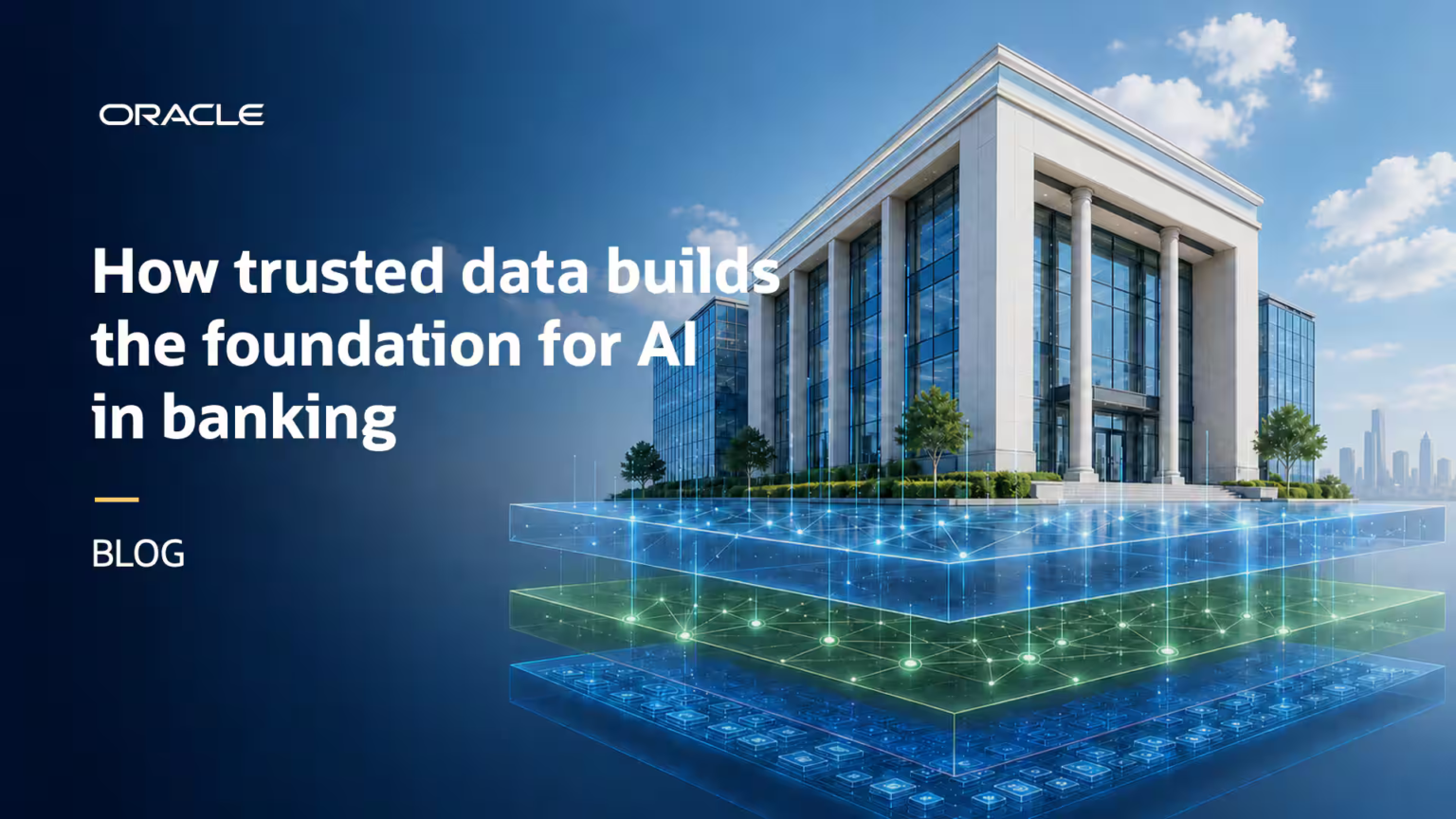

Trusted Data as Strategic Moat: Why Banking’s AI Race Will Be Won in the Data Layer, Not the Model Layer
Oracle’s latest post on AI in banking is, on the surface, vendor content. But strip away the product positioning and what remains is a genuinely important strategic argument that every financial services executive should sit with: the competitive differentiation in enterprise AI is not going to be determined by which foundation model a bank licenses. It will be determined by who builds the most trusted, semantically rich, governed data foundation underneath those models. That is a more durable, harder-to-replicate advantage than any model choice — and most banks are not yet thinking about it that way.
- The Setup: AI Adoption Is High, But “Deployed” Does Not Mean “Scaled”
- The Core Argument: Data Quality Is the Actual AI Problem
- The Semantic Layer Is the Strategic Differentiator
- The Oracle Positioning: Integrated Stack as Competitive Wedge
- What Executive Leaders Should Actually Do With This
- The Strategic Conclusion: The Foundation Is the Moat
The Setup: AI Adoption Is High, But “Deployed” Does Not Mean “Scaled”
The headline statistics are genuinely striking. EY-Parthenon puts generative AI launch or soft-launch rates at 77% of banks in 2025. JPMorgan Chase claims roughly $2 billion in annual business value across nearly 1,000 use cases. Bank of America reports that more than 90% of its employees use an internal AI assistant, cutting IT service desk calls by more than 50%. These are not pilot numbers. These are scaled deployment numbers — at least for the industry’s largest, best-resourced institutions.
But the Oracle piece correctly identifies the inflection point that separates the leaders from everyone else: moving from pilot to enterprise scale inside organizations where data has accumulated across decades of systems, acquisitions, and departmental silos. That is where AI initiatives stall, and the piece is right to name it plainly. The failure mode is not the model. It is the data layer beneath the model.
The Core Argument: Data Quality Is the Actual AI Problem
Oracle’s framing — that enterprise AI has become a data problem — is analytically correct and importantly underappreciated in how banks are currently allocating investment and attention. The instinct in most organizations is to focus on the AI layer: which model, which vendor, which use case. The harder, less glamorous, and ultimately more determinative work is what Oracle’s Paul Lilford identifies precisely: “Enterprise data often lacks the context AI needs to produce consistent, explainable results.”
This matters for a specific reason that is unique to banking. In consumer applications, an AI that returns a plausible-but-wrong answer is an annoyance. In a regulated financial institution, an AI that returns an explainable-but-wrong answer triggers regulatory scrutiny, audit findings, and potential enforcement action. The bar for “trusted” is categorically higher, and it is set externally by regulators and auditors, not internally by product managers.
The practical consequence: banks cannot simply point AI at their data and expect production-grade results. They need metadata, lineage, business definitions, governance policies, and permissions to travel with the data into whatever AI system is consuming it. Without that context layer, AI returns an answer. With it, AI returns the right answer — one that a CFO, a regulator, or an auditor can trace back to its source and validate.
The Semantic Layer Is the Strategic Differentiator
The most important and least-discussed element of Oracle’s argument is the concept of business semantics — the idea that raw data does not explain itself to AI. A customer record in a core banking system, a customer record in an ERP, and a customer record in a CRM may all refer to the same entity but carry different identifiers, different definitions, and different governance requirements. A financial metric like “net interest margin” may be calculated differently across business lines depending on which regulatory framework applies. Regulatory calculations frequently depend on policies and relationships that exist entirely outside the structured data itself.
This is not a new problem. It is the problem that master data management, data governance, and data catalog initiatives have been attempting to solve for twenty years. What AI does is dramatically raise the stakes. When a human analyst pulls data from multiple systems and reconciles it manually, the reconciliation step — however painful — is visible and auditable. When AI does it autonomously, the reconciliation logic is embedded in the model’s inference process, and if the underlying data definitions are inconsistent, the error is invisible until it surfaces in a regulatory filing or a risk decision.
Lilford’s framing is worth quoting directly: “You want your platform to orchestrate AI, not AI orchestrating your platform.” That is the correct governance posture, and it is one that most enterprises have not yet operationalized. The default in many early AI deployments is to give AI broad access to enterprise data and let it figure out the context. That approach fails in regulated industries — and it is starting to fail visibly enough that it is shifting the conversation.
The Oracle Positioning: Integrated Stack as Competitive Wedge
It would be intellectually dishonest not to engage with what Oracle is actually doing here strategically. The argument — that the right approach is a platform that brings together operational systems, data infrastructure, governance, and business applications — is a direct argument against best-of-breed data architecture. Oracle is saying: the reason fragmentation created your data problem is that you assembled too many specialized tools. The solution is integration, and we are the integrator.
This is a defensible position, but it comes with real tradeoffs. Banks that have already invested heavily in modern data stacks — Snowflake, Databricks, dbt for semantic layers, Collibra or Alation for data catalogs — will not find it straightforward to collapse that architecture into an Oracle-native environment. The practical modernization path Oracle describes — catalog data, establish governance, connect structured and unstructured information, apply lineage and security controls, deploy AI into existing operational systems — is sound advice regardless of which vendor delivers it. The question of whether Oracle’s integrated stack is the right delivery mechanism depends heavily on how deeply a given institution is already embedded in Oracle’s application ecosystem.
For institutions running Oracle Fusion for finance, Oracle industry applications for banking, and Oracle Cloud Infrastructure, the value proposition is clear: business definitions already embedded in those applications can extend directly into the AI and data catalog layer without a translation step. For institutions that are not Oracle-native, the argument is less immediately compelling, though the underlying principle — ground AI in governed, semantically rich enterprise data — remains universally valid.
What Executive Leaders Should Actually Do With This
For CIOs and CTOs, the immediate priority is governance architecture for AI data access. The question is not whether your models are good enough. It is whether your data catalog, lineage tracking, and semantic layer are mature enough to make model outputs auditable. If your AI team cannot explain to a regulator exactly which data sources fed a specific model output, and which governance policies applied to those sources, you have a production risk that no model improvement will fix.
For CISOs, the critical issue is that AI dramatically expands the attack surface for data governance failures. When AI can autonomously query across operational systems, the permissions and security controls that govern data access must be enforced at the platform level, not managed manually per use case. The Oracle framing of AI operating “within established enterprise policies” is the right target state — but it requires that those policies be machine-readable and enforced programmatically, not documented in a governance handbook.
For CFOs and CDOs, the Federal Reserve data point in the article — generative AI saving roughly 5.4% of working time, with experienced users saving considerably more — provides the ROI anchor for making the case that investment in data infrastructure is not a cost center. It is the prerequisite for realizing productivity gains at scale. The institutions that spend the next 18 months building trusted data foundations will compound those productivity gains. The institutions that skip the foundation work and deploy AI on fragmented data will face remediation costs and regulatory pressure that will erase the early gains.
For CROs and Chief Compliance Officers, the governance posture Oracle describes — AI grounded in the same business definitions that risk and compliance teams already use — is the only defensible architecture for AI in a regulated environment. Any AI deployment that introduces new business definitions, new data lineage, or new governance frameworks that are parallel to existing enterprise controls creates audit exposure. The principle should be: AI consumes the same governed data, with the same governance controls, that every other enterprise system consumes.
The Strategic Conclusion: The Foundation Is the Moat
The Oracle post closes with a line worth taking seriously beyond its rhetorical elegance: “Trust has always been the bedrock of banking’s business model. It ultimately may become the defining characteristic of its enterprise AI.” This is not marketing language dressed up as strategy. It is a genuine structural observation about where competitive advantage will accumulate in financial services AI over the next decade.
Models are commoditizing. The major foundation models are converging in capability at a rate that makes model selection a diminishing source of differentiation. What will not commoditize — what cannot be purchased and deployed in a quarter — is a trusted, governed, semantically rich enterprise data foundation built on decades of institutional knowledge, properly catalogued, properly governed, and properly connected to AI systems that can use it reliably in production.
JPMorgan’s $2 billion in AI value and Bank of America’s 90% employee adoption rate did not happen because those institutions chose better models than their competitors. They happened because those institutions invested earlier and more aggressively in the data and governance infrastructure that makes AI trustworthy at scale. Every other financial institution now faces a version of the same build decision. The banks that treat the data foundation as the real AI investment will be the ones still leading the conversation five years from now.
Based on reporting from How trusted data builds the foundation for AI in banking, originally published 2026-08-07 15:07:00.