
Share with your CTO
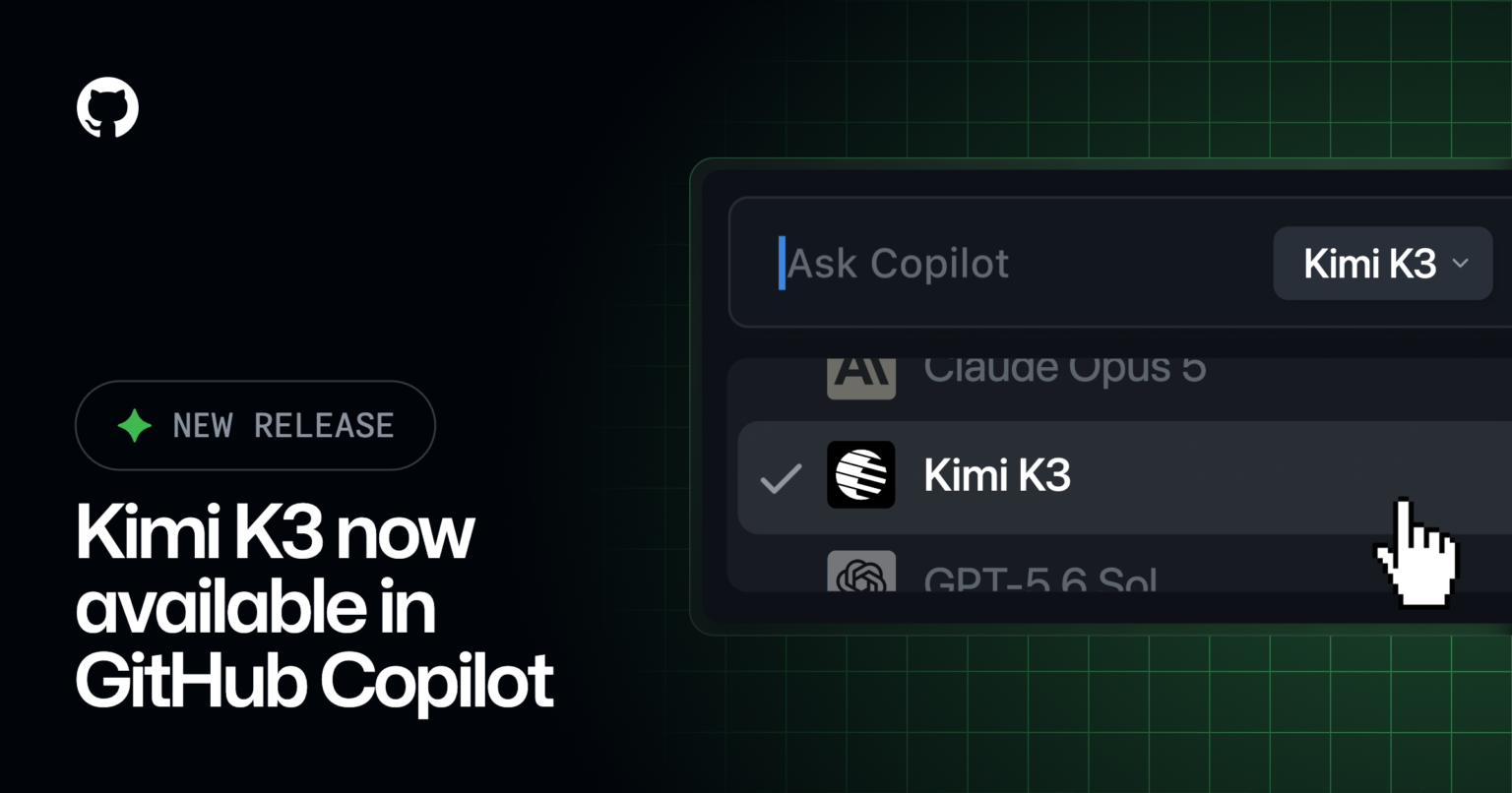
GitHub is expanding its Copilot model marketplace with Kimi K3, an open-weight coding model from Chinese AI lab Moonshot AI, now generally available across every major Copilot plan and IDE. Pricing lands at $3 per million input tokens and $15 per million output tokens, hosted by GitHub on Fireworks AI. The Kimi K3 availability announcement covers VS Code, JetBrains, Xcode, Eclipse, and GitHub’s own cloud agent, though Business and Enterprise administrators must explicitly enable it before anyone on their team can touch it.
What this means for your business
The default-off posture for Business and Enterprise plans is the detail that actually matters here. GitHub is handing your engineering org a cost lever, not a mandate. At $3 per million input tokens, Kimi K3 undercuts the premium frontier models meaningfully. If your teams are running high-volume agentic coding tasks, the per-token math adds up fast. A team generating 500 million output tokens monthly saves real money compared to GPT-4o or Claude Sonnet at their respective list rates.
GitHub is quietly building a model supermarket inside Copilot, and Kimi K3 is the latest SKU. The strategic logic is clear: by hosting third-party open-weight models through Fireworks AI and billing at provider list pricing, GitHub captures the platform margin without bearing model development costs. For your engineering org, this means more pricing flexibility but also a new procurement complexity. Each model addition requires a fresh admin policy decision, which means your Copilot governance process needs to scale alongside the model catalog.
Open-weight models carry a different risk profile than closed proprietary ones. Open-weight means the model weights are publicly released, so the underlying architecture isn’t a black box the way GPT-4 is. That sounds reassuring, but it also means GitHub’s data handling guarantees matter more than the model’s lineage. The signal worth watching is whether GitHub publishes explicit data residency and inference logging commitments for Fireworks AI-hosted models before your security review catches it first.
Concept deep-dive: Open-weight models
An open-weight model is one where the trained parameters are publicly released, meaning anyone can download and run the model without accessing the original training pipeline. Closed models like GPT-4 keep weights proprietary. Open-weight emerged because releasing weights accelerates research and third-party deployment. Think of it like publishing a recipe versus keeping it trade secret. For an enterprise, the business implication is dual: open-weight models can be self-hosted for data control, but when accessed through a vendor like GitHub, your actual data protection depends entirely on that vendor’s infrastructure contracts, not on the model’s open nature.
Based on reporting from Kimi K3 is now available in GitHub Copilot, originally published 2026-08-06 13:27:00.