
Share with your CTO
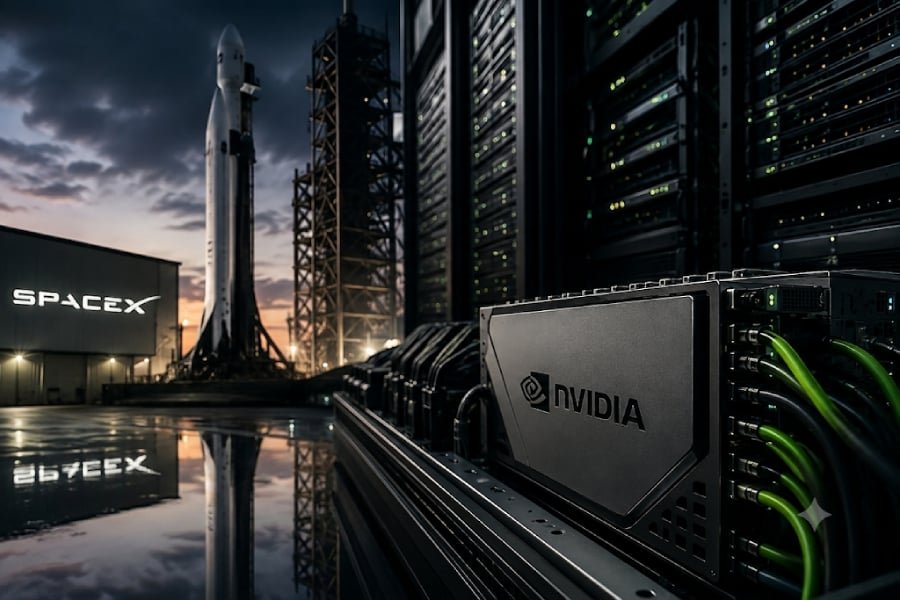
SpaceX is betting its entire AI computing stack on Nvidia, committing to buy chips “exclusively” from the company and singling out the forthcoming Vera Rubin architecture as the best available platform. The strategic logic extends well beyond internal workloads: SpaceX has disclosed agreements to lease GPU capacity to Google for up to $920 million per month and to Anthropic for up to $1.25 billion per month, turning SpaceX’s chip infrastructure into a revenue line. Musk expects SpaceX to receive a significant share of Nvidia’s total GPU output next year, a claim that, if accurate, will tighten an already constrained supply market.
What this means for your business
The companies most exposed here aren’t the ones competing with SpaceX. They’re any organization still treating GPU procurement as a commodity purchase. SpaceX’s move signals that the largest buyers are locking in multi-year architectural commitments, and that supply allocations at the top of the market tend to crowd out the middle. If your infrastructure roadmap depends on Nvidia’s most advanced systems arriving on a specific schedule, the queue just got longer and more competitive at the front.
What SpaceX is executing is a platform lock-in strategy that works in both directions. Nvidia’s real moat isn’t chip performance, it’s CUDA (the software layer developers use to write programs that run on Nvidia hardware), the networking stack, and years of tooling that makes migrating workloads to a competitor feel less like a hardware swap and more like a rewrite. SpaceX standardizing on a single architecture reduces its own integration complexity, but it also means every future infrastructure decision, from cooling to networking to software hiring, gets made in Nvidia’s coordinate system. The platform becomes the constraint before the contract does.
SpaceX is simultaneously funding Terafab, a custom-silicon manufacturing initiative shared with xAI and Tesla, which punctures any reading of this as pure Nvidia loyalty. The honest interpretation is that SpaceX is buying Nvidia at scale today because it has to, and building an exit ramp because it’s smart. Most organizations can’t afford both moves at once. The relevant question for any CTO sitting on an Nvidia-heavy roadmap isn’t whether to diversify now, it’s whether the vendor contracts, software dependencies, and team skills you’re accumulating this year are making a future pivot structurally harder to fund.
Concept deep-dive: Supply allocation
In chip markets, allocation refers to how a manufacturer like Nvidia distributes production across customers when demand exceeds supply. It’s less like a store shelf and more like a long-term purchasing agreement with priority tiers. Customers who commit to larger, longer-term orders tend to receive preferential access. For enterprise buyers, this means procurement strategy directly shapes what hardware is available and when, independent of whether a given chip is technically superior to an alternative.
Based on reporting from Elon Musk Goes All-In on Nvidia: What SpaceX’s Chip Strategy Means for AI Infrastructure, originally published 2026-08-06 12:15:00.